Junte-se a nós em uma viagem ao mundo dos livros!
Adicionar este livro à prateleira
Grey
Deixe um novo comentário Default profile 50px
Grey
Assine para ler o livro completo ou leia as primeiras páginas de graça!
All characters reduced
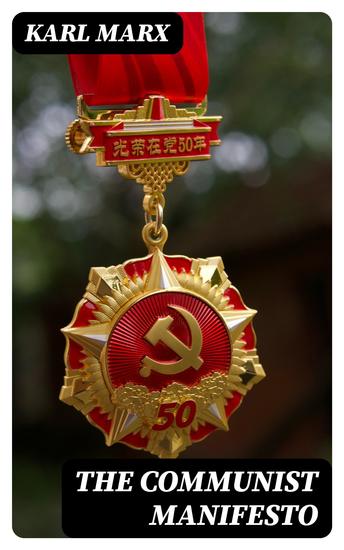
The Communist Manifesto - cover
LER

The Communist Manifesto

Karl Marx

Editora: DigiCat

  • 0
  • 0
  • 0

Sinopse

The Communist Manifesto, penned by Karl Marx and Friedrich Engels in 1848, is a seminal text that articulates the principles of communism and critiques the socio-political structures of capitalism. Employing a fiery rhetorical style that blends historical analysis with passionate calls to action, the manifesto navigates the stark class antagonisms that define capitalist societies. It underscores the inevitable clash between the bourgeoisie and the proletariat, ultimately advocating for a revolutionary overthrow of the capitalist system. The text, steeped in the context of its tumultuous political environment, served not only as a rallying cry for workers but also as a profound theoretical foundation for subsequent socialist movements worldwide. Karl Marx, a philosopher, economist, and social theorist, was profoundly influenced by the socio-economic conditions of 19th-century Europe, marked by rapid industrialization and stark class disparities. His engagement with Hegelian dialectics and reaction to the alienation experienced by laborers shaped his revolutionary ideology. Collaborating with Engels, Marx sought to inspire a global working-class movement, reflecting his commitment to social justice and equality that transcended national boundaries. The Communist Manifesto remains a crucial read for anyone seeking to understand the historical and ideological underpinnings of modern political thought. Its incisive critique of capitalism and its rallying call for collective action are as relevant today as they were in the 19th century. Readers are invited to explore the transformative ideas that continue to challenge the status quo and inspire future generations.
Disponível desde: 13/06/2022.
Comprimento de impressão: 43 páginas.

Outros livros que poderiam interessá-lo

  • Anatomy of a Purple State - A North Carolina Politics Primer - cover

    Anatomy of a Purple State - A...

    Christopher A. Cooper

    • 0
    • 0
    • 0
    North Carolina represents a perfect distillation of the promise and peril of modern American democracy: hyperpartisanship, gerrymandering, dissatisfaction with the two-party system, the urban-rural divide—these issues are all brought into sharp relief in the Tar Heel State. For that reason, North Carolina politics and government are increasingly of interest not just to North Carolina citizens but to journalists, political observers, and people across the country. Political scientist Christopher A. Cooper, to whom the national media go when they need a quote about North Carolina politics, offers a primer made for all people, no matter their political leanings. 


    Listeners will be introduced to everything that has made North Carolina the most purple of purple states—from the state constitution and the influence of think tanks to the growing racial diversity of the state and the limitations on the governor's power. By explaining how we came to be in the political situation we are in, Cooper shows us where we might go next. And, as many have said, "As North Carolina goes, so goes the nation."
    Ver livro
  • America's Forgotten Terrorists - The Rise and Fall of the Galleanists - cover

    America's Forgotten Terrorists -...

    Jeffrey D. Simon

    • 0
    • 0
    • 0
    Though largely forgotten today, one of the most destructive terrorist groups in the United States was the Galleanists, a fiery band of Italian anarchists active during the early 1900s. In America's Forgotten Terrorists, Jeffrey D. Simon shows how alienation and frustration among segments of a community were transformed into a militant extremist movement. 


    Luigi Galleani, a gifted writer and speaker, tapped into widespread disappointment among Italian immigrants concerning their lives in America. Unemployment, low wages, long working hours, discrimination, and a poor quality of life made many Italian immigrants receptive to his words. The Galleanists introduced terrorist tactics and strategies that are still used today: they were the first group to send package bombs across the country and to exploit the media for their own advantage. 


    The story of the Galleanists is a chilling journey through a volatile period in American history, including labor-management conflicts, World War I, and the Red Scare. An expert in terrorism, Simon offers striking insights into the Galleanist era and some of its eerie connections to modern America, calling us to recognize the risks of repeating our history. How the Galleanists operated and how the U.S. government responded hold lessons for today as we continue to deal with the threat of terrorism.
    Ver livro
  • The illegal power of elites - cover

    The illegal power of elites

    Thierry Brugvin

    • 0
    • 0
    • 0
    “If the people of this nation understood our banking and monetary system, I believe there would be a revolution before morning.” Henry Ford
    Our contemporary liberal democracies have gradually given way to ademocratic, chaotic and illegal governance. By exploiting the flaws in our system to their advantage, the ruling class secures supreme power for itself, while the citizens sacrifice more and more.
    How extensive is the illegal power of the elites? And what can be done to change things?
    In this book, Thierry Brugvin provides valuable material for any citizen concerned with preserving the rule of law. He conducts a damning investigation into our contemporary democracies in order to expose their inner workings, while proposing avenues for modernization towards a better distribution of wealth.
    Ver livro
  • Operation Northwoods: The History of the Controversial Government Plan to Stage False Flag Attacks on Americans and Blame Cuba - cover

    Operation Northwoods: The...

    Editors Charles River

    • 0
    • 0
    • 0
    Throughout the history of warfare, the practice of placing blame on innocent parties in order to justify attacking them has been a constant feature. In the 20th century, this practice began to be commonly referred to as a “false flag” operation. The essence of a false flag scenario is that it is conducted by one party or government and “made to appear as though another party sponsored it.”[1] In informal legal terminology, the practice is commonly referred to as a “stitch up”[2] or “setup.”[3] The modern use of this action based on deceit originated in the 16th century, typically when ships displayed the flags of a neutral or enemy country to hide their identities. 
    	The severity of false flag operations moves in tandem with the perceived danger. In the late 20th century, the Soviet Union constituted an ongoing threat to the United States, ideologically and militarily. When Fidel Castro, a Soviet sympathizer, came to power in Cuba in 1959, the presence of a communist extension of Soviet influence so near American shores caused great discomfort to the U.S. government. 
    	Some of the Cold War’s tensest moments involved Cuba, including the Bay of Pigs invasion and the Cuban Missile Crisis, amply demonstrating that throughout the early 1960s, alarmed individuals within the American government believed that the only way to handle Castro was by immediate elimination and a takeover of Cuba. They were pitted against more nuanced points of view held by others within the Kennedy administration. The Pentagon was of the general mind that in such a perilous environment, military decision-making should come to the front and civilians should withdraw, even the White House. Diplomacy was seen as being of little use by the Joint Chiefs of Staff against an encroaching Soviet superpower led by a political street fighter and his puppet situated just off the coast of Florida. 	This charged atmosphere would lead to one of the most controversial proposals in history.
    Ver livro
  • The Secrets of the Cold War – Spies Propaganda and Power - Covert Operations Espionage and the Battle for Global Influence - cover

    The Secrets of the Cold War –...

    Logan Powell

    • 0
    • 0
    • 0
    The Cold War was more than just a standoff between the United States and the Soviet Union—it was a battle fought in the shadows. From top-secret spy missions to global propaganda campaigns, the struggle for power shaped the modern world in ways still felt today. 
    This audiobook uncovers the hidden world of espionage, double agents, nuclear threats, and psychological warfare. Learn about the CIA vs. KGB, the Berlin Wall, the Cuban Missile Crisis, and the secret operations that defined an era of fear and suspicion. 
    The Secrets of the Cold War – Spies, Propaganda, and Power is a must-listen for history lovers, intelligence enthusiasts, and those fascinated by the real-life intrigue of global power struggles.
    Ver livro
  • The Cultural Revolution - A Decade of Upheaval - cover

    The Cultural Revolution - A...

    Jun Liu

    • 0
    • 0
    • 0
    The Cultural Revolution, which lasted from 1966 to 1976, was a decade of intense political and social upheaval in China. It was initiated by Mao Zedong, the Chairman of the Chinese Communist Party, as a means to reassert his ideological dominance and eliminate perceived threats within the party and society. The roots of the Cultural Revolution can be traced back to the aftermath of the Great Leap Forward, growing political divisions, and Mao’s desire to reshape China’s ideological landscape. 
    One of the key factors that led to the Cultural Revolution was Mao’s declining influence following the disastrous Great Leap Forward (1958–1962). This economic and social campaign, aimed at transforming China into a communist utopia through rapid industrialization and collectivization, resulted in widespread famine and the deaths of millions. The failures of the Great Leap Forward weakened Mao’s credibility, and he was forced to step back from day-to-day governance, allowing more pragmatic leaders such as Liu Shaoqi and Deng Xiaoping to implement economic reforms. These leaders promoted policies that prioritized economic stability over radical communist ideology, which Mao saw as a betrayal of the revolution’s goals. 
    In response to his diminished authority, Mao sought to reassert control by launching an ideological campaign against those he deemed “capitalist roaders” within the party. By the early 1960s, internal power struggles intensified as Mao and his radical supporters, including Lin Biao and Jiang Qing, clashed with moderate leaders advocating for a more pragmatic approach to governance. Mao viewed the growing influence of his rivals as a direct threat to his vision for China. To counter their policies, he began promoting the idea of a new revolutionary movement that would purify Chinese society and eliminate counterrevolutionary elements.
    Ver livro