Join us on a literary world trip!
Add this book to bookshelf
Grey
Write a new comment Default profile 50px
Grey
Subscribe to read the full book or read the first pages for free!
All characters reduced
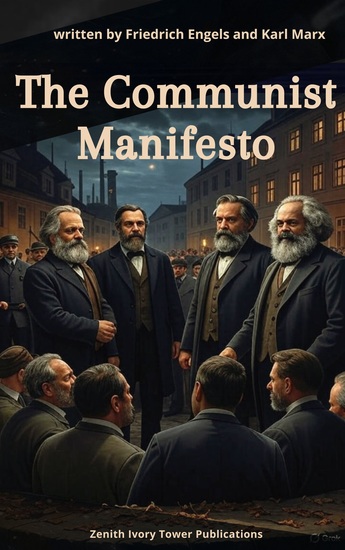
The Communist Manifesto - Marx and Engels' Revolutionary Blueprint for Class Struggle and Social Change - cover

The Communist Manifesto - Marx and Engels' Revolutionary Blueprint for Class Struggle and Social Change

Karl Marx, Friedrich Engels, Zenith Ivory Tower Publications

Publisher: Zenith Ivory Tower Publications

  • 0
  • 0
  • 0

Summary

🛠️ "Workers of the world, unite!"
Few political texts have shaped the modern world as powerfully as The Communist Manifesto. Written by Karl Marx and Friedrich Engels in 1848, this fiery and fearless pamphlet became the foundation of Marxist theory—and one of the most influential manifestos in history.

⚙️ A call to arms against inequality, oppression, and the exploitation of labor.
In just a few pages, Marx and Engels lay out a bold vision of class struggle, the history of economic systems, and the inevitable collapse of capitalism. They advocate for a classless, stateless society where the means of production belong to the people.

🌍 Provocative, visionary, and undeniably impactful.
The Communist Manifesto has inspired revolutions, ignited political movements, and reshaped global ideologies. Whether you agree or disagree with its vision, it is essential reading for anyone seeking to understand the modern world—and the ongoing debates around justice, labor, and power.

🌟 What Critics and Readers Say:
"A compact but explosive text." — The Guardian

"Its influence on world politics is undeniable." — The New York Times

"Still a lightning rod of discussion and debate." — Amazon Reviewer

🎯 Why You'll Love This Book (or Need to Read It):
A foundational text in political and economic philosophy

Perfect for students of history, sociology, economics, and political science

Provides context for modern socialism, labor rights, and revolution

Essential reading for anyone exploring radical political thought

🛒 Click Buy Now to Read the Document That Changed the World.
Challenge your thinking. Explore revolutionary ideas.
👉 Click Buy Now to read The Communist Manifesto by Karl Marx and Friedrich Engels—a powerful vision of resistance, reform, and revolution.
Available since: 07/17/2025.
Print length: 28 pages.

Other books that might interest you

  • Beyond States - Powers Peoples and Global Order - cover

    Beyond States - Powers Peoples...

    Anthony Pagden

    • 0
    • 0
    • 0
    Today, the majority of the peoples of the planet live in nation-states, based upon the idea, if never the reality, of a single people, a single culture, a single rule of law, and a single source of sovereign authority. But will they continue to do so in the future? 


    None of the major challenges that confront humanity today—from climate change to disease, from terrorism to mass migration—can be handled effectively by single nation-states, no matter how powerful. The world is no longer made up only of states but also of an ever-increasing multitude of interstate networks and organizations which recognize no borders. We are beginning to be able to imagine the very real possibility of a new global civil society. But what political form should this take? 


    By examining the history of the evolution of human society from the world's first empires to today's world of interstate networks, this book argues that there now exists the possibility of the emergence of a new political form, a global 'federation of federations', that will bring the species closer to the possibility of a more harmonious, equitable, and secure future.
    Show book
  • Long Haul - Hunting the Highway Serial Killers - cover

    Long Haul - Hunting the Highway...

    Frank Figliuzzi

    • 0
    • 0
    • 0
    ""A true-crime masterpiece."" —Don Winslow 
    A Mystery Writers of America Edgar Award Finalist (Best Fact Crime) 
    From the FBI’s former assistant director, a shocking journey to the dark side of America’s highways, revealing the FBI Highway Serial Killings Initiative’s hunt for the long-haul truckers behind an astonishing 850 murders–and counting. 
    In 2004, the FBI was tipped off to a gruesome pattern of unsolved murders along American roadways. Today at least 850 homicides have been linked to a solitary breed of predators: long-haul truck drivers. They have been given names like the “Truck Stop Killer,” who rigged a traveling torture chamber in the rear of his truck and is suspected to have killed fifty women, and “The Interstate Strangler,” who once answered a phone call from his mother while killing one of his dozen victims. The crisis was such that the FBI opened a special unit, the Highway Serial Killings Initiative. In many cases, the victims—often at-risk women—are picked up at truck stops in one jurisdiction, sexually assaulted and murdered in another, and dumped along a highway in a third place. The transient nature of the offenders and multiple jurisdictions involved make these cases incredibly difficult to solve. 
    Based on his own on-the-ground research and drawing on his twenty-five-year career as an FBI special agent, Frank Figliuzzi investigates the most terrifying cases. He also rides in a big-rig with a long-haul trucker for thousands of miles, gaining an intimate understanding of the life and habits of drivers and their roadside culture. And he interviews the courageous trafficked victims of these crimes, and their inspiring efforts to now help others avoid similar fates. 
    Long Haul is a gripping exploration of a violent, disordered world hiding in plain sight, and the heroes racing to end the horror. It will forever unsettle how you travel on the road. 
    Shortlisted for four 2025 True Crime Awards
    Show book
  • I Never Did Like Politics - How Fiorello La Guardia Became America's Mayor and Why He Still Matters - cover

    I Never Did Like Politics - How...

    Terry Golway

    • 0
    • 0
    • 0
    Fiorello LaGuardia was one of the twentieth century's most colorful politicians—on the New York and national stage. He was also quintessentially American: the son of Italian immigrants, who rose in society through sheer will and chutzpah. Almost one hundred years later, America is once again grappling with issues that would have been familiar to the Little Flower, as he was affectionately known. It's time to bring back LaGuardia, argues historian and journalist Terry Golway, to remind us all what an effective municipal officer (as he preferred to call himself) can achieve . . .  


    Golway examines LaGuardia's extraordinary career through four essential qualities: As a patriot, a dissenter, a leader, and a statesman. He needed them all when he stood against the nativism, religious and racial bigotry, and reactionary economic policies of the 1920s, and again when he faced the realities of Depression-era New York and the rise of fascism at home and abroad in the 1930s. Just before World War II, the Roosevelt administration formally apologized to the Nazis when LaGuardia referred to Hitler as a "brown-shirted fanatic." 


    There was nobody quite like Fiorello LaGuardia. In this immensely listenable book, as entertaining as the man himself, Terry Golway captures the enduring appeal of one of America's greatest leaders.
    Show book
  • Still Hopeful - Lessons from a Lifetime of Activism - cover

    Still Hopeful - Lessons from a...

    Maude Barlow

    • 0
    • 0
    • 0
    “Canada’s best-known voice of dissent.” — CBC
    		 
    “It’s time we listened to the Maude Barlows of the world.” — CNN
    		 
    In this timely book, Barlow counters the prevailing atmosphere of pessimism that surrounds us and offers lessons of hope that she has learned from a lifetime of activism. She has been a linchpin in three major movements in her life: second-wave feminism, the battle against free trade and globalization, and the global fight for water justice. From each of these she draws her lessons of hope, emphasizing that effective activism is not really about the goal, rather it is about building a movement and finding like-minded people to carry the load with you. Barlow knows firsthand how hard fighting for change can be. But she also knows that change does happen and that hope is the essential ingredient.
    Show book
  • Commander in Chief - Partisanship Nationalism and the Reconstruction of Congressional War Powers - cover

    Commander in Chief -...

    Casey B. K. Dominguez

    • 0
    • 0
    • 0
    The constitutional balance of war powers has shifted from Congress to the president over time. Today, presidents broadly define their constitutional authority as commander in chief. In the nineteenth century, however, Congress was the institution that claimed and defended expansive war powers authority. This discrepancy raises important questions: How, specifically, did Congress define the boundaries between presidential and congressional war powers in the early republic? Did that definition change? 


    Casey Dominguez's Commander in Chief systematically analyzes the authority that members of Congress ascribe to the president as commander in chief and the boundaries they put around that authority. 


    Dominguez shows that for more than a century members of Congress defined the commander in chief's authority narrowly. But in a wave of nationalism during the Spanish-American War, members of Congress began to argue that Congress owed deference to the commander in chief. They also tended to argue that a president of their own party should have broad war powers, while the powers of a president in the other party should be defined narrowly. Together, these two dynamics suggest that the conditions for presidentially dominated modern constitutional war powers were set at the turn of the twentieth century, far earlier than is often acknowledged.
    Show book
  • Summary of George Soros’s In Defense of Open Society - cover

    Summary of George Soros’s In...

    Falcon Press

    • 0
    • 0
    • 0
    Buy now to get the main key ideas from George Soros’s In Defense of Open Society 
      
    In Defense of Open Society (2019) is a collection of essays, articles, and speeches by George Soros, an international philanthropist. Soros examines the many dangers facing open societies, from rising dictatorships to the growing threat of tech companies and artificial intelligence. He chronicles his journey to philanthropy in detail, telling how he survived Nazi Germany, started a hedge fund, became mega-rich, and turned his attention toward protecting democracy and resolving world economic problems. Soros touches on many current global issues, especially in Europe - including a prophetic look at Ukraine’s perilous situation.
    Show book