Begleiten Sie uns auf eine literarische Weltreise!
Buch zum Bücherregal hinzufügen
Grey
Einen neuen Kommentar schreiben Default profile 50px
Grey
Jetzt das ganze Buch im Abo oder die ersten Seiten gratis lesen!
All characters reduced
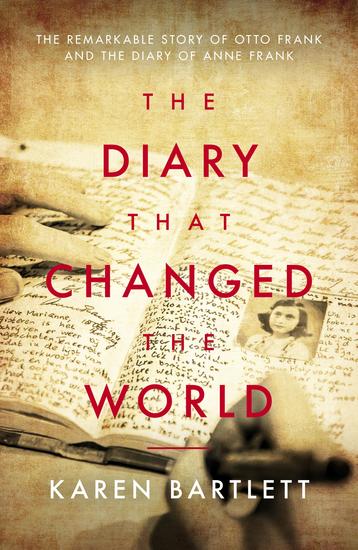
The Diary That Changed the World - The Remarkable Story of Otto Frank and the Diary of Anne Frank - cover

The Diary That Changed the World - The Remarkable Story of Otto Frank and the Diary of Anne Frank

Karen Bartlett

Verlag: Biteback Publishing

  • 0
  • 0
  • 0

Beschreibung

"A meticulous account of the fascinating, convoluted and sometimes ugly publishing history of the world's most famous diary. Karen Bartlett's book is all the more relevant at a time of untruths and fake news." – Caroline Moorehead, bestselling author of Village of Secrets: Defying the Nazis in Vichy France
***
When Otto Frank unwrapped his daughter's diary with trembling hands and began to read the first pages, he discovered a side to Anne that was as much a revelation to him as it would be to the rest of the world.
Little did Otto know he was about to create an icon recognised the world over for her bravery, sometimes brutal teenage honesty and determination to see beauty even where its light was most hidden.
Nor did he realise that publication would spark a bitter battle that would embroil him in years of legal contest and eventually drive him to a nervous breakdown and a new life in Switzerland. Today, more than seventy-five years after Anne's death, the diary is at the centre of a multi-million-pound industry, with competing foundations, cultural critics and former friends and relatives fighting for the right to control it.
In this insightful and wide-ranging account, Karen Bartlett tells the full story of The Diary of Anne Frank, the highly controversial part it played in twentieth-century history, and its fundamental role in shaping our understanding of the Holocaust.
At the same time, she sheds new light on the life and character of Otto Frank, the complex, driven and deeply human figure who lived in the shadows of the terrible events that robbed him of his family, while he painstakingly crafted and controlled his daughter's story.
Verfügbar seit: 28.04.2022.
Drucklänge: 304 Seiten.

Weitere Bücher, die Sie mögen werden

  • A 1940s Childhood - From Bomb Sites to Children's Hour - cover

    A 1940s Childhood - From Bomb...

    James Marsh

    • 0
    • 0
    • 0
    Do you remember collecting shrapnel and listening to Children's Hour? Carrying gas masks or sharing your school with evacuees from the city? The 1940s was a decade of great challenge for everyone who lived through it. The hardships and fear created by a world war were immense. Britain's towns and cities were being bombed on an almost nightly basis, and many children faced the trauma of being parted from their parents and sent away to the country to live with complete strangers. For just over half of this decade the war continued, meaning food and clothing shortages became a way of life. But through it all, and afterwards, the simplicity of kids shone. From collecting bits of shot-down German aircraft to playing in bomb-strewn streets, kids made their own fun. Then there was the joy of the second half of the 1940s, when fathers came home and the magic of 'normal life' returned. 
     
    This trip down memory lane will take you through the most memorable and evocative experiences of growing up in the 1940s.
    Zum Buch
  • From Aristotle to Christ - How Aristotelian Thought Clarified the Christian Faith - cover

    From Aristotle to Christ - How...

    Louis Markos

    • 0
    • 0
    • 0
    Credo Book Award Winner—Natural Theology
    Discover how Aristotelian thought has shaped Christianity through history and remains relevant for Christians today
    When Christians of any age, country, or denomination debate the nature of the good life, the soul, free will, or design, Aristotle lies behind their logic as well as their rhetoric. Although Aristotle did not have access to the Bible's special revelation, he made full use of general revelation to arrive at deep truths about the nature of God, human identity, and the universe. In the Catholic Middle Ages the spiritual vision that undergirded Dante's Divine Comedy was strongly indebted to Aristotle's cosmology, and in the Protestant Reformation and Enlightenment the social vision of a well-run state was equally indebted to his political science.
    In a follow up to his well-loved book From Plato to Christ, renowned scholar Louis Markos takes us on a vigorous and celebratory journey through the work of Plato's greatest student, demonstrating Aristotle's often unacknowledged influence on the Christian faith. In Markos's hands, Aristotle is far from an irrelevant ancient philosopher but is instead an important conversation partner for some of history's greatest Christian thinkers and a thoughtful guide to today's most challenging questions.
    With this book, you'll:
    
    - Consider the influence of Aristotle's thought on the Christian faith,
    - Carefully analyze several of Aristotle's best-known texts,
    - Trace Aristotle's influence upon many key theologians in Christian history, and
    - Understand Aristotle's continuing importance for Christians today.
    This book is a perfect addition to any classroom that seeks to understand how classical thought intersects with Christianity, both past and present. Grab your copy today and explore the relationship between Aristotelian philosophy and Christianity.
    Zum Buch
  • Egyptian Symbolism - The Meaning and Use of Symbols in Ancient Culture - cover

    Egyptian Symbolism - The Meaning...

    Omar Khalil

    • 0
    • 0
    • 0
    Egyptian symbolism is one of the most captivating aspects of ancient Egyptian culture, reflecting their deeply spiritual worldview and providing insight into their daily lives, religious practices, and understanding of the universe. From the majestic pyramids to the intricate hieroglyphs on temple walls, symbolism played a crucial role in conveying meanings that went beyond the literal. It was a tool to communicate with the gods, mark divine power, and ensure continuity in both life and the afterlife. 
    At the heart of Egyptian symbolism was the belief that the world was filled with hidden meanings and spiritual forces, each symbol carrying its own power. This belief was manifested in art, architecture, rituals, and even the everyday objects used by the ancient Egyptians. Symbols were not just representations; they were believed to hold an active force that could influence the material world and the spiritual realm. For example, the Ankh, a symbol resembling a cross with a loop at the top, represented life and was often used in funerary texts to ensure immortality for the deceased. 
    In Egyptian society, symbols were central to religious practices. The gods and goddesses, each represented by specific symbols and animal forms, embodied different aspects of life, death, and the cosmos. The sun god Ra, for instance, was depicted as a falcon, symbolizing both the sun’s power and the bird's dominance in the sky. The scarab beetle, a symbol of rebirth and protection, was commonly used in amulets and artifacts, signifying the cyclical nature of life and the hope for resurrection.
    Zum Buch
  • Governing by Fake News - cover

    Governing by Fake News

    Jacques Baud

    • 0
    • 0
    • 0
    What are Islamic State is seeking to create a civil war in France; that Syrian President Bashar al-Assad used chemical weapons; that Vladimir Putin is trying to destabilise our democracies; that terrorism has struck France, not for what it does, but for what it is; that the genocide in Darfur has claimed 400,000 victims?... Literally none, but these assertions are enough to establish the foreign policy of Western countries. The author, a former agent of the Swiss strategic intelligence service, reviews the main contemporary conflicts that Western countries have managed with fake news over the last thirty years. Jacques Baud, a colonel, chemical and nuclear weapons expert, trained in counter-terrorism and counter-guerrilla warfare, designed the Geneva International Centre for Humanitarian Demining (GICHD) and its Information Management System for Mine Action (IMSMA). In the service of the United Nations, he served as Chief of Doctrine for Peacekeeping Operations in New York, and was engaged in Africa. In NATO, he led the fight against the proliferation of small arms. He is the author of several books on intelligence, asymmetric warfare and terrorism. 
    This audiobook is read by a synthesized voice.
    Zum Buch
  • The Atomic Bombings of Hiroshima & Nagasaki - cover

    The Atomic Bombings of Hiroshima...

    Usac Engineers

    • 0
    • 0
    • 0
    On 6 and 9 August 1945, the United States detonated two atomic bombs over the Japanese cities of Hiroshima and Nagasaki respectively. The bombings killed between 129,000 and 226,000 people, most of whom were civilians, and remain the only use of nuclear weapons in an armed conflict. Japan surrendered to the Allies on 15 August, six days after the bombing of Nagasaki and the Soviet Union's declaration of war against Japan and invasion of Japanese-occupied Manchuria. The Japanese government signed the instrument of surrender on 2 September, effectively ending the war.
    Zum Buch
  • Mad Dogs and Englishmen - Shooting Cartoons by Bryn Parry - cover

    Mad Dogs and Englishmen -...

    Bryn Parry

    • 0
    • 0
    • 0
    Bryn Parry (1956–2023) was one of Britain's best-known countryside cartoonists. This re-issue of Mad Dogs and Englishmen is a superb collection of Bryn's shooting and dog cartoons. It gives an insight into a world that can really only be understood by a participant for whom it is more than a sport; it is a way of life.
    Zum Buch