Junte-se a nós em uma viagem ao mundo dos livros!
Adicionar este livro à prateleira
Grey
Deixe um novo comentário Default profile 50px
Grey
Assine para ler o livro completo ou leia as primeiras páginas de graça!
All characters reduced
Hair Power - Essays on Control and Freedom - cover
LER

Hair Power - Essays on Control and Freedom

Kajal Odedra

Editora: 404 Ink

  • 0
  • 0
  • 0

Sinopse

Hair is potent. Its presence and its absence has profound influence upon our lives, across race, gender, sexuality, status, and more. It will grow in places you don't like and it may desert you – suddenly, or gradually. Whatever your experience, you have had a relationship with hair and its power. Kajal Odedra considers how hair has shaped society today, from the 'perfect' blondes in the school playground to the angry skinheads on the streets. Mohawks, wigs, afros, these are just a few of the ways in which hair has been part of history and wider activism. The word 'essay' derives from the French 'essayer', meaning 'to try' or 'to attempt'. This is Odedra's 'try' at hair – part memoir, part observation across history, politics, religion, and culture. Hair/Power explores the power, control and ultimate liberation that hair can provide.
Disponível desde: 06/04/2023.
Comprimento de impressão: 112 páginas.


Outros livros que poderiam interessá-lo

  • We Can't Run Away From This - Racing to improve running's footprint in our climate emergency - cover

    We Can't Run Away From This -...

    Damian Hall

    • 0
    • 0
    • 0
    What if running in beautiful places was paradoxically contributing to the destruction of those precious environments and causing irreversible global harm to people and animals too?
    In We Can't Run Away From This, ultrarunner Damian Hall examines the impact of running in our climate and ecological emergency. Packed with insights from experts, it is an enlightening read which will prompt us all to really think about our kit, food and travel, and to identify simple changes we can make to our running and wider lives. But Damian also asks if concentrating on our individual footprints (pun unintended) is really the answer.
    We can't run away from this any more, and this book will give every runner ideas about how to live and exercise more sustainably.
    Ver livro
  • Archaic Humans: The History of the Different Prehistoric Species in the Genus Homo - cover

    Archaic Humans: The History of...

    Editors Charles River

    • 0
    • 0
    • 0
    The evolutionary path from the original primates to modern man is a long one and has taken many twists and turns, but naturally, as the fossil record grows, scientists gain a more complete understanding of our own mental and physical history in terms of genetics and anatomy. However, the correct order and relationships of the various specimen types are difficult to pin down. Many representative samples have been found in such minute amounts as to not preclude anomalies. They have been discovered in various stages of wear. Modern features did not occur simultaneously or uniformly, taking millions of years to become manifest in later types. Up to the present day’s Homo sapiens, examples of the main types have been hybrids of older and more modern features. 
    	One of the earliest species of the genus Homo to be discovered is Homo habilis, which basically means “handy man.” The name comes from the belief at the time of its discovery that this species was the first to start using stone tools. The first fossils to be uncovered in Olduvai Gorge were from the same stratigraphic layer as simple stone tools. Fossils of the crania and postcranial skeleton for this species have been found in both eastern and southern Africa and date to around 2.5–1.6 million years ago.  
    	Features of Homo erectus suggest an evolution toward modern humans, and the features which separate Homo erectus from the other Homo species are found in the skull. The size of the brain was approximately 900 cc, making it larger than the brain size of Homo habilis. Homo erectus would not have the largest brain capacity of the Homo genus during its existence, with the emergence of Homo heidelbergensis approximately 800,000 years ago. The larger brain size may not matter much when the size of the brain is considered with the size of the body, which also increased. 
    Ver livro
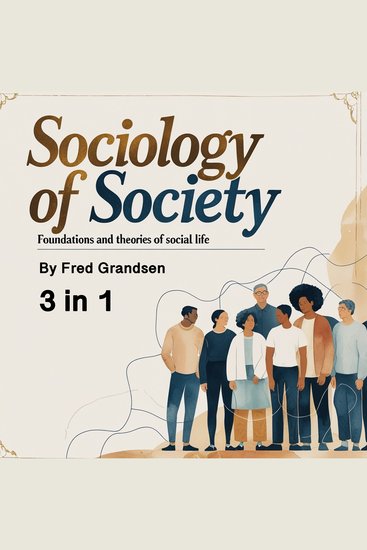
  • Sociology of Society - Foundations and Theories of Social Life (3 in 1) - cover

    Sociology of Society -...

    Fred Grandsen

    • 0
    • 0
    • 0
    This book bundle is a comprehensive 3-in-1 guide that explores the structures, behaviors, and ideas that shape human life in community. This volume introduces readers to the essential foundations of sociology, weaving together the study of social organization, the psychology of human interaction, and the grand theories that explain collective behavior. 
    The first section, Society, investigates how individuals come together to form communities, institutions, and cultures. Topics include norms, values, group structures, institutions, and the forces that hold or disrupt social cohesion. 
    In the second section, Social Psychology, the focus narrows to how individuals behave in social contexts. It examines identity, attitudes, conformity, group influence, and the psychological mechanisms driving human interaction in everyday life. 
    The final section, Social Theory, offers insight into the foundational ideas of key thinkers like Karl Marx, Max Weber, and Émile Durkheim. It explores modern and postmodern theories, systems of power, inequality, identity, and the forces of change and resistance that shape social realities. 
    This book is ideal for students, educators, and curious minds who want a clear, engaging, and meaningful introduction to the study of society and its most powerful forces.
    Ver livro
  • Merian Tin Moutan Part - I - cover

    Merian Tin Moutan Part - I

    Dr. Indu Bali

    • 0
    • 0
    • 0
    Merian Tin Moutan (My Three Deaths) is a thought-provoking short story collection by Dr. Indu Bali, a talented and acclaimed writer known for her deep insight into human emotions and society. The book reflects the realities of its time, offering fresh perspectives and social reflection. Translated from Hindi to Punjabi by the renowned writer Shri Ram Sarup Anakhi, the collection bridges linguistic and emotional connections between two rich literary traditions. It highlights Dr. Indu Bali’s versatility as a novelist, critic, and artist, whose contributions to literature and art have earned her the prestigious "Shiromani Hindi Sahitkar" award in 1982.
    Ver livro
  • The Will to Power - cover

    The Will to Power

    Friedrich Nietzsche

    • 0
    • 0
    • 0
    The Will to Power by Friedrich Nietzsche 
    What if the very force that shapes civilizations, topples empires, and drives every human desire could be named? 
    In The Will to Power, Friedrich Nietzsche ventures beyond the boundaries of conventional philosophy to unveil the hidden engine of human behavior—our relentless striving for power, meaning, and self-overcoming. This posthumously compiled work gathers Nietzsche’s most unfiltered thoughts, offering a glimpse into the raw blueprint of his later philosophy. 
    Explore his bold dismantling of morality in its traditional form, his chilling critique of modernity and nihilism, and his radical reimagination of truth, becoming, and the eternal return. With haunting aphorisms and prophetic clarity, Nietzsche invites us to question everything we hold sacred—while hinting at a deeper, untamed potential within us. 
    Nietzsche’s thought has shaped existentialism, psychoanalysis, postmodernism, and countless other intellectual revolutions. His ideas remain as urgent now as they were incendiary in his time, continuing to inspire and disturb seekers of truth around the world. 
    This audiobook offers an immersive encounter with Nietzsche's turbulent genius, where each sentence pulses with intensity and provocation. The clear, refined AI narration captures his complex tone—measured yet piercing—making his challenging prose accessible without diminishing its depth. 
    Dare to listen to the voice of one of history’s most enigmatic minds and step into the storm of becoming.
    Ver livro
  • A Woman's Guide to Claiming Space - Stand Tall Raise Your Voice Be Heard - cover

    A Woman's Guide to Claiming...

    Eliza VanCort, Alma Derricks

    • 0
    • 0
    • 0
    For too long, women have been told to confine themselves-physically, socially, and emotionally. Eliza VanCort says now is the time for women to stand tall, raise their voices, and claim their space. 
     
    Women fight the pressure to make themselves small in private, professional, and public spaces. VanCort, a teacher, consultant, and speaker, provides the necessary tools for women to rewrite the rules and create the stories of their choosing safely and without apology. 
     
    VanCort identifies the five key behaviors of all "Space-Claiming Queens": use your voice and posture to project confidence and power, end self-sabotage, forge connections, neutralize unsafe spaces, and unite across differences. Through personal narrative, research, and actionable strategies, VanCort provides how-tos on combating challenges, such as antimentors and microaggressions, and gives advice for building up your "old girls" club, asking for what you're worth, and owning your space without apology. 
     
    Bold, fun, and enlightening, this book is birthed from VanCort's incredible story. Having a mother with schizophrenia forced VanCort to learn to be small and invisible at an early age, and suffering a traumatic brain injury as an adult required her to rethink communication from the ground up. Drawing on these experiences, and those of real women everywhere, VanCort empowers women to claim space for themselves and for their sisters with courage, empathy, and conviction because "when we rise together, we rise so much higher."
    Ver livro