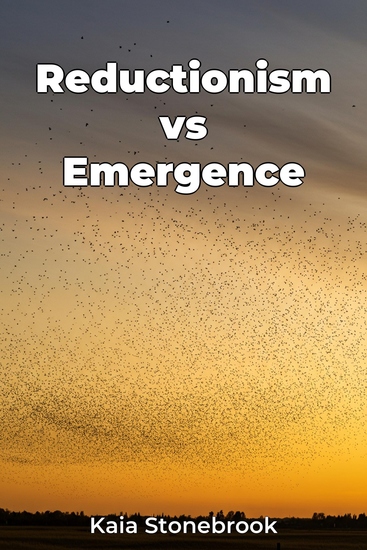
Reductionism vs Emergence
Kaia Stonebrook
Translator A AI
Publisher: Publifye
Summary
Reductionism vs Emergence explores two fundamental approaches to understanding complex systems: reductionism, which dissects systems into their components, and emergence, which studies properties arising at higher levels of organization. These differing perspectives shape scientific inquiry across various disciplines, from physics to biology. The book highlights how reductionism, a cornerstone of scientific methodology for centuries, has enabled us to understand the basic building blocks of reality. Conversely, emergence helps explain phenomena like consciousness and climate patterns, which cannot be predicted solely from individual components, emphasizing holistic interactions.


This book uniquely argues that both reductionism and emergence are necessary and complementary, offering a balanced perspective rather than advocating for one over the other. It traces the historical roots of each concept, from ancient atomists to modern complexity science, setting the stage for current debates. Through case studies in physics, biology, and neuroscience, the book illustrates the strengths and weaknesses of each approach. For example, it contrasts particle physics' reductionist approach with emergent phenomena in condensed matter physics.


Ultimately, the book proposes a framework for integrating reductionist and emergent perspectives. It begins by defining core concepts and their historical roots, progresses through specific case studies, and culminates in a synthesis. By drawing on scientific literature, philosophical treatises, and empirical data, the book aims to provide a comprehensive understanding of complex systems, appealing to scientists, philosophers, and anyone interested in the nature of reality.
Available since: 02/25/2025.
Print length: 67 pages.