Junte-se a nós em uma viagem ao mundo dos livros!
Adicionar este livro à prateleira
Grey
Deixe um novo comentário Default profile 50px
Grey
Assine para ler o livro completo ou leia as primeiras páginas de graça!
All characters reduced
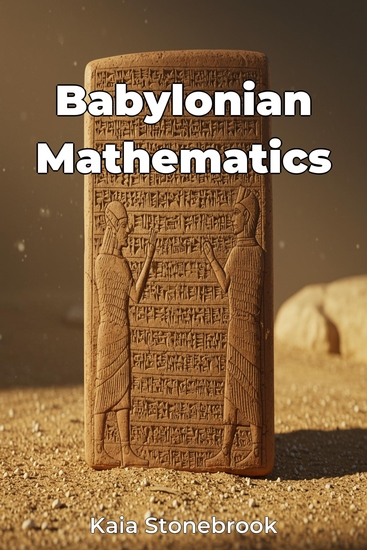
Babylonian Mathematics - cover
LER

Babylonian Mathematics

Kaia Stonebrook

Tradutor A AI

Editora: Publifye

  • 0
  • 0
  • 0

Sinopse

Babylonian Mathematics explores the sophisticated mathematical system developed in ancient Babylonia, highlighting its lasting influence on modern science and mathematics. The book delves into their innovative base-60 number system, which remarkably survives today in our measurement of time and angles, and their advanced algebraic techniques. Discover how the Babylonians solved complex equations and understood geometric principles, including a version of the Pythagorean Theorem predating Pythagoras himself. 

 
The book carefully reconstructs the historical context of Babylonian mathematical innovation, examining cuneiform texts and the role of scribes in developing mathematical tools for administration and commerce. By analyzing translated clay tablets, the author reveals the practical applications of their mathematics, offering a unique perspective on how they tackled real-world problems. Each chapter progresses from the number system to algebra, geometry, and finally, the lasting legacy of Babylonian contributions.
Disponível desde: 29/03/2025.
Comprimento de impressão: 69 páginas.

Outros livros que poderiam interessá-lo

  • Philosophy of Language - Words Meaning and Reality - cover

    Philosophy of Language - Words...

    Hector Davidson

    • 0
    • 0
    • 0
    Language plays a fundamental role in human life, functioning not only as a means of communication but as a structure that shapes the way we think, perceive, and understand the world. The philosophy of language seeks to unravel the complex relationships between words, meanings, and reality, exploring how language functions, how it conveys meaning, and how it relates to the world and our experiences. This chapter serves as an introduction to these foundational issues and provides an overview of the central questions and debates within the philosophy of language. 
    At its core, language is a system of symbols—words, phrases, and sentences—that represent concepts, objects, and actions. Understanding language, however, requires more than just examining its structure. It involves questioning how words acquire meaning, how those meanings change in different contexts, and how language can both represent and distort reality. This inquiry into meaning is not limited to how words correspond to things in the world, but also explores how they function in communication, how they shape thought, and how they reflect the underlying structures of human experience. 
    The structure of language itself is another crucial aspect. Language is governed by rules—such as syntax, grammar, and semantics—that allow words to be combined in meaningful ways. Syntax provides the framework for sentence structure, while grammar dictates how words should be used within that structure. Semantics, on the other hand, deals with the meaning of words and how they combine to form meaning within a sentence. Each of these aspects must be understood in relation to each other to grasp how language functions at a deeper level.
    Ver livro
  • Two Three Words (Do Se Kalameh) - cover

    Two Three Words (Do Se Kalameh)

    Aram Hessami

    • 0
    • 0
    • 0
    Where is the driving force for change? Who envisions a better future, crafts the path to democracy, and strategizes the movement? Who fuels it with revolutionary zeal and the will to power? And where is the force that can fulfill the unfinished promise of Iran's Constitutional Revolution? In three words: The Iranian Citizenry. Thirty years before Iran's Constitutional Revolution, the treatise One Word (Yek Kalameh) ignited a movement—challenging absolute monarchy, advocating the rule of law, and empowering the people. Now, Two, Three Words (Do, Se Kalameh) draws inspiration from the courageous youth of Iran. It articulates their aspirations, forges a new discourse, and unites a narrative that could pave the way for democratic alternatives.
    Ver livro
  • Mummies and Magic - The Preservation of Ancient Egyptian Bodies - cover

    Mummies and Magic - The...

    Omar Khalil

    • 0
    • 0
    • 0
    Mummification is one of the most fascinating and iconic aspects of ancient Egyptian culture. The practice, rooted in both religious beliefs and practical preservation techniques, developed over thousands of years. Understanding the origins of mummification requires a look into early burial practices, the evolution of the methods used, and the profound spiritual significance behind this ancient tradition. 
    In the Predynastic period, before the rise of the Pharaohs, ancient Egyptians buried their dead directly in the hot, dry desert sands. The natural arid conditions acted as a primitive form of preservation, desiccating the bodies and preventing decomposition. These simple burials, often in shallow pits, led to accidental mummification as the desert sands rapidly absorbed moisture. Early communities likely noticed that bodies buried in this way remained intact, sparking the realization that dryness was key to preservation. 
    As Egyptian society evolved, so did burial practices. The transition from pit burials to more elaborate tombs posed new challenges, as the enclosed environments led to faster decomposition. To counter this, early experiments with artificial preservation began. Initially, these efforts were rudimentary, involving simple wrappings and the use of resins. Over time, embalmers refined their techniques, experimenting with salts, oils, and various substances to dry and protect the body. By the Old Kingdom period, the practice had transformed into a highly ritualized and sophisticated process.
    Ver livro
  • Mr Vic’s X-Rated Television: “Miss Fisher Mysteries!” “Lesbian Loving For Miss Fisher and Dot!” - cover

    Mr Vic’s X-Rated Television:...

    VIC VITALE

    • 0
    • 0
    • 0
    "Lesbians Without Consent!" 
    While investigating a murder, Miss Phryne Fisher, along with Dot Williams and Doctor Mac, go to a seedy downtown bar to seek information.  
    It's at this place of shady repute where the three women fall prey to the sapphic element that frequents the establishment. 
     
    Ver livro
  • Supremachist Constructions of Gender in Multiplatform Fictional Narrations and Patriarchal Statism - From conceptual representation to socio-political projection - cover

    Supremachist Constructions of...

    Sergio Yagüe-Pasamón

    • 0
    • 0
    • 0
    Is male 'supremachism' really over? The pages you are holding in your hands sow doubts on the common belief that the governance of 'the macho' came to its end. As the proverb confirms, 'the old dies hard', despite the yet-to-improve individual and institutional efforts to achieve gender equality. With the serious tone this capital issue requires, the author debunks the myth of male supremacism as a phenomenon from a past and raises awareness of the subliminal survival of the supremachist ideological apparatus. Subtlety reveals as a key factor for the survival of subliminal supremachist campaigns, which threatens a promising future of non-discrimination. Essentially, democratic citizenship must pose itself a crucial question: Are current Western societies' concessions to feminism genuine or a cover by supremachism to survive in an ideologically volatile world?
    Ver livro
  • Picturing America - The Golden Age of Pictorial Maps - cover

    Picturing America - The Golden...

    Stephen J. Hornsby

    • 0
    • 0
    • 0
    Instructive, amusing, colorful—pictorial maps have been used and admired since the first medieval cartographer put pen to paper depicting mountains and trees across countries, people and objects around margins, and sea monsters in oceans. More recent generations of pictorial map artists have continued that traditional mixture of whimsy and fact, combining cartographic elements with text and images and featuring bold and arresting designs, bright and cheerful colors, and lively detail. In the United States, the art form flourished from the 1920s through the 1970s, when thousands of innovative maps were mass-produced for use as advertisements and decorative objects—the golden age of American pictorial maps.  Picturing America is the first book to showcase this vivid and popular genre of maps. Geographer Stephen J. Hornsby gathers together 158 delightful pictorial jewels, most drawn from the extensive collections of the Library of Congress. In his informative introduction, Hornsby outlines the development of the cartographic form, identifies several representative artists, describes the process of creating a pictorial map, and considers the significance of the form in the history of Western cartography. Organized into six thematic sections, Picturing America covers a vast swath of the pictorial map tradition during its golden age, ranging from “Maps to Amuse” to “Maps for War.” Hornsby has unearthed the most fascinating and visually striking maps the United States has to offer: Disney cartoon maps, college campus maps, kooky state tourism ads, World War II promotional posters, and many more. This remarkable, charming volume’s glorious full­-color pictorial maps will be irresistible to any map lover or armchair traveler.
    Ver livro