¡Acompáñanos a viajar por el mundo de los libros!
Añadir este libro a la estantería
Grey
Escribe un nuevo comentario Default profile 50px
Grey
Suscríbete para leer el libro completo o lee las primeras páginas gratis.
All characters reduced
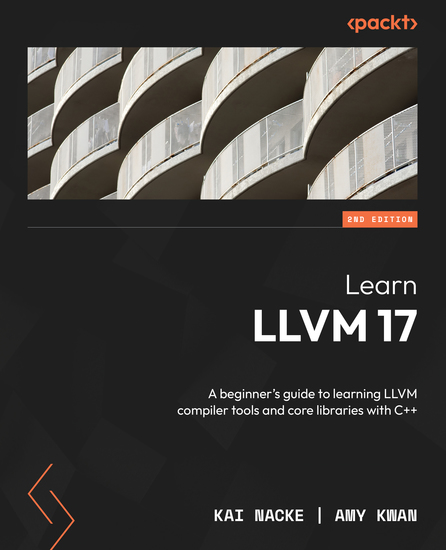
Learn LLVM 17 - A beginner's guide to learning LLVM compiler tools and core libraries with C++ - cover

Learn LLVM 17 - A beginner's guide to learning LLVM compiler tools and core libraries with C++

Kai Nacke, Amy Kwan

Editorial: Packt Publishing

  • 0
  • 0
  • 0

Sinopsis

LLVM was built to bridge the gap between the theoretical knowledge found in compiler textbooks and the practical demands of compiler development. With a modular codebase and advanced tools, LLVM empowers developers to build compilers with ease. This book serves as a practical introduction to LLVM, guiding you progressively through complex scenarios and ensuring that you navigate the challenges of building and working with compilers like a pro.The book starts by showing you how to configure, build, and install LLVM libraries, tools, and external projects. You’ll then be introduced to LLVM's design, unraveling its applications in each compiler stage: frontend, optimizer, and backend. Using a real programming language subset, you'll build a frontend, generate LLVM IR, optimize it through the pipeline, and generate machine code. Advanced chapters extend your expertise, covering topics such as extending LLVM with a new pass, using LLVM tools for debugging, and enhancing the quality of your code. You'll also focus on just-in-time compilation issues and the current state of JIT-compilation support with LLVM. Finally, you’ll develop a new backend for LLVM, gaining insights into target description and how instruction selection works.By the end of this book, you'll have hands-on experience with the LLVM compiler development framework through real-world examples and source code snippets.
Disponible desde: 12/01/2024.
Longitud de impresión: 416 páginas.

Otros libros que te pueden interesar

  • From Swamp to Wetland - The Creation of Everglades National Park - cover

    From Swamp to Wetland - The...

    Chris Wilhelm

    • 0
    • 0
    • 0
    This book chronicles the creation of Everglades National Park, the largest subtropical wilderness in the United States. Prior to the park's creation, the Everglades was seen as a reviled and useless swamp, unfit for typical recreational or development projects. 


    Park advocates drew on new ideas concerning the value of biota and ecology, the importance of wilderness, and the need to protect habitats, marine ecosystems, and plant life to redefine the Everglades. Using these ideas, the Everglades began to be recognized as an ecologically valuable and fragile wetland—and thus a region in need of protective status. 


    While these new ideas foreshadowed the later emergence of modern environmentalism, tourism and the economic desires of Florida's business and political elites also impacted the park's future. These groups saw the Everglades' unique biology and ecology as a foundation on which to build a tourism empire. 


    Yet, even after the park's creation, conservative landowners successfully fought to limit the park and saw it as a threat to their own economic freedoms. The battle to save the swamp's biodiversity continues, and Everglades Park stands at the center of ongoing restoration efforts.
    Ver libro
  • The Physics of Everyday Things - Understanding the Physics Behind Daily Life - cover

    The Physics of Everyday Things -...

    Mark Hedges

    • 0
    • 0
    • 0
    Motion is a fundamental aspect of the physical world, affecting everything we do and experience. From walking down the street to driving a car, the principles of motion are always at work. In physics, understanding the forces that cause and influence motion is essential to understanding how objects behave in the world around us. This chapter will explore Newton's laws of motion and the application of forces in our daily lives, helping to make sense of the movements and actions that shape our experiences. 
    At the heart of motion is Newton's First Law, also known as the Law of Inertia. This law states that an object will remain at rest or in uniform motion unless acted upon by an external force. Essentially, things like to keep doing what they’re doing. For instance, a car coasting down the highway will continue moving unless the brakes are applied, or friction slows it down. This simple concept explains why, when you're in a car that suddenly stops, you feel as if you're still moving forward—your body wants to keep going, even though the car has halted. The application of this principle is not limited to vehicles but can be observed in everyday activities, like pushing a shopping cart or standing still on a bus that starts to move. 
    Newton's Second Law, the Law of Acceleration, takes it further. It tells us that the force applied to an object is equal to its mass times its acceleration (F = ma). This means that heavier objects require more force to accelerate, while lighter objects can be moved more easily. When you push a sled across the snow, the amount of effort you need depends on how much the sled weighs and how fast you want it to move. This relationship helps explain why it’s harder to get a heavy truck moving than a small bicycle. Understanding this law helps us calculate everything from how much effort it takes to lift an object to how quickly a rocket can launch into space.
    Ver libro
  • Why the Dose Matters - Assessing the Health Risk of Exposure to Toxicants - cover

    Why the Dose Matters - Assessing...

    Urs A. Boelsterli

    • 0
    • 0
    • 0
    Each day we are exposed to a myriad of natural and human-made chemicals in our food, drinking water, air, soil, at home or at the workplace—pesticide residues, food additives, drugs, household products—but how can we gauge the human health risk posed by these chemicals? Should we believe the somber headlines that depict a serious threat for humans and the environment, or should we follow the reassuring voices of others who claim that the angst is totally unfounded? 


    Why the Dose Matters: Assessing the Health Risk of Exposure to Toxicants uses a rational, science-based approach to explain in plain language that a quantitative view is key for understanding and predicting potentially toxic effects of chemicals. 


    Key Features: 


    ● Explains the basics of toxicology in easily understandable terms. 


    ● Includes numerous examples. 


    ● Clears up common misconceptions and dispels myths. 


    ● Provides take-home messages for each chapter.
    Ver libro
  • Life Lessons from a Parasite - What Tapeworms Flukes Lice and Roundworms Can Teach Us About Humanity's Most Difficult Problems - cover

    Life Lessons from a Parasite -...

    John Janovy Jr.

    • 0
    • 0
    • 0
    The answers to life's biggest questions can be found by looking at the little things . . . 


    Though you may not be able to see them with the naked eye, parasites—miniscule life forms that live inside other organisms—inhabit our everyday lives. From headlice to bird droppings, litterboxes to unfiltered water, you have brushed up against the most common way of life on our planet. 


    In this unique book, John Janovy Jr., one of the world's preeminent experts on parasites, reveals what can humans learn from the most reviled yet misunderstood animals on Earth: lice, tapeworms, flukes, and maggots that can eat a lizard from the inside, and how these lessons help us negotiate our own complicated world. Whether we're learning to adapt to adverse conditions, accept our own limitations, or process new information in an ever-changing landscape—we can be sure a parasite did it first. 


    At once peculiar and profound, Life Lessons from a Parasite makes a case for using knowledge of the natural world, with all its wonderful mysteries and quirks, to tackle our worst problems.
    Ver libro
  • Medical Virology - Viruses and Viral Diseases - cover

    Medical Virology - Viruses and...

    Ava Westwood

    • 0
    • 0
    • 0
    Virology is the branch of microbiology that focuses on the study of viruses, including their structure, classification, replication, pathogenesis, and interactions with hosts. Viruses are unique infectious agents that exist at the boundary between living and non-living entities. Unlike bacteria and other microorganisms, viruses cannot replicate independently; they rely entirely on host cells to reproduce. This dependency makes them significant in the fields of medicine, biotechnology, and public health. 
    The significance of virology has expanded with the emergence of novel viral diseases, pandemics, and the continuous evolution of viral pathogens. From early discoveries of viral infections to the development of vaccines and antiviral therapies, virology has played a crucial role in advancing medical science. The study of viruses extends beyond human health, influencing veterinary medicine, agriculture, and environmental sciences. Understanding the fundamental principles of virology is essential for diagnosing, treating, and preventing viral diseases. 
    Historically, virology began with the discovery of infectious agents that were too small to be seen under a microscope. The first major breakthrough occurred in the late 19th century when Dmitri Ivanovsky and Martinus Beijerinck independently demonstrated that certain infectious agents, later identified as viruses, could pass through filters that trapped bacteria. This led to the realization that viruses were distinct from other microorganisms. The discovery of bacteriophages, viruses that infect bacteria, further expanded the field and paved the way for molecular virology.
    Ver libro
  • Python Programming for Kids: Getting Started - Fun and Easy Guide to Building Your First Programs - cover

    Python Programming for Kids:...

    Lily Anderson

    • 0
    • 0
    • 0
    Welcome to the exciting world of Python programming! "Python Programming for Kids: Getting Started - Fun and Easy Guide to Building Your First Programs" is your gateway to learning how to code in one of the most popular and beginner-friendly programming languages. This book is designed specifically for kids, offering clear explanations, engaging examples, and fun projects that make learning to code a joyful adventure. 
    Inside, you'll discover the basics of Python, from understanding variables, loops, and functions to exploring more advanced topics like file handling, debugging, and object-oriented programming. Each chapter builds on the previous one, helping you develop your skills step-by-step while keeping you entertained with exciting and relatable examples. 
    You'll get hands-on experience by building simple projects like games, calculators, and interactive applications. You'll learn valuable troubleshooting and debugging techniques along the way, ensuring you can confidently solve problems and improve your programs. 
    Whether you're entirely new to programming or looking to expand your knowledge, this book will guide you through the process with ease and enjoyment. Get ready to unleash your creativity and become a Python programmer with "Python Programming for Kids: Getting Started - Fun and Easy Guide to Building Your First Programs." Happy coding!
    Ver libro