Join us on a literary world trip!
Add this book to bookshelf
Grey
Write a new comment Default profile 50px
Grey
Subscribe to read the full book or read the first pages for free!
All characters reduced
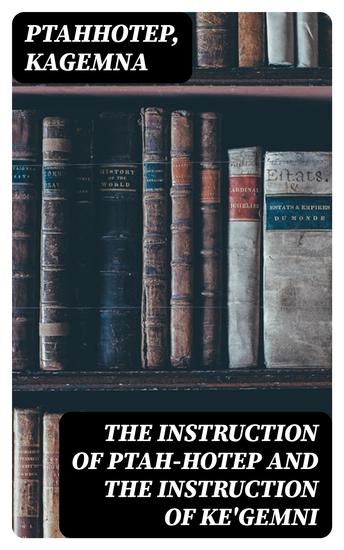
The Instruction of Ptah-Hotep and the Instruction of Ke'Gemni - The Oldest Books in the World - cover

The Instruction of Ptah-Hotep and the Instruction of Ke'Gemni - The Oldest Books in the World

Ptahhotep, Kagemna

Translator Battiscombe G. Gunn

Publisher: DigiCat

  • 0
  • 0
  • 0

Summary

In 'The Instruction of Ptah-Hotep and the Instruction of Ke'Gemni,' readers encounter an exploration of ancient wisdom perfectly encapsulated in the timeless teachings of two eminent Egyptian viziers. This collection skillfully interlaces discourses on morality, governance, and personal conduct, offering a rich tapestry of ancient rhetorical styles and philosophical queries. The works collectively create a profound dialogue on how ethical living can influence both personal contentment and social harmony, embodying the importance of wisdom literature in shaping early Egyptian culture and beyond. The diversity of teachings presented provides varied insights into ancient Egyptian perceptions of justice, authority, and the ethical obligations held by individuals within society. The context of the authors, Ptahhotep and Kagemna, is instrumental to the collection, drawing from their positions as pharaonic officials immersed in the realities of leadership and moral obligations. Their writings reflect a civilization deeply intertwined with values that transcend time, resonating with themes of justice, truth, and balance. As preservers of wisdom, these figures contribute layers of historical, cultural, and philosophical depth to the anthology, aligning with the ancient literary movement of wisdom texts known for synthesizing practical and philosophical insights. This volume offers readers a unique opportunity to delve into classical Egyptian thought articulated by voices that echo through the ages. For scholars, educators, or any avid reader interested in a panoramic view of ancient wisdom, this collection serves as an educational trove, fostering dialogue and reflection. By engaging with these insightful texts, the collection invites readers to journey into an intellectual realm where the past illuminates perennial human truths, encouraging a deeper understanding of life's ethical dimensions.
Available since: 05/28/2022.
Print length: 37 pages.

Other books that might interest you

  • The Agatha Christie Collection - cover

    The Agatha Christie Collection

    Agatha Christie

    • 0
    • 0
    • 0
    This ebook collection contains the following works of Agatha Christie:The Mysterious Affair at Styles Track 1 to 13The Secret Adversary Starts Track 14 to 42The Murder on the Links Track 43 to 70The Disappearance of Mr. Davenheim Track 71The Adventure of the "Western Star" Track 72The Tragedy at Marsdon Manor Track 73The Million Dollar Bond Robbery Track 74The Adventure of the Cheap Flat Track 75The Mystery of the Hunter's Lodge Track 76The Kidnapped Prime Minister Track 77The Adventure of the Egyptian Tomb Track 78The Adventure of the Italian Nobleman Track 79The Case of the Missing Will Track 80The Chocolate Box Track 81The Veiled Lady Track 82The Lost Mine Track 83The Affair at the Victory Ball Track 84 to 89The Adventure of the Clapham Cook Track 90The Cornish Mystery Track 91 to 98The The Kidnapping of Johnnie Waverly Track 99The Double Clue Track 100The  Adventure of the King of Clubs Track 101 to 105The Lemesurier Inheritance Track 106 to 113The Mystery of the Plymouth Express Track 114 to 119The Submarine Plans Track 120The Market Basing Mystery Track 121The Curious Disappearance of the Opalsen Pearls Track 122
    Show book
  • My Path to Atheism - cover

    My Path to Atheism

    Annie Besant

    • 0
    • 0
    • 0
    "My Path to Atheism" by Annie Besant is a compelling autobiographical account of Besant's journey from devout religious belief to atheism. Through a candid exploration of her personal struggles, intellectual inquiries, and the contradictions she encountered within organized religion, Besant embraces rational thought and secularism. This thought-provoking narrative delves into profound questions of faith, reason, and the search for truth, offering valuable insights into the path to intellectual and spiritual independence.
    Show book
  • A Thief and a Hero - The true story of Johnny Ramensky the daring saboteur who stole secret Nazi war plans - cover

    A Thief and a Hero - The true...

    Robert Jeffrey

    • 0
    • 0
    • 0
    When John Ramsay dropped into the Schorfheide Forest, north east of Berlin in 1944 his mission had two parts: to locate and infiltrate Goering's Headquarters, then once inside to blow the safe and steal the Nazi war plans. As a Commando, John Ramsay was trained for the first part, but it was only as Johnny Ramensky, Scotland's most infamous career thief that he was qualified to do the latter. A THIEF AND A HERO tells the extraordinary story of Gentle Johnny Ramensky: the son of Lithuanian immigrant parents who went on to become a household name as the foremost safe-blower in the country. His daring escapes from prison would further endear him to the public and eventually bring him to the attention of the British army. When the Second World War broke, he was hand-picked to join the Commandos and rechristened himself Ramsay.It was there that he used his talent and bravery for King and country, parachuting behind enemy lines to crack the safes of key people in the German High Command; Rommel and Goering among them.Thief. Commando. Saboteur. Hero. This is his story.
    Show book
  • Lucius D Clay - An American Life - cover

    Lucius D Clay - An American Life

    Jean Edward Smith

    • 0
    • 1
    • 0
    A military biography of the American soldier and statesman who managed the WWII Lend-Lease program and acted as governor of postwar Germany.During World War II, President Roosevelt called upon Lucius D. Clay to run military procurement. It took a man of his logistical genius to oversee the requirements of an eight-million-man army. Clay set priorities, negotiated contracts, monitored production, and coordinated military Lend-Lease—all without a breath of scandal.In 1945, Clay was called upon once again to act as military governor of a decimated Germany. He dealt with everything from de-Nazification to quarrelsome allies, from feeding a starving people to processing vast numbers of homeless and displaced. Above all, he had to convince a doubting American public and a hostile State Department that German recovery was essential to the stability of Europe.Clay went on to play key roles in business and politics, advising presidents of both parties. He helped run Eisenhower's 1952 campaign, led the federal highway program, raised the ransom money for the Bay of Pigs prisoners, and boosted morale in Germany as the Berlin Wall was built. In honor of their debt to him, the Berliners placed a simple stone tablet at his West Point grave: Wir Danken Dem Bewahrer Unserer Freiheit—We Thank the Defender of Our Freedom.
    Show book
  • A Dialogue Among Clever People - From their pens to your ears genius in every story - cover

    A Dialogue Among Clever People -...

    Leo Tolstoy

    • 0
    • 0
    • 0
    Leo Tolstoy was born in 1828 in the Russian province of Tula to a wealthy noble family. As a child, he had private tutors but he showed little interest in any formal education. When he went to the University of Kazan in 1843 to study oriental languages and law, he left without completing his courses.  Life now was relaxed and idle but with some writing also taking place.  Gambling debts forced an abrupt change of path and he joined the army to fight in the Crimean War.  He was commended for his bravery and promoted but was appalled at the brutality and loss of life.  He recorded these and other earlier experiences in his diaries which formed the basis of several of his works. 
    In 1852 ‘Childhood’ was published to immediate success and was followed by ‘Boyhood’ and ‘Youth’. 
    His experience in the army and the horrors he witnessed resulted in ‘The Cossacks’ in 1862 and the trilogy ‘Sevastopol Tales’. After the war he travelled around Europe, visiting London and Paris and meeting such luminaries as Victor Hugo and Charles Darwin.  
    It was now that Tolstoy began his masterpiece, ‘War and Peace’. Published in 1869 it was an epic work that changed literature. He quickly followed this with ‘Anna Karenina’.  
    These successes made Tolstoy rich and helped him accomplish many of his dreams but also brought problems as he grappled with his faith and the lot of the oppressed poor. These revolutionary views became so popular that the authorities now kept him under surveillance.  
    He led a life of asceticism and vegetarianism and put his socialist ideals into practice by establishing numerous schools for the poor and food programmes. He also believed in giving away his wealth, which caused much discord with his wife.  
    His writing continued to bring forth classics such as ‘The Death of Ivan Ilyich’ and many brilliant and incisive short stories such as ‘How Much Land Does A Man Need’.  
    In 1901 Tolstoy was excommunicated from the Church and controversially deselected for the Nobel Prize for Literature. 
    Whilst undertaking a pilgrimage by train in October 1910 with his daughter Aleksandra he caught pneumonia in the nearby town of Astapovo.  Leo Tolstoy died on November 9th, 1910, he was 82.
    Show book
  • Poor Folk - A Heartfelt Story of Love Poverty and Human Struggle - cover

    Poor Folk - A Heartfelt Story of...

    Fyodor Dostoevsky, Tim Zengerink

    • 0
    • 0
    • 0
    What if love and dignity could survive even the harshest poverty? 
    In this emotionally charged epistolary novel, Poor Folk introduces us to two souls struggling with loneliness, hardship, and the quiet hope for human connection.  
    Makar Devushkin and Varvara Dobroselova—two distant relatives living in squalid conditions—exchange heartfelt letters that reveal their pain, their unspoken love, and their attempts to preserve dignity in the face of overwhelming poverty. 
    This modern translation brings new life to Dostoevsky’s first published novel, making its characters and themes resonate as powerfully today as they did in 1846. 
    What you'll discover inside: 
    - A Tender Story of Emotional Bonding – A touching portrayal of letter-bound love and friendship 
    - Early Dostoevsky at His Most Vulnerable – A glimpse into the emotional roots of his future genius 
    - Modern, Clear Narration – Accessible language that preserves the soul of Dostoevsky’s debut 
    - A Lens on Class and Compassion – A heartbreaking look at how the poor survive with grace and feeling 
    Dive into a story that speaks softly but pierces deeply—an unforgettable journey through the human heart.
    Show book