Junte-se a nós em uma viagem ao mundo dos livros!
Adicionar este livro à prateleira
Grey
Deixe um novo comentário Default profile 50px
Grey
Assine para ler o livro completo ou leia as primeiras páginas de graça!
All characters reduced
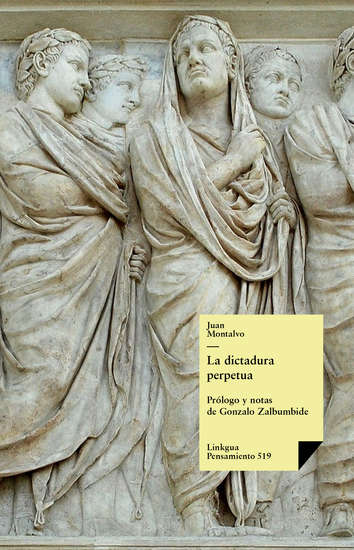
La dictadura perpetua - cover
LER

La dictadura perpetua

Juan Montalvo, Gonzalo Zambulbide

Editora: Linkgua

  • 0
  • 0
  • 0

Sinopse

Juan Montalvo es uno de los más grandes pensadores de América Latina. Vivió en el siglo XIX, durante un período de inestabilidad política y restricciones de las libertades públicas. Pasó la vida defendiendo la libertad de prensa y combatiendo las tiranías y el clericalismo. Se enfrentó sin descanso contra los gobiernos autoritarios y sufrió por ello persecuciones que lo mantuvieron exilado de su patria, el Ecuador, por largas temporadas.
Buena parte de la producción de Montalvo tiene como finalidad defender los valores del libre pensamiento y el derecho a la libertad de conciencia.
En 1874, apareció un artículo en el periódico panameño Star and Herald, donde se ensalzaban los logros de Gabriel García Moreno como presidente y se apoyaba su candidatura a la tercera reelección. Montalvo se indignó y escribió la misiva que aquí publicamos al diario, bajo el titulo de La dictadura perpetua. En ella su prosa mordaz y directa ponía en relieve las perversiones del gobierno de García Moreno.
Este texto, subtitulado, canto a la libertad y a la lucha contra la tiranía, se leyó clandestinamente en Ecuador y contribuyó a quitar la venda de los ojos de nuestros antepasados, no llegó a Ecuador hasta mayo de 1875.
La dictadura perpetua es un retrato del poder ejercido en sus extremos. Construido, a través del análisis del carácter y la psicología de un dictador. El libro inspiró a un grupo de jóvenes liberales a ejecutar a Gabriel García Moreno, entonces presidente del Ecuador, el 6 de agosto de 1875.
Muchas de las ideas que aparecen en La dictadura perpetua siguen teniendo total vigencia en el presente:
«¿A dónde van a parar los principios democráticos, a dónde las instituciones liberales, a dónde los derechos de los pueblos, a dónde la justicia, a dónde el pundonor, a dónde la dignidad humana, a dónde la libertad, a dónde la esperanza?»
«¡Desdichado, por otra parte, el pueblo donde la revolución viniese a ser imposible!»
Disponível desde: 10/12/2022.
Comprimento de impressão: 109 páginas.

Outros livros que poderiam interessá-lo

  • Adolphe Tonduz and the Golden Age of Botany in Costa Rica - cover

    Adolphe Tonduz and the Golden...

    Gregorio Dauphin-López

    • 0
    • 0
    • 0
    Certain eras in the development of humanity have been characterized by their effervescence and diversification of artistic, technical, intellectual, and scientific activities; one of them occurred at the end of the 19th century in Europe and North America. At that time, currents of change were generated that would later define many of the trends in today's world. 
    
    The once endless virgin forests and impassable rural roads, plains, rivers, and mountains of Costa Rica, as well as the city of San José, were also the scene of such effervescence. Here, botanical explorers such as Adolphe Tonduz, Henri Pittier or Paul Biolley, with sweat, effort, and collaboration, laid the foundations for the scientific exploration of this small Central American republic, and made it stand out in Latin America. 
    
    In the second edition of the work Adolphe Tonduz and the golden age of botany in Costa Rica, reference is made to this feat by incorporating, in addition to the pleasant stories of the Swiss naturalist, his agronomic texts, which represent the beginnings of the fight against pests of economically important tropical crops, such as coffee, bananas and cocoa. New and updated images of the actors, settings and correspondence have also been included, which constituted the primary source of the work. 
    
    Aimed not only at professionals in botany, natural sciences, and history, but also at agronomists, anthropologists and the public, this book transports us directly to the context of Tonduz, as well as to the dawn of modern Costa Rica.
    Ver livro
  • Edison And His Life And Interviews - cover

    Edison And His Life And Interviews

    Frank Lewis Dyer

    • 0
    • 0
    • 0
    A detailed biography of Thomas Alva Edison, inventor of such things as the telephone, the microphone, the electric motor, the storage battery, and the electric light. In the words of the authors, "It is designed in these pages to bring the reader face to face with Edison; to glance at an interesting childhood and a youthful period marked by a capacity for doing things, and by an insatiable thirst for knowledge; then to accompany him into the great creative stretch of forty years, during which he has done so much. This book shows him plunged deeply into work for which he has always had an incredible capacity, reveals the exercise of his unsurpassed inventive ability, his keen reasoning powers, his tenacious memory, and his fertility of resources; follows him through a series of innumerable experiments, conducted methodically, reaching out like rays of search-light into all the regions of science and nature, and finally exhibits him emerging triumphantly from countless difficulties bearing with him in new arts the fruits of victorious struggle. This is his story!
    Ver livro
  • And a Bang on the Ear - Reclaiming My Life After a Brain Injury - cover

    And a Bang on the Ear -...

    Phil Quinlan

    • 0
    • 0
    • 0
    Phil Quinlan was a sports-mad fifteen year old when he packed his bag one Sunday morning in 1989 to play a game of football. A clash of heads on the pitch changed his life forever. Falling into a coma, he was given a twenty-five-percent chance to live. He regained consciousness six weeks later, waking to a world filled with pain.
    
    Full of hope and humour, rage and despair, this is Phil's story of chronic pain and rehabilitation, travelling the globe and finding love.
    A hugely inspirational tale of determination to overcome the results of a devastating injury.
    Ver livro
  • Cage Eleven - Prison Writings from Long Kesh - cover

    Cage Eleven - Prison Writings...

    Gerry Adams

    • 0
    • 1
    • 0
    Long before he became President of Sinn Féin, Gerry Adams was a civil rights activist who took part in sit-ins, marches and protests in Northern Ireland. Along with hundreds of other men, Adams was interned on the Maidstone prison ship and in Long Kesh prison – without charge or trial – during the 1970s for his political activities. Women were interned also, in Armagh Women's Prison. Cage Eleven is his own account – sometimes passionate, often humorous – of life in Long Kesh. Written while Adams was a prisoner, the pieces were smuggled out for publication.
    This updated edition includes a new introduction and sketches drawn in Cage Eleven by another prisoner at the time, Danny Devenny.
    'Offers a unique insight into … the experience of internment … an unrivalled representation of the resilience and humour that were as much a part of the life of the political prisoner as the adherence to a set of political ideals.' Irish Herald
    Ver livro
  • Essays - cover

    Essays

    George Orwell

    • 0
    • 0
    • 0
    "George Orwell (1903-50) is known around the world for his satirical novella Animal Farm and his dystopian novel Nineteen Eighty-Four, but he was arguably at his best in the essay form. Below, we've selected and introduced ten of Orwell's best essays for the interested newcomer to his non-fiction, but there are many more we could have added. What do you think is George Orwell's greatest essay?
    Contents:
    POLITICS AND THE ENGLISH LANGUAGE
    NOTES ON NATIONALISM (1945)
    WHY I WRITE (1946)"
    Ver livro
  • The Illustrated Letters of Jane Austen - cover

    The Illustrated Letters of Jane...

    Penelope Hughes-Hallett

    • 0
    • 0
    • 0
    A beautifully illustrated account of the letters and correspondence of Jane Austen.
    It has been said that Jane Austen the woman and Jane Austen the author are all of a piece, and nowhere is this more evident to the lovers of her novels than in the pages of her letters. This handsome celebration of Austen's letters is illustrated with portraits, facsimile letters, topographical engravings and fashion plates, all helping to bring to life the world Jane Austen inhabited.
    The letters, with an accompanying commentary by Penelope Hughes-Hallett, are separated into six periods of Jane Austen's life, between the years 1796, when she was twenty, and 1817, the year of her death. They celebrate Jane Austen's talent for expressing exactly what she perceived, making this an illuminating companion to her novels. Although the book follows a broadly chronological scheme, the letters are arranged round visual themes, including the Hampshire countryside, social life in Bath and London, domestic pursuits, paying visits and travelling by carriage.
    The author, who was born in Jane Austen's Hampshire village of Steventon, lectured on English Literature for the Open University and the Oxford University Department of External Studies. 
    Ver livro