¡Acompáñanos a viajar por el mundo de los libros!
Añadir este libro a la estantería
Grey
Escribe un nuevo comentario Default profile 50px
Grey
Suscríbete para leer el libro completo o lee las primeras páginas gratis.
All characters reduced
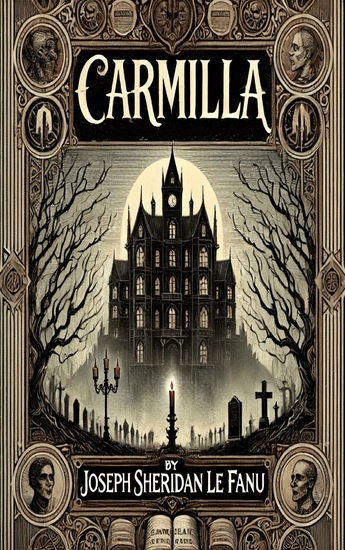
Carmilla - A Gothic Vampire Classic - cover

Carmilla - A Gothic Vampire Classic

Joseph Sheridan Le Fanu, Zenith Blue Ridge

Editorial: Zenith Blue Ridge Books

  • 0
  • 0
  • 0

Sinopsis

Before Dracula, there was Carmilla—a chilling, seductive tale that laid the foundation for vampire fiction as we know it.

Set in a mysterious and secluded castle in 19th-century Styria, Carmilla tells the story of Laura, a young woman who encounters the enigmatic and alluring Carmilla. What begins as a friendship blossoms into something more intimate, but as Carmilla's true nature is slowly revealed, Laura finds herself ensnared in a web of eerie secrets, danger, and supernatural horror.

A masterpiece of gothic literature, Carmilla explores themes of love, desire, and the sinister allure of the unknown. With its haunting atmosphere, compelling characters, and suspenseful narrative, this novella by Joseph Sheridan Le Fanu is an unforgettable journey into the shadowy world of vampires.

As one of the earliest works of vampire fiction, Carmilla has inspired generations of writers, from Bram Stoker's Dracula to modern-day interpretations of the vampire myth. This timeless tale continues to captivate readers with its blend of gothic romance and spine-tingling terror.

Hailed as a gothic classic, Carmilla remains a cornerstone of vampire literature. Praised by critics and beloved by readers, it has influenced countless adaptations and inspired some of the greatest works of horror and gothic fiction.

Step into the haunting world of Carmilla and discover the story that shaped vampire fiction. Add this gothic masterpiece to your library today and experience the tale that started it all.
Disponible desde: 27/01/2025.
Longitud de impresión: 160 páginas.

Otros libros que te pueden interesar

  • To Build a Fire - cover

    To Build a Fire

    Jack London

    • 0
    • 0
    • 0
    In the frozen wilderness of the Yukon, the line between survival and surrender is razor-thin. Jack London's To Build a Fire is more than a story; it is a stark, unforgettable confrontation with the raw power of nature and the frailty of human pride.
    Here, the biting cold isn't just a setting—it's an unyielding adversary, testing the limits of determination and the cost of hubris. The tale whispers of isolation so profound that silence becomes deafening, and of choices so crucial that a single misstep can spell the difference between life and death.
    Through prose as sharp as the frostbitten air, London paints a brutal, awe-inspiring portrait of man versus nature. Yet beneath the surface lies something deeper: an exploration of the delicate balance between human ingenuity and the primal forces of the wild. To Build a Fire dares readers to reflect on their own resilience—and their vulnerability—when faced with an indifferent universe.
    This is a story not merely to read, but to experience: a chilling reminder that nature does not forgive, and survival is earned one breath at a time.
    Ver libro
  • A Starry Drive - cover

    A Starry Drive

    Robert Louis Stevenson

    • 0
    • 0
    • 0
    In our rule at Silverado, there was a melancholy interregnum. The queen and the crown prince with one accord fell sick; and, as I was sick to begin with, our lone position on Mount Saint Helena was no longer tenable, and we had to hurry back to Calistoga and a cottage on the green. By that time we had begun to realize the difficulties of our position. We had found what an amount of labour it cost to support life in our red canyon; and it was the dearest desire of our hearts to get a China-boy to go along with us when we returned. We could have given him a whole house to himself, self-contained, as they say in the advertisements; and on the money question we were prepared to go far. Kong Sam Kee, the Calistoga washerman, was entrusted with the affair; and from day to day it languished on, with protestations on our part and mellifluous excuses on the part of Kong Sam Kee.
    Ver libro
  • A Wireless Message - From their pens to your ears genius in every story - cover

    A Wireless Message - From their...

    Ambrose Bierce

    • 0
    • 0
    • 0
    Ambrose Gwinnett Bierce was born on 24th June 1842 at Horse Cave Creek in Meigs County, Ohio. His parents were poor but they introduced him to literature at an early age, instilling in him a deep appreciation of books, the written word and the elegance of language.  
    Growing up in Koscuisko County, Indiana poverty and religion were defining features of his childhood, and he would later describe his parents as “unwashed savages” and fanatically religious, showing him little affection but always quick to punish. He came to resent religion, and his introduction to literature appears to be their only positive effect. 
    At age 15 Bierce left home to become a printer’s devil, mixing ink and fetching type at The Northern Indian, a small Ohio paper. Falsely accused of theft he returned to his farm and spent time sending out work in the hopes of being published. 
    His Uncle Lucius advised he be sent to the Kentucky Military Institute. A year later he was commissioned as an Officer.  As the Civil War started Bierce enlisted in the 9th Indiana Infantry Regiment.  
    In April 1862 Bierce fought at the Battle of Shiloh, an experience which, though terrifying, became the source of several short stories. Two years later he sustained a serious head wound and was off duty for several months. He was discharged in early 1865.  
    A later expedition to inspect military outposts across the Great Plains took him all the way to San Francisco. He remained there to become involved with publishing and editing and to marry, Mary Ellen on Christmas Day 1871.  They had a child, Day, the following year.  
    In 1872 the family moved to England for 3 years where he wrote for Fun magazine. His son, Leigh, was born, and first book, ‘The Fiend’s Delight’, was published.  
    They returned to San Francisco and to work for a number of papers where he gained admiration for his crime reporting. In 1887 he began a column at the William Randolph Hearst’s San Francisco Examiner.  
    Bierce’s marriage fell apart when he discovered compromising letters to his wife from a secret admirer. The following year, 1889 his son Day committed suicide, depressed by romantic rejection. 
    In 1891 Bierce wrote and published the collection of 26 short stories which included ‘An Occurrence at Owl Creek Bridge’.  Success and further works including poetry followed.  
    Bierce with Hearst’s resources helped uncover a financial plot by a railroad to turn 130 million dollars of loans into a handout. Confronted by the railroad and asked to name his price Bierce answered “my price is $130 million dollars. If, when you are ready to pay, I happen to be out of town, you may hand it over to my friend, the Treasurer of the United States”.  
    He now began his first foray as a fabulist, publishing ‘Fantastic Fables’ in 1899.  But tragedy again struck two years later when his second son Leigh died of pneumonia relating to his alcoholism.  
    He continued to write short stories and poetry and also published ‘The Devil’s Dictionary’.  
    At the age of 71, in 1913 Bierce departed from Washington, D.C., for a tour of the battlefields where he had fought during the civil war. At the city of Chihuahua he wrote his last known communication, a letter to a friend. It’s closing words were “as to me, I leave here tomorrow for an unknown destination,” Ambrose Bierce then vanished without trace.
    Ver libro
  • At Christmas Time - From their pens to your ears genius in every story - cover

    At Christmas Time - From their...

    Anton Chekhov

    • 0
    • 0
    • 0
    Anton Pavlovich Chekhov was born on 29th January 1860 in Taganrog, on the south coast of Russia.  
    His family life was difficult; his father was strict and over-bearing but his mother was a passionate story-teller, a subject Chekhov warmed to. As he later said; ‘our talents we got from our father, but our soul from our mother’.  
    At school Chekhov was distinctly average. At 16 his father mis-managed his finances and was declared bankrupt. His family fled to Moscow. Chekhov remained and eked out a living by various means, including writing and selling short sketches to newspapers, to finish his schooling. That completed and with a scholarship to Moscow University obtained he rejoined his family. 
    He was able to help support them by selling satirical sketches and vignettes of Russian lifestyles and gradually obtained further commissions. In 1884, he qualified as a physician and, although it earned him little, he often treated the poor for free, he was fond of saying ‘Medicine is my lawful wife, and literature is my mistress.’ 
    His own health was now an issue as he began to cough up blood, a symptom of tuberculosis.  Despite this his writing success enabled him to move the family into more comfortable accommodation.  
    Chekhov wrote over 500 short stories which included many, many classics including ‘The Kiss’ and ‘The Lady with a Dog’.  His collection ‘At Dusk’ won him the coveted Pushkin Prize when was only 26.  
    He was also a major playwright beginning with the huge success of ‘Ivanov’ in 1887.   
    In 1892 Chekhov bought a country estate north of Moscow. Here his medical skills and money helped the peasants tackle outbreaks of cholera and bouts of famine. He also built three schools, a fire station and a clinic.  It left him with less time for writing but the interactions with real people gained him detailed knowledge about the peasantry and their living conditions for his stories.  
    His most famous work, ‘The Seagull’ was received disastrously at its premiere in St Petersburg. It was later restaged in Moscow to highlight its psychological aspects and was a huge success. It led to ‘Uncle Vanya’, ‘The Three Sisters’ and ‘The Cherry Orchard’.  
    Chekhov suffered a major lung hemorrhage in 1897 while visiting Moscow. A formal diagnosis confirmed tuberculosis and the doctors ordered changes to his lifestyle.  
    Despite a dread of weddings the elusive literary bachelor quietly married the actress Olga Knipper, whom he had met at rehearsals for ‘The Seagull’, on 25th May 1901. 
    By May 1904 with his tuberculosis worsening and death imminent he set off for the German town of Badenweiler writing cheerful, witty letters to his family and assuring them his health was improving.  
    On 15th July 1904 Anton Chekhov died at Badenweiler.  He was 44.
    Ver libro
  • Martin Chuzzlewit Volume 1 - cover

    Martin Chuzzlewit Volume 1

    Charles Dickens

    • 0
    • 0
    • 0
    In Martin Chuzzlewit Volume 1, Charles Dickens introduces a tale of greed, generosity, and self-discovery. The story centers on the Chuzzlewit family, notorious for its selfish members. Young Martin Chuzzlewit, defying his miserly grandfather's expectations, rejects materialism and embarks on a path of independence. Meanwhile, the kind-hearted Mary Graham remains loyal despite being spurned by the elder Martin. Through vivid characters like the scheming Pecksniff and the humorous Mrs. Gamp, Dickens critiques hypocrisy and explores themes of morality and redemption. This volume sets the stage for a journey that will test loyalties and transform lives.
    Ver libro
  • Tono-Bungay - Book the Third: The Great Days of Tono-Bungay (Unabridged) - cover

    Tono-Bungay - Book the Third:...

    H. G. Wells

    • 0
    • 0
    • 0
    Herbert George "H. G." Wells (1866 - 1946) was an English writer.
    He was prolific in many genres, including the novel, history, politics, social commentary, and textbooks and rules for war games. Wells is now best remembered for his science fiction novels and is called a "father of science fiction"
    BOOK THE THIRD: THE GREAT DAYS OF TONO-BUNGAY: But now that I resume the main line of my story it may be well to describe the personal appearance of my uncle as I remember him during those magnificent years that followed his passage from trade to finance. The little man plumped up very considerably during the creation of the Tono-Bungay property, but with the increasing excitements that followed that first flotation came dyspepsia and a certain flabbiness and falling away.
    Ver libro