Rejoignez-nous pour un voyage dans le monde des livres!
Ajouter ce livre à l'électronique
Grey
Ecrivez un nouveau commentaire Default profile 50px
Grey
Abonnez-vous pour lire le livre complet ou lisez les premières pages gratuitement!
All characters reduced
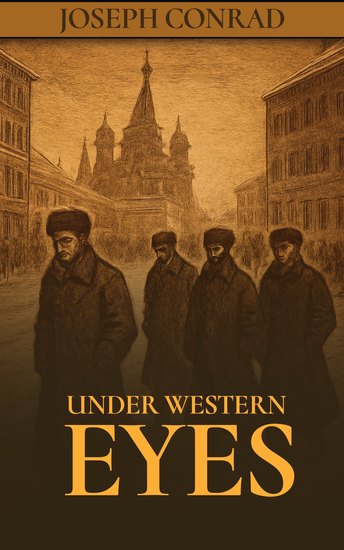
Under Western Eyes - cover

Under Western Eyes

Joseph Conrad

Maison d'édition: CLXBX

  • 0
  • 0
  • 0

Synopsis

Under Western Eyes is Joseph Conrad's penetrating novel of political idealism, betrayal, and moral isolation, set against the turbulent world of early twentieth-century Russian revolutionary movements. Dark, introspective, and psychologically complex, the novel offers a profound exploration of conscience under the weight of political extremism.

The story follows Razumov, a reserved and ambitious university student in St. Petersburg whose quiet life is shattered when a revolutionary assassin seeks refuge in his room. Faced with an impossible moral dilemma, Razumov makes a choice that binds him irrevocably to the revolutionary cause he neither believes in nor fully understands. His decision leads to exile, surveillance, and a life governed by fear and self-betrayal.

Narrated by an English teacher living abroad, the novel unfolds through layered perspectives that emphasize misunderstanding, cultural distance, and moral ambiguity. Conrad deliberately distances the reader from certainty, mirroring Razumov's growing alienation and inner turmoil.

As Razumov becomes entangled with exiled revolutionaries in Geneva, Conrad exposes the contradictions of political idealism and the emotional cost of living under constant suspicion. The novel scrutinizes the destructive power of ideology—on individuals, relationships, and moral integrity.

Somber, ironic, and intensely reflective, Under Western Eyes stands alongside The Secret Agent as one of Conrad's most important political novels. It is a haunting meditation on guilt, responsibility, and the price of silence in a world dominated by ideological conflict.
Disponible depuis: 07/02/2026.
Longueur d'impression: 393 pages.

D'autres livres qui pourraient vous intéresser

  • Edgar Allan Poe - Selected Tales (Volume 2) - cover

    Edgar Allan Poe - Selected Tales...

    Edgar Allan Poe

    • 0
    • 0
    • 0
    Though he is most often remembered as the architect of the modern tale of terror, Edgar Allan Poe's short fiction ranges far beyond the confines of the macabre. In these 13 selected stories, he deals not merely with fear, but with consciousness itself: its obsessions, its perversities, its fragile hold upon identity, memory, and reason. 
    Ligeia – A meditation on beauty, intellect, and the terrifying possibility that the will may conquer death itself. 
    Berenice – A stark study of monomania, in which intellectual obsession descends into horror. 
    Eleonora – A gentle tale, exploring idealised love, memory, and the redemptive power of beauty. 
    Morella – A dark philosophical romance concerning the persistence of the self beyond death. 
    Three Sundays in a Week – A playful tale of ingenuity and deception. 
    The Imp of the Perverse – Poe’s chilling exploration of the irrational impulse that drives us toward self-destruction. 
    The Assignation – A tale of passion and fatalism, set against a decaying aristocratic world . 
    The Facts in the Case of M. Valdemar – A disturbing experiment at the border of life and death, told with clinical precision. 
    The Cask of Amontillado – A masterclass in cool revenge, where pride, cruelty, and calculation lead to perfect atrocity. 
    Silence – A Fable – A haunting parable about the terror of absolute stillness. 
    Shadow – A Parable – A solemn meditation on death and inevitability. 
    The Man of the Crowd – An early exploration of urban alienation and the unsettling mystery of the unknowable individual. 
    Some Words with a Mummy – A sharp satire skewering modern arrogance through an encounter with the ancient past.
    Voir livre
  • The Bird of Popular Song - cover

    The Bird of Popular Song

    Hans Christian Andersen

    • 0
    • 0
    • 0
    The Bird of Popular Song is one of Hans Christian Andersen’s most profound and lyrical meditations on memory, voice, and cultural inheritance. Set against the vast stillness of a northern winter, the story unfolds as a reflection on how song preserves what time and silence would otherwise erase. 
    From a snowbound world of buried towns, forgotten heroes, and frozen nights, Andersen traces the enduring power of popular song—the living voice that carries history, faith, love, and identity from one generation to the next. Kings may vanish, cities may lie hidden beneath snow, and names may fade from stone, but song survives, moving freely across mountains and centuries, awakening remembrance in the human heart. 
    Blending myth, folklore, and spiritual reflection, this is not a fairy tale of spectacle, but a quiet, resonant allegory about the immortality of the spoken and sung word. The Bird of Popular Song becomes the voice of a people—gentle, faithful, and eternal—speaking in the language of home even in the darkest winter. 
    Narrated with clarity and reverence by Jerry Dugan, this audiobook offers listeners a contemplative experience—timeless, dignified, and deeply human—reminding us that while history may sleep beneath snow, its song is never lost.
    Voir livre
  • Twelfth Night | Shakespeare for kids - Shakespeare in a language kids will understand and love - cover

    Twelfth Night | Shakespeare for...

    Jeanette Vigon

    • 0
    • 0
    • 0
    Embark on a magical journey into "Twelfth Night," a place where the serene coastlines of Illyria become the backdrop for a whimsical tale of love, disguise, and festive revelry. This isn't just another comedy; it's an intricate dance of affection, identity, and the pursuit of true happiness, masterfully adapted for young readers. 
    Why "Twelfth Night" is a must-read for young adventurers:Timeless Tale, New Perspective: Dive into Shakespeare's beloved story, reimagined for children, maintaining the original acts and scenes for an authentic experience.Enchanting Characters: Meet Viola, Sebastian, and a vibrant cast entangled in a web of love and playful schemes, teaching lessons of loyalty, sincerity, and the folly of arrogance.Educational and Entertaining: Designed to bridge the gap between Shakespeare's rich narratives and the imaginative worlds of young readers, fostering a love for literature that will grow with them.Accessible Literary Language: Experience the beauty of Shakespeare's works in a form that's engaging and understandable, stimulating intellectual curiosity without overwhelming.Appropriate and Thoughtful: Enjoy themes and scenes carefully chosen for young audiences, presenting lessons of love, loyalty, and justice in a captivating manner. 
    Ready your heart for laughter, prepare to be charmed, and let's embark on this delightful adventure. Discover "Twelfth Night," where every twist of fate is a step closer to joy, every laugh a note in the symphony of life, and every ending a light towards understanding love's true essence.
    Voir livre
  • The Voyage Out - cover

    The Voyage Out

    Virginia Woolf

    • 0
    • 0
    • 0
    The Voyage Out is the first novel by Virginia Woolf, published in 1915 by Duckworth.
    Woolf began work on The Voyage Out by 1910 (perhaps as early as 1907) and had finished an early draft by 1912. The novel had a long and difficult gestation; it was not published until 1915, as it was written during a period in which Woolf was especially psychologically vulnerable. She suffered from periods of depression and at one point attempted suicide. The resultant work contained the seeds of all that would blossom in her later work: the innovative narrative style, the focus on feminine consciousness, sexuality and death.
    Voir livre
  • The Adventure of the Second Stain - cover

    The Adventure of the Second Stain

    Sir Arthur Conan Doyle

    • 0
    • 0
    • 0
    Holmes must recover a highly inflammatory stolen document, which may result in a world war if its contents become known to certain parties. Then a murder further complicates the desperate situation.
    Voir livre
  • A Journey of Little Profit - From their pens to your ears genius in every story - cover

    A Journey of Little Profit -...

    John Buchan

    • 0
    • 0
    • 0
    The Scottish novelist John Buchan enjoyed a remarkable career as politician, historian and Governor General. He was born John Buchan on 26th August 1875 and later added 1st Baron Tweedsmuir PC GCMG GCVO CH to his name.  
    Buchan studied at Hutchesons’ Grammar School, Glasgow and at seventeen won a scholarship to the University of Glasgow to study classics. There he began to write poetry. In 1895 he transferred to Oxford to continue his study of Classics and in 1896 ‘Sir Quixote of the Moors’ was published followed by the non-fiction ‘Scholar-Gipsies’. His prolific literary output now hardly faltered. 
    He graduated in 1900 and became the private secretary to Alfred Milner, the High Commissioner for Southern Africa and other colonies. Buchan found the same inspiration in the African landscape as he had in the Scottish Borders, and would later set many works here. Returning to London he became a partner in a publishing house, and garnered an editorial role at The Spectator. He also completed his law studies. He was called to the bar in 1901 but never practiced.  
    On 15th July 1907 Buchan married Susan Charlotte Grosvenor, the cousin of the Duke of Westminster. In 1910 he wrote ‘Prester John’, the first of a series set in South Africa.  
    In 1911 Buchan entered politics as a Unionist candidate in the Scottish Borders advocating the support of free trade, women’s suffrage, national insurance, and reducing the power of the House of Lords.  
    The Great War saw Buchan writing for the War Propaganda Bureau and as Times correspondent in France. In 1915, he published ‘The Thirty-Nine Steps’, his most famous book and a follow-up Richard Hannay novel, ‘Greenmantle’, in 1916.  
    In 1916 Buchan enlisted in the Intelligence Corps which included writing speeches for Sir Douglas Haig. By 1917 he was Director of Information under Lord Beaverbrook. Buchan called it “the toughest job he ever took on”. He somehow found time to assist in a history of the war magazine. This was later published in 24 volumes: Nelson’s History of the War. 
    After the war his writing focused on historical studies. In 1927 Buchan became the Unionist Party Member of Parliament for the Combined Scottish Universities. In a speech to Parliament he said “I believe every Scotsman should be a Scottish nationalist. If it could be proved that a Scottish parliament were desirable… Scotsmen should support it.”  
    Over the next decade he continued to distinguish himself politically and in literature.  On the 1st June 1935 he became 1st Baron Tweedsmuir of Elsfield in the County of Oxford.  
    He was now also given the position of Governor General in Canada and resolved to travel all over Canada to gain a better insight of the country. Having crossed both length and breadth he saw the cultural shift between areas and their common ground and helped bring about a clear national Canadian identity. 
    On the 6th February 1940 he collapsed from a stroke and sustained a very serious head injury in falling. Two rounds of surgery to stabilise his condition were unsuccessful and Buchan died on the 11th February. After a state funeral in Ottawa his ashes were returned to his estate in Oxfordshire.
    Voir livre