¡Acompáñanos a viajar por el mundo de los libros!
Añadir este libro a la estantería
Grey
Escribe un nuevo comentario Default profile 50px
Grey
Suscríbete para leer el libro completo o lee las primeras páginas gratis.
All characters reduced
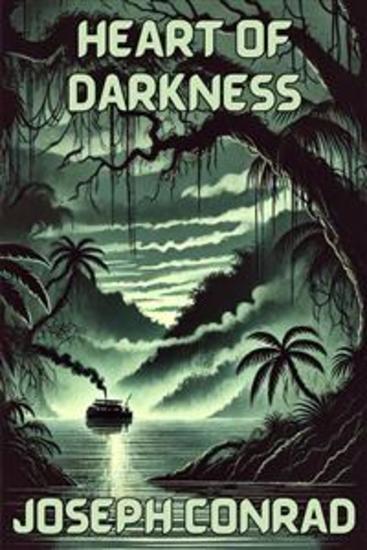
Heart Of Darkness(Illustrated) - cover

Heart Of Darkness(Illustrated)

Joseph Conrad

Editorial: Swish

  • 0
  • 0
  • 0

Sinopsis

Illustrated Edition featuring 20 captivating illustrations
	Includes a comprehensive summary
	Contains a detailed character list
	Features a biography of author Joseph Conrad

Heart of Darkness by Joseph Conrad is a timeless novella that plunges readers into the heart of both the African Congo and the human soul. In this gripping story, follow Charles Marlow as he embarks on a journey to retrieve Kurtz, a powerful and enigmatic ivory trader who has descended into madness deep in the jungle.
As Marlow ventures into the dense, mysterious wilderness, he uncovers the horrifying realities of European imperialism, moral decay, and the thin veil that separates civilization from savagery. Along the way, readers encounter vivid depictions of the Congo's haunting landscape and its oppressive atmosphere, reflecting the inner turmoil of the characters.
In this illustrated edition, 20 stunning images bring Conrad's haunting scenes to life, offering a visual journey alongside the powerful narrative. Additionally, readers will find a summary, a detailed character list, and a biography of Joseph Conrad, providing a deeper understanding of the story and its historical context.
Immerse yourself in this extraordinary tale of darkness, discovery, and the fragility of the human soul. Heart of Darkness remains one of literature’s most powerful examinations of the human condition, an essential read for both new readers and long-time fans of Conrad's work.
 
Disponible desde: 02/11/2024.

Otros libros que te pueden interesar

  • The Murders in the Rue Morgue - cover

    The Murders in the Rue Morgue

    Edgar Allan Poe

    • 0
    • 0
    • 0
    The Murders in the Rue Morgue is a short story by Edgar Allan Poe published in Graham's Magazine in 1841. It has been recognized as the first modern detective story; Poe referred to it as one of his "tales of ratiocination". Two works that share some similarities predate Poe's stories, including Das Fräulein von Scuderi (1819) by E. T. A. Hoffmann and Zadig (1747) by Voltaire. C. Auguste Dupin is a man in Paris who solves the mystery of the brutal murder of two women. Numerous witnesses heard a suspect, though no one agrees on what language was spoken.     At the murder scene, Dupin finds a hair that does not appear to be human. As the first fictional detective, Poe's Dupin displays many traits which became literary conventions in subsequent fictional detectives, including Sherlock Holmes and Hercule Poirot. Many later characters, for example, follow Poe's model of the brilliant detective, his personal friend who serves as narrator, and the final revelation being presented before the reasoning that leads up to it. Dupin himself reappears in "The Mystery of Marie Rogêt" and "The Purloined Letter".
    Ver libro
  • The Man Who Would Be King - cover

    The Man Who Would Be King

    Rudyard Kipling

    • 0
    • 0
    • 0
    "The Man Who Would Be King" is a novella written by British author Rudyard Kipling. It was first published in 1888 as part of Kipling's collection "The Phantom 'Rickshaw and other Eerie Tales." The novella is known for its adventure, exploration, and themes related to imperialism and cultural clash. 
     
    The story follows the adventures of two British soldiers, Daniel Dravot and Peachey Carnehan, who have become disillusioned with their lives in the British Army stationed in India. They decide to leave the army and embark on a journey to the remote, fictional land of Kafiristan, located in the mountains of Afghanistan. In Kafiristan, they plan to establish themselves as god-like rulers and exploit the region's wealth and resources. 
     
    Their journey is fraught with challenges, but the two men manage to impress the local people with their superior knowledge and advanced weaponry. They are hailed as gods and establish themselves as rulers. However, as time passes, their ambition, arrogance, and desire for power lead to a series of events that result in a dramatic and tragic conclusion. 
     
    "The Man Who Would Be King" explores themes of colonialism, cultural clash, and the consequences of unchecked ambition. It is a cautionary tale that illustrates the dangers of imperialism and the hubris of those who believe they can manipulate foreign cultures for their own gain. 
     
    The novella has been adapted into various forms over the years, including a highly regarded 1975 film directed by John Huston, starring Sean Connery as Daniel Dravot and Michael Caine as Peachey Carnehan. The story's enduring appeal lies in its examination of the human desire for power and the consequences of attempting to subjugate foreign lands and cultures.
    Ver libro
  • Don Quixote: Book Summary & Analysis - cover

    Don Quixote: Book Summary &...

    Briefly Summaries

    • 0
    • 0
    • 0
    This is a concise summary and analysis of  Don Quixote, by Miguel de Cervantes Saavedra.
     
    It is not the original book and is not affiliated with or endorsed by Miguel de Cervantes Saavedra.
     
    Ideal those seeking a quick and insightful overview.


    A timeless tale of adventure, imagination, and folly, Don Quixote follows the exploits of a delusional yet noble-hearted Spanish nobleman who, inspired by chivalric romances, sets out on a quest to revive knighthood. Accompanied by his loyal squire, Sancho Panza, he battles windmills, confronts bandits, and pursues his ideal of justice, often with humorous and tragic results. This novel is a brilliant satire of medieval ideals and a profound meditation on reality, identity, and the power of storytelling.
    Ver libro
  • A Little Woman - A man tries to appease a woman frustrated with him in true Kafkaesque fashion - cover

    A Little Woman - A man tries to...

    Franz Kafka

    • 0
    • 0
    • 0
    Franz Kafka was born on 3rd July 1883 in Prague, then in Bohemia, the eldest of 6, into a middle-class Jewish family. 
     
    Life for the young Kafka and his passion for literature was often made an ordeal by his over-bearing and domineering entrepreneur of a father.   
     
    In 1889 Kafka was sent to the Deutsche Knabenschule, an elementary school in Prague. His father would only allow him to be educated in German-speaking schools and even went so far as to limit visits to the synagogue to four a year. 
     
    In 1901 he graduated from the classics-oriented Altstädter Gymnasium. Kafka did well there and across a large range of subjects.  He now enrolled at the Charles Ferdinand University, to study chemistry, but quickly switched to law for which he obtained his degree in June 1906 and then performed the mandatory year of unpaid service as clerk at the civil and criminal courts. 
     
    A job at an Italian insurance company left him little time to write and after a year he took another job with the Worker's Accident Insurance Institute for the Kingdom of Bohemia where he stayed until ill health led to his resignation in 1922. 
     
    Although he saw work as a means to pay the bills and to allow him time to write, he received several promotions and was noted as a good employee. 
     
    By 1917 Kafka was suffering from tuberculosis, which required frequent periods of convalescence. Interspersed with this, were several intense affairs before he settled in Berlin with Dora Diamant, a 25-year-old kindergarten teacher who herself having left the ghetto now influenced Kafka's interest in the book of Jewish law, the Talmud. 
     
    Kafka’s on-going health was littered with problems. Apart from TB there were several other ailments, including migraines, insomnia, boils, depression, all usually brought on by excessive stresses and strains. He attempted to counteract all of this by naturopathic treatments, a vegetarian diet and consuming large quantities of unpasteurized milk. 
     
    His tuberculosis still worsened. He returned to Prague, where he died on 3rd June 1924. He was 40. 
     
    His literary works are few in number but towering in influence.  His masterpieces include ‘The Trial’, ‘The Metamorphosis’ as well as a number of short stories which reveal facets of humankind that truthfully could only be born from Kafka’s brain and pen.
    Ver libro
  • Dracula - A Full Cast Audio Drama - cover

    Dracula - A Full Cast Audio Drama

    Hamilton Deane, John L. Balderston

    • 0
    • 0
    • 0
    This full-cast performance of Dracula offers a new way to experience Bram Stoker's seminal vampire story, which follows Abraham Van Helsing's efforts to track down Lucy Seward after she becomes the victim of Count Dracula. Originally written by Irish playwright Hamilton Deane, this stage play was the first authorized adaptation of the 1897 epistolary novel Dracula. Beginning a tour in England in 1924, it was then revised by American writer John L. Balderstone for a Broadway production that opened in October, 1927, featuring Hungarian-American actor Bela Lugosi in his first English-language role. Balderstone's revision would become the basis of the 1931 film adaptation, also starring Lugosi. The play was revived in 1977, receiving the Tony Award for Best Revival and leading to the 1979 film, both starring Frank Langella.
    Ver libro
  • The Autobiography of an Ex-Colored Man - cover

    The Autobiography of an...

    James Weldon Johnson

    • 0
    • 0
    • 0
    "The Autobiography of an Ex-Colored Man" by James Weldon Johnson is a captivating novel that delves into the complexities of racial identity and the quest for self-discovery. Let me take you on a journey through its pages.James Weldon Johnson's emotionally gripping novel is a landmark in black literary history and, more than eighty years after its original anonymous publication, a classic of American fiction.
    Ver libro