Join us on a literary world trip!
Add this book to bookshelf
Grey
Write a new comment Default profile 50px
Grey
Subscribe to read the full book or read the first pages for free!
All characters reduced
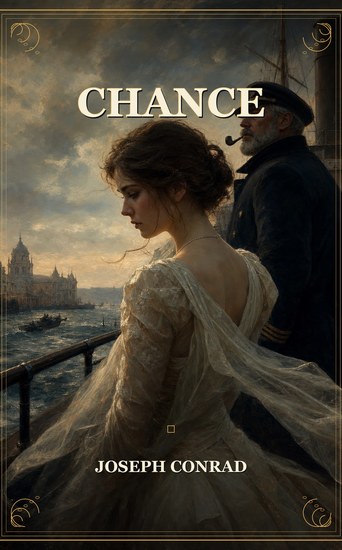
Chance - cover

Chance

Joseph Conrad

Publisher: Caelwick Press

  • 0
  • 0
  • 0

Summary

We rely on your support to help us keep producing beautiful, free, and unrestricted editions of literature for the digital age. Will you support our efforts with a donation ? Flora de Barral is the daughter of a successful banker. When he's tried and convicted of fraud, her prosperous life turns miserable. While on the brink of suicide, she meets an older sea captain and marries him as a means of escape. Her dramatic life is recounted by several characters, but mainly by Marlow, Conrad's favorite recurring narrator. Chance , serialized in 1912 and published as a book the following year, is Conrad's only novel with a female protagonist. It was also his first commercially successful novel, despite its complex narrative structure. Joseph Conrad (died 1924) was a major literary figure of the early 20th century. Their work has endured across generations and continues to be read and studied worldwide. As a work of classic literary fiction, Chance exemplifies the narrative craft and social insight that defined great storytelling of its era. Literary fiction of this period was characterized by careful attention to character psychology, social milieu, and the moral questions that animated public discourse.
Available since: 05/19/2026.
Print length: 480 pages.
Other books that might interest you

  • Little Dorrit - cover

    Little Dorrit

    Charles Dickens

    • 0
    • 0
    • 0
    Little Dorrit , like many of Charles Dickens' novels, was originally published in serial form over a period of about 18 months, before appearing in book form in 1857. The novel focuses on the experiences of its protagonist Arthur Clenham, who has spent some twenty years in China helping his father run the family business there. After his father dies, Arthur returns home to London. His mother gives him little in the way of welcome. She is a cold, bitter woman who has brought Arthur up under a strict religious regime concentrating on the punitive aspects of the Old Testament. Despite this upbringing, or perhaps in reaction to it, Arthur is a kind, considerate man. He is intrigued by a slight young woman he encounters working as a part-time seamstress for his mother, whom his mother calls simply "Little Dorrit." Arthur senses some mystery about her mother's employment of Little Dorrit, and proceeds to investigate. There are several subplots and a whole host of characters. Compared to some of Dickens' work, Little Dorrit features a good deal of intrigue and tension. There are also some strong strands of humor, in the form of the fictional "Circumlocution Office," whose sole remit is "How Not To Do It," and which stands in the way of any improvement of British life. Also very amusing are the rambling speeches of Flora, a woman with whom Arthur was enamored before he left for China, but whose shallowness he now perceives only too well. Little Dorrit has been adapted for the screen many times, and by the BBC in 2010 in a limited television series which featured Claire Foy as Little Dorrit, Matthew Macfayden as Arthur Clenham, and Andy Serkis as the villain Rigaud.
    Show book
  • The Orwell Huxley Anthology - 1984 Brave New World Twin Bios - cover

    The Orwell Huxley Anthology -...

    George Orwell, Aldous Huxley

    • 0
    • 0
    • 0
    1984 by George Orwell and Brave New World by Aldous Huxley are two of the most famous and influential dystopian novels ever written. Both books depict a future world in which individual freedom and privacy are subordinated to the demands of a totalitarian state, and citizens are manipulated and controlled through technology, propaganda, and social conditioning. 
     
    1984 is set in a grim, authoritarian society in which all citizens are monitored and controlled by the ruling Party. The novel's protagonist, Winston Smith, begins to question the oppressive regime and becomes involved in a dangerous and ultimately doomed rebellion. Orwell's writing in 1984 is characterized by its stark realism and its unflinching depiction of the horrors of totalitarianism. The novel remains a powerful warning about the dangers of unchecked government power and the importance of individual freedom. 
     
    Brave New World, on the other hand, is set in a more technologically advanced and ostensibly utopian society, in which citizens are conditioned from birth to be content with their predetermined place in the social hierarchy. The novel's protagonist, Bernard Marx, rebels against the conformity and emptiness of his society, but ultimately finds himself unable to escape its grip. Huxley's writing in Brave New World is characterized by its irony and satire, as well as its incisive critique of the impact of technology on human nature. 
    . The two novels have often been compared and contrasted, and both are considered to be among the most important works of literature of the 20th century. 
     
    Here is the ultimate Audiobook celebration of this great enduring artist narrated by Emmy-nominated actor and author Geoffrey Giuliano.
    Show book
  • Imaginary Portraits - cover

    Imaginary Portraits

    Walter Pater

    • 0
    • 0
    • 0
    Four invented lives, each a study in what a mind does with beauty: a Watteau seen through a girl's diary, a Dutch philosopher, a German prince, a young Frenchman. Pater's conclusion to The Renaissance — that we should burn with a hard, gemlike flame — became the motto of the aesthetes and frightened him so much he withdrew it; these 1887 pieces are that argument made into people.
    Show book
  • The Strange Case of Dr Jekyll and Mr Hyde - cover

    The Strange Case of Dr Jekyll...

    Robert Louis Stevenson

    • 0
    • 0
    • 0
    This audiobook is narrated by an AI Voice. "The Strange Case of Dr Jekyll and Mr Hyde" by Robert Louis Stevenson is a classic gothic novella exploring the both the good and evil sides of human nature. 
     
     Seeking to isolate his darker impulses, Dr. Jekyll develops a potion.  Drinking it transforms him into Edward Hyde - a smaller, younger, and purely evil persona.  Jekyll enjoys the freedom of being Hyde, who commits violent acts, such as trampling a child and murdering Sir Danvers Carew. Jekyll maintains a separate home for Hyde. 
     
    Jekyll finds himself turning into Hyde involuntarily, even without the potion. The potion begins to lose its effectiveness, as the salt used for it was impure.  Hyde takes over completely, and Jekyll locks himself in his laboratory, eventually running out of the necessary ingredients for the potion. 
     
    Jekyll loses control as Hyde takes over fully, leading them both to their deaths.
    Show book
  • The Black Cat - cover

    The Black Cat

    Edgar Allan Poe

    • 0
    • 0
    • 0
    Enter the chilling world of Edgar Allan Poe with "The Black Cat," the fourth part of an Edgar Allan Poe short story collection, narrated by Jake Urry. This dark tale follows a man whose descent into madness leads him to commit horrifying acts against those he loves, spurred by his obsession with a sinister black cat. As his guilt and paranoia intensify, the story spirals toward a terrifying conclusion. 
    Jake Urry's gripping narration captures the macabre and psychological complexity of Poe's story, making this audiobook an enthralling experience. His evocative voice and expert pacing bring the horror and suspense to life, immersing listeners in a tale of guilt, terror, and the supernatural.
    Show book
  • The Portrait of a Lady - cover

    The Portrait of a Lady

    Henry James

    • 0
    • 0
    • 0
    A young American woman inherits a fortune she did not ask for and is thereby made free to choose — which is the trap. James thought this his most perfect design: an heiress, three suitors, an expatriate circle in Florence and Rome, and a marriage entered into for the noblest reason and the worst judgment. He revised it heavily in old age, and readers still argue about which version to read. This edition brings together the complete work — both volumes in one.
    Show book