¡Acompáñanos a viajar por el mundo de los libros!
Añadir este libro a la estantería
Grey
Escribe un nuevo comentario Default profile 50px
Grey
Suscríbete para leer el libro completo o lee las primeras páginas gratis.
All characters reduced
Perfil de nuestras letras - cover

Perfil de nuestras letras

Jorge Mañach

Editorial: Linkgua

  • 0
  • 0
  • 0

Sinopsis

Como él mismo Jorge Mañach señala, Perfil de nuestras letras surgió de una sugerencia de la dirección del periódico Diario de la Marina, para que comenzase a redactar una serie de artículos en los cuales desarrollara algún tema continuo. Entre febrero de 1947 y octubre de 1948 publicó 34 trabajos, que siempre salían en la edición dominical y en la página de Opinión (esto último solo se alteró en una ocasión). Al cabo de casi ocho años, en mayo de 1956 decidió continuar la serie "por algún tiempo más". Lo hizo hasta comienzos de agosto de ese año. En esta segunda entrega, la serie mantuvo el espacio dominical hasta fines de junio, cuando pasó a salir indistintamente miércoles, jueves o viernes. Asimismo desde mayo redujo el nombre a Nuestras letras.


Edición a cargo de: Carlos Espinosa.
Disponible desde: 01/04/2019.
Longitud de impresión: 194 páginas.

Otros libros que te pueden interesar

  • Make Bold Choices Today for the Life You Desire Tomorrow - "Embrace bold choices today and unlock the life you desire with our transformative audio lessons!" - cover

    Make Bold Choices Today for the...

    Orson Merriweather

    • 0
    • 0
    • 0
    Make Bold Choices Today for the Life You Desire Tomorrow 
    ⭐⭐ Simplified Guide & Explanations Included ⭐⭐ 
    Are you eager to advance in your career and enhance your understanding by successfully navigating transformative decisions? 
    Searching for a comprehensive resource that encompasses everything you need for personal and professional growth? 
    Your search ends here! 
    This guide is your ultimate companion for fostering your understanding, applying actionable strategies, and engaging in practical exercises. With this, you're poised for success. 
    Updated for the latest approaches to personal and professional life transformation. 
    Key features of this enhanced guide: 
    - In-depth insights about empowering your journey through bold, transformative decisions 
    - Detailed explanations of the choices that can reshape your future 
    - Effective strategies for preparation and execution of your decisions 
    Our guide sets itself apart through thorough coverage, essential for your journey to success. Concepts are not simply mentioned; they are explored with clarity. 
    Please be aware that this guide is an independent resource and not affiliated with any official organization. 
    Crafted with a clear structure and straightforward language, our guide ensures seamless transitions between topics. Say goodbye to convoluted jargon and embrace clear, precise, and technically sound content. 
    So, why wait? Click the BUY NOW button, grab your guide, and embark on your journey to a fulfilling life through bold choices!  
    Make bold choices today for the life you desire tomorrow!
    Ver libro
  • The Notebook - A History of Thinking on Paper - cover

    The Notebook - A History of...

    Roland Allen

    • 0
    • 0
    • 0
    A Kirkus Most Anticipated Book of Fall 2024 


    We see notebooks everywhere we go. But where did these indispensable implements come from? How did they revolutionize our lives? And how can using a notebook help change the way you think? In this wide-ranging history, Roland Allen reveals how the notebook became our most dependable and versatile tool for creative thinking. He tells the notebook stories of Leonardo and Frida Kahlo, Isaac Newton and Marie Curie, and writers from Chaucer to Henry James; shows how Darwin developed his theory of evolution in tiny pocket books and Agatha Christie plotted a hundred murders in scrappy exercise books; and introduces a host of cooks, kings, sailors, fishermen, musicians, engineers, politicians, adventurers, and mathematicians, all of whom used their notebooks as a space to think—and in doing so, shaped the modern world. 


    In an age of AI and digital overload, the humble notebook is more relevant than ever. Allen shows how bullet points can combat ADHD, journals can ease PTSD, and patient diaries soften the trauma of reawakening from coma. The everyday act of moving a pen across paper, he finds, can have profound consequences, changing the way we think and feel: making us more creative, more productive—and maybe even happier.
    Ver libro
  • Life in the Clearings Versus the Bush - cover

    Life in the Clearings Versus the...

    Susanna Moodie

    • 0
    • 0
    • 0
    As a middle class Englishwoman Moodie did not particularly enjoy "the bush", as she called it. She and her husband moved to Belleville in 1840, which she referred to as "the clearings". Here she described urban life, including religion, art, and education, especially as compared to relative lack of these things in "the bush". She studied the Family Compact and became sympathetic to the moderate reformers led by Robert Baldwin, while remaining critical of radical reformers such as William Lyon Mackenzie. This caused problems for her husband, who shared her views, but, as sheriff of Belleville, had to work with members and supporters of the Family Compact. (Summary from Wikipedia)This was read as a duet by Cori Samuel and Esther. Joined in section 9 by Jim Mowatt, and in section 12 by Glen Hallstrom.
    Ver libro
  • Virtual Searches - Regulating the Covert World of Technological Policing - cover

    Virtual Searches - Regulating...

    Christopher Slobogin

    • 0
    • 0
    • 0
    A host of technologies—including digital cameras, drones, facial recognition devices, night-vision binoculars, automated license plate readers, GPS, geofencing, DNA matching, datamining, and artificial intelligence—have enabled police to carry out much of their work without leaving the office or squad car, in ways that do not easily fit the traditional physical search and seizure model envisioned by the framers of the Constitution. Virtual Searches develops a useful typology for sorting through this bewildering array of old, new, and soon-to-arrive policing techniques. It then lays out a framework for regulating their use that expands the Fourth Amendment's privacy protections without blindly imposing its warrant requirement, and that prioritizes democratic over judicial policymaking. 


    The coherent regulatory regime developed in Virtual Searches ensures that police are held accountable for their use of technology without denying them the increased efficiency it provides in their efforts to protect the public. Whether policing agencies are pursuing an identified suspect, constructing profiles of likely perpetrators, trying to find matches with crime scene evidence, collecting data to help with these tasks, or using private companies to do so, this book provides a template for ensuring their actions are constitutionally legitimate and responsive to the polity.
    Ver libro
  • The Democratic Marketplace - How a More Equal Economy Can Save Our Political Ideals - cover

    The Democratic Marketplace - How...

    Elisa Herzog

    • 0
    • 0
    • 0
    Democracy has been hollowed out by capitalism. A narrow view of markets and their aims now dominates thinking about democracy itself. Citizens are ignorant of the deep principles of self-governance, having long since adopted a facile equation between democracy and voting as a consumer choice. Lisa Herzog argues that democracy is still possible, but only if democratic values get embedded in everyday experience―including economic experience. That requires new ways of thinking about markets and their goals. 


    The Democratic Marketplace theorizes the foundational structures of a democratic economy, in which markets are not just tools for maximizing profit via exploitation and extraction. To this end, employees are empowered to participate in corporate governance. Economic disparities are curbed so that citizens can negotiate their inevitable differences on a truly equal footing. And while a democratic economy need not eschew growth, it does renounce today's growth-at-all-costs expectations, instead balancing growth with goals like ecological sustainability and the preservation of time outside of work. 


    These are not utopian dreams, Herzog contends. The proposals that follow from the theory of democratic economics are already being tested around the world. And the shift in social norms that they necessitate is already under way.
    Ver libro
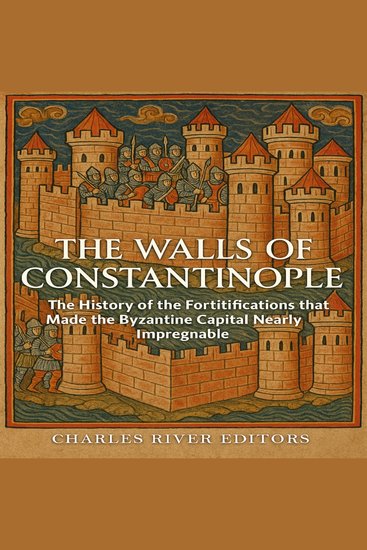
  • Walls of Constantinople The: The History of the Fortifications that Made the Byzantine Capital Nearly Impregnable - cover

    Walls of Constantinople The: The...

    Charles River Editors

    • 0
    • 0
    • 0
    In terms of geopolitics, perhaps the most seminal event of the Middle Ages was the successful Ottoman siege of Constantinople in 1453. Naturally, the Ottoman Empire would also use Constantinople as the capital of its empire after their conquest effectively ended the Byzantine Empire, and thanks to its strategic location, it has been a trading center for years and remains one today under the Turkish name of Istanbul. The end of the Byzantine Empire had a profound effect not only on the Middle East but Europe as well. Constantinople had played a crucial part in the Crusades, and the fall of the Byzantines meant that the Ottomans now shared a border with Europe. The Ottomans were viewed as a threat by the predominantly Christian continent to their west, and it took little time for different European nations to start clashing with them. In fact, the Ottomans would clash with Russians, Austrians, Venetians, Polish, and more before collapsing as a result of World War I, when they were part of the Central Powers.  
    Of course, it wasn’t an accident that Constantinople survived for so long. Since ancient times, settlements have been protected by walls, ranging from simple earth fortifications, mounds, and ditches to sophisticated structures incorporating gates and watchtowers. The globe is replete with famous walls such as that built by Hadrian in the north of England and the Great Wall of China, which spans hundreds of miles across a vast landscape. Some of the earliest evidence of defensive walling can be found in Africa, and the Bible includes references to the walls of Jericho, dating back to at least the 8th century BCE. Walls have protected great civilizations and occasionally been their downfall, and the Byzantine Empire relied on Constantinople’s extensive, sophisticated walls, among the greatest engineering achievements of the ancient world and Early Middle Ages, to survive as long as it did. 
    Ver libro