¡Acompáñanos a viajar por el mundo de los libros!
Añadir este libro a la estantería
Grey
Escribe un nuevo comentario Default profile 50px
Grey
Suscríbete para leer el libro completo o lee las primeras páginas gratis.
All characters reduced
Law of Attraction - Unleash Your Dreams and Destiny Through Powerful Manifestation and Meditation - cover

Law of Attraction - Unleash Your Dreams and Destiny Through Powerful Manifestation and Meditation

Jordan Hollis

Editorial: Publishdrive

  • 0
  • 2
  • 0

Sinopsis

How to Finally Overcome the Hurdles of ManifestingProven, effective and enjoyable ways to help you manifest faster…Right now, think of something that makes you successful. If you have something in your mind but you don't know how to achieve them, This book will show you how! Before you learn how to master it, you need to understand Law of Attraction. This book is designed for beginners who are clueless about Law of Attraction. It provides a Non-repetitive daily step-by-step guide in manifestation just for you so that you can absorb and practice them. It works because it only takes 1 hour of your time each day.If anyone can do it, you can do it too!The law of attraction is a physical law of the universe that is working 24/7. It can work for you or against you. The law will work against you if you fail to grasp the important key concepts. In this book, I'm going to share with you how you can ensure your success and never make the mistake that so many people make, which is attracting what they don't want rather than what they desire. This book will teach you step-by-no fluff-step how to operate the law of attraction successfully. The information is practical, inviting, lenient, friendly and insightful. This approach has worked for many to attract the good they deserve, and it will work for you too, if you let it.Channel your desires into reality with simple actions.Download your copy today!
Disponible desde: 29/08/2018.

Otros libros que te pueden interesar

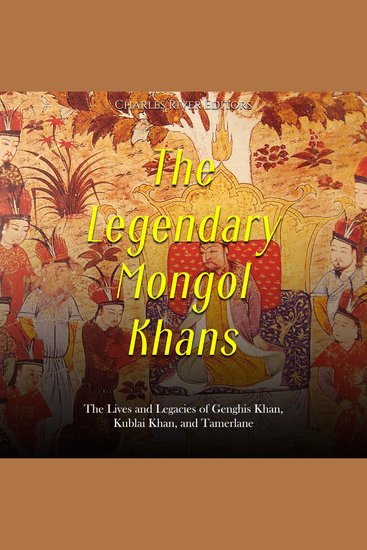
  • Legendary Mongol Khans The: The Lives and Legacies of Genghis Khan Kublai Khan and Tamerlane - cover

    Legendary Mongol Khans The: The...

    Editors Charles River

    • 0
    • 0
    • 0
    Though history is usually written by the victors, the lack of a particularly strong writing tradition from the Mongols ensured that history was largely written by those who Genghis Khan vanquished. Because of this, Genghis Khan’s portrayal in the West and the Middle East has been extraordinarily (and in many ways unfairly) negative for centuries, at least until recent revisions to the historical record. Certainly Genghis Khan was not a peaceful man, or a particularly merciful one, and he famously boasted to the Khwaremzids that he was “the flail of God, come to punish you for your sins”. However, the image of him as a bloodthirsty barbarian is largely the result of hostile propaganda.  
    As Great Khan, Kublai Khan ruled the Mongolian Empire from his capital in modern-day Beijing, with a court that included Mongolians, Arabs, and Persians from throughout his empire. While Genghis may have been a warrior, Kublai was a man of culture, intellect and curiosity, and his court was a luxurious one rich in art, music, and goods. Under his reign, trade along the Silk Road was both easier and more efficient than ever before.  
    Aside from Genghis and his grandson Kublai Khan, the most famous Mongol conqueror was Tamerlane, who dominated Eurasia in the 14th century. He was known by the name Timur in Asia, while the Europeans used the name Tamerlane, which came from the Persian Timur-i-Leng, meaning “Timur the Lame. Tamerlane came from a Turkicized Mongol tribe, the Barlas, which had several constituent sub-clans. A number of original Mongol tribes had migrated west, where the majority of the population was Turkish, and over time, the Mongols blended with the Turks. However, due to his many conquests and his expansive empire, Tamerlane is closely associated with the Mongols today, and while he styled himself a pious leader, his main aim was to reestablish Genghis Khan’s vast Mongol Empire.
    Ver libro
  • Babe Ruth and Ty Cobb: The Lives and Careers of Major League Baseball’s First Superstars - cover

    Babe Ruth and Ty Cobb: The Lives...

    Charles River Editors

    • 0
    • 0
    • 0
    As one of America’s oldest and most beloved sports, baseball has long been touted as the national pastime, but of all the millions of people who have played it over the last few centuries, the first name that many associate with Major League Baseball is Babe Ruth, whose career spanned over 20 years on the way to becoming the sport’s biggest legend. The Bambino came onto the scene as a pitcher for the Boston Red Sox, only to be infamously sold to the rival New York Yankees, where he went on to set records for most home runs (714), runs batted in (2,213), walks (2,062), slugging percentage (.690), and on-base plus slugging (1.164). The Sultan of Swat’s records would take decades to be surpassed, but he also managed to win more than 20 games as a pitcher for Boston, along with three World Series before heading to New York. Boston wouldn’t win another championship for over 80 years after Ruth’s departure, a drought famously referred to as “The Curse of the Bambino.” 
    As if he wasn’t accomplished enough in Boston, Ruth went on to become a pop culture fixture in New York while playing 15 years for the Yankees on some of the sport’s most legendary teams. In addition to leading the Bronx Bombers to four World Series during his time there, Ruth set several single season and career records, elevating the team and MLB itself in ways that athletes could hardly dream of today.  
    	Few have influenced Major League Baseball like Ty Cobb, whose career spanned over 20 seasons. The Georgia Peach overcame early hardships to set nearly 100 MLB records in his time as a player and player-manager for the Detroit Tigers and Philadelphia Athletics. With an MVP and Triple Crown under his belt by the age of 25, Cobb went on to produce statistics that still lead MLB in several categories, including 4,065 combined runs scored and RBIs, a career batting average over .365, and at least 11 batting titles.
    Ver libro
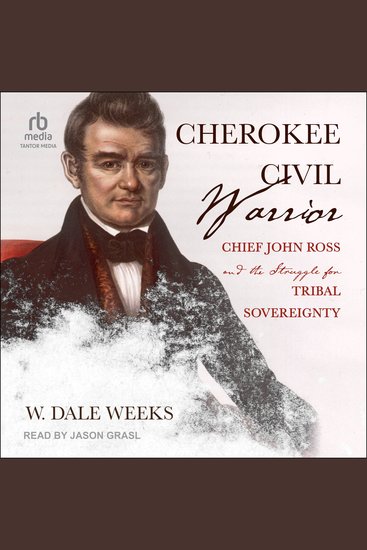
  • Cherokee Civil Warrior - Chief John Ross and the Struggle for Tribal Sovereignty - cover

    Cherokee Civil Warrior - Chief...

    W. Dale Weeks

    • 0
    • 0
    • 0
    John Ross served the Cherokee Nation in a public capacity for nearly fifty years, thirty-eight as its constitutionally elected principal chief. Historian W. Dale Weeks describes Ross's efforts to protect the tribe's interests amid systematic attacks on indigenous culture throughout the nineteenth century. At the outset of the Civil War, Ross called for all Cherokees to remain neutral in a war they did not support—a position that became untenable when the US withdrew its forces from Indian Territory. The vacated forts were quickly occupied by Confederate troops, who pressured the Cherokees to align with the South. 


    Viewed from the Cherokee perspective, these events can be seen in their proper context, as part of the history of US "Indian policy," failed foreign relations, and the Anglo-American conquest of the American West. This approach also clarifies President Lincoln's acknowledgment of the federal government's abrogation of its treaty obligation and his commitment to restoring political relations with the Cherokees—a commitment abruptly ended when Andrew Johnson sought to punish the Cherokees for their perceived disloyalty. 


    Centering a Native point of view, this book recasts and expands what we know about John Ross, the Cherokee Nation, its commitment to maintaining its sovereignty, and the Civil War era in Indian Territory.
    Ver libro
  • City Steps of Pittsburgh - A History & Guide - cover

    City Steps of Pittsburgh - A...

    Laura Zurowski, Charles Succop,...

    • 0
    • 0
    • 0
    Exploring Pittsburgh's Ups and Downs 
     
    In Pittsburgh, the elevation varies wildly, fluctuating 660 feet from highest to lowest points throughout the area and making it one of the hilliest cities in the United States. Throughout this unruly and physically challenging landscape, the city's first mass transportation system was built—a steadily expanding network of public stairways, locally referred to as city steps, these flights of stairs are a throwback to a very different time in history and a very different Pittsburgh. Authors Laura Zurowski, Charles Succop, and Matthew Jacob present the history of the Steel City steps and a walking guide to their scenic locations today.
    Ver libro
  • The Last Kings of Macedonia and the Triumph of Rome - cover

    The Last Kings of Macedonia and...

    Ian Worthington

    • 0
    • 0
    • 0
    In the history of ancient Macedonia, the last three Antigonid kings—Philip V, his son Perseus, and the pretender Andriscus or Philip VI—are commonly overlooked in favor of their predecessors Philip II and his son Alexander the Great, who established a Macedonian empire. By the time Philip V became king, Macedonia was no longer an imperial power and Rome was fast spreading its dominance over the Mediterranean. Viewed as postscripts to the kingdom's heyday, the last Macedonian kings are often denounced for self-serving ambitions, flawed policies, and questionable personal qualities by hostile ancient writers. They are condemned for defeats by Rome that saw both the end of the monarchy and the fall of the formidable Macedonian phalanx before the Roman legion. 


    Producing the first full-scale treatment of Philip V in eighty years and the first in English of Perseus and Andriscus in more than fifty, Ian Worthington argues that this period was far from a postscript to Macedonia's Classical greatness and disagrees that the last Antigonid kings were merely collateral damage in Rome's ascendancy in the east. Despite superior Roman manpower and resources, Philip and Perseus often had the upper hand in their wars against Rome. As Worthington asserts, these kings deserve to be remembered for striving to preserve their kingdom's independence against staggering odds.
    Ver libro
  • Meroitic Kingdom - Forgotten Kingdom of the Nile's Black Pharaohs - cover

    Meroitic Kingdom - Forgotten...

    Rolf Hedger

    • 0
    • 0
    • 0
    The Land of Kush, an ancient and powerful civilization, thrived along the banks of the Nile in what is now Sudan. Situated south of Egypt, Kush was a land of vast deserts, fertile floodplains, and rich natural resources. This region played a crucial role in shaping the history of northeastern Africa, serving as a bridge between central Africa and the Mediterranean world. The rise of the Kingdom of Kush was deeply influenced by its geography, trade networks, and interactions with neighboring civilizations. 
    The Nile River was the lifeline of Kush, providing water for agriculture, transportation, and trade. The river's annual flooding deposited nutrient-rich silt, allowing the Kushites to cultivate crops such as barley, wheat, and sorghum. This agricultural abundance supported growing populations and enabled the kingdom to expand its influence. The vast deserts surrounding Kush acted as natural barriers, protecting the civilization from invasions while also encouraging the development of trade routes that connected Kush to Egypt, the Red Sea, and beyond. 
    Kush's wealth was largely derived from its abundant natural resources, particularly gold, iron, and precious stones. Gold mines in Nubia were among the richest in the ancient world, making Kush a major supplier of gold to Egypt and other civilizations. Ironworking became another defining feature of Kushite industry, allowing the kingdom to produce advanced tools and weapons that strengthened its economy and military. The Kushites also controlled trade routes that transported luxury goods such as ivory, ebony, and incense, further enriching their civilization.
    Ver libro