Junte-se a nós em uma viagem ao mundo dos livros!
Adicionar este livro à prateleira
Grey
Deixe um novo comentário Default profile 50px
Grey
Assine para ler o livro completo ou leia as primeiras páginas de graça!
All characters reduced
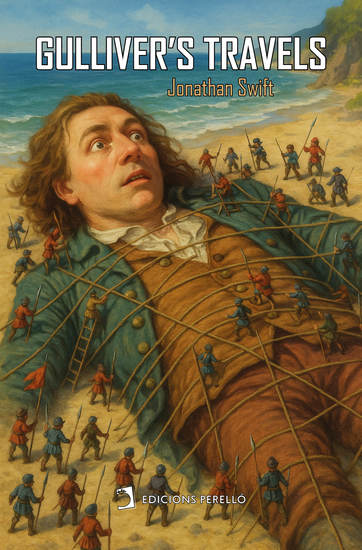
Gulliver's Travels - cover
LER

Gulliver's Travels

Jonathan Swift

Editora: Edicions Perelló

  • 0
  • 0
  • 0

Sinopse

Gulliver's Travels (1726) is a masterpiece of satirical literature written by Jonathan Swift, blending adventure, boundless imagination, and sharp social critique. Through the extraordinary voyages of Captain Lemuel Gulliver—from the tiny realm of Lilliput to the giant land of Brobdingnag, the floating island of Laputa, and the philosophical horses of the Houyhnhnms—Swift delivers a biting commentary on politics, science, war, and human nature.

With a vivid style and limitless creativity, this novel has captivated readers for centuries and continues to challenge audiences to reflect on the world around them. Gulliver's Travels is a timeless classic that remains as relevant and thought-provoking today as it was when first published.
Disponível desde: 22/07/2025.
Comprimento de impressão: 290 páginas.

Outros livros que poderiam interessá-lo

  • Arch Rascal An - From their pens to your ears genius in every story - cover

    Arch Rascal An - From their pens...

    Knut Hamsun

    • 0
    • 0
    • 0
    Knud Pedersen was born in Lom in the Gudbrandsdal valley of Norway on the 4th of August, 1859 in what was then the United Kingdoms of Sweden and Norway.  He was the fourth son of seven children born to poor parents who, when he was three, were invited to an uncle’s farm to work his land. 
    When he was nine he moved away from his family to help another uncle who ran a post office.  Whilst with him he was beaten and starved which manifested in a series of chronic nervous difficulties.  The treatment endured for six years until he managed to escape back to Lom. 
    For some time he now took any job that was available to him, including store clerk, peddler, shoemaker's apprentice, sheriff's assistant, elementary-school teacher and ropemaker's apprentice.  At about the same time, with the wealth of these gained experiences, he began to explore his literary talents. 
    In 1877 he published his first book ‘The Enigmatic Man: A Love Story from Northern Norway’, others soon followed but real success only came in 1890 with ‘Hunger’, an influential work for later novelists with its internal monologue and bizarre logic.  His work is often associated with Pantheism; where nature and mankind are unified in a strong and often mystical bond.   
    His work was so influential that in 1920 he was awarded the Novel Prize for Literature. 
    Shortly after this point his works became fewer and his interests darker.  During World War II he became a fervent admirer of the Nazi’s, even meeting Hitler, even though German armies had overrun Norway.  With the war’s end he was detained on charges of treason.  His old age was apparently the primary reason given for Hamsun receiving only a fine.  Other reasons also sought to excuse his abhorrent behaviour but it was clear that whilst he was loved for his literature he was detested for his politics and morals. 
    His literary canon includes more than 20 novels, a poetry collection, short stories, plays, a travelogue, other works of non-fiction and essays. 
    Knut Hamsun died on the 19th February 1952 in Grimstad. He was 92.
    Ver livro
  • Marriage à la Mode - cover

    Marriage à la Mode

    Katherine Mansfield

    • 0
    • 0
    • 0
    Marriage à la Mode is a 1921 short story by Katherine Mansfield. It was first published in The Sphere on 31 December 1921, and later reprinted in The Garden Party and Other Stories. - The title is a play on the phrase mariage à la mode in French, which means 'fashionable marriage'.
    William would usually buy his children sweets because he knows his wife won't let him buy them 'big donkeys and engines', as that would be unseemly. This time he buys fruit instead.
    Ver livro
  • Selfish Giant The (Unabridged) - cover

    Selfish Giant The (Unabridged)

    Oscar Wilde

    • 0
    • 0
    • 0
    "The Selfish Giant" Owns a beautiful garden which has 12 peach trees and lovely fragrant flowers, in which children love to play after returning from the school. On the giant's return from seven years visiting his friend the Cornish Ogre, he takes offence at the children and builds a wall to keep them out. He put up a notice board "TRESPASSERS WILL BE PROSECUTED". The garden falls into perpetual winter.
    Ver livro
  • The Disappearance of Lady Frances Carfax - cover

    The Disappearance of Lady...

    Arthur Conan Doyle

    • 0
    • 0
    • 0
    The Disappearance of Lady Frances Carfax is one of the 56 Sherlock Holmes short stories written by Sir Arthur Conan Doyle. It is one of the eight stories in the cycle collected as His Last Bow, and one of the few stories in which for much of the plot Watson must act alone and try his best with Holmes left in the background.Holmes sends Dr. Watson to Lausanne to investigate Lady Frances Carfax's disappearance since he himself is too busy in London. Lady Frances is a lone, unwed woman denied a rich inheritance on account of her sex. She does, however, carry valuable jewels with her. It is also her habit to write to her old governess, Miss Dobney, every other week, but for the past five weeks, there has not been a word from her. She has left the Hôtel National for parts unknown. Her last two bank transactions were cheques, one to pay her hotel bill, and another for £50 to her maid, Miss Marie Devine.In Switzerland, Watson finds out that Lady Frances stayed at the Hôtel International for several weeks, but then suddenly left in a hurry one day. Only one witness could suggest an explanation, one involving a big, bearded man who kept hounding her. It also emerges that Lady Frances's maid has left her employ, although it is not known why...Famous works of the author Arthur Conan Doyle: A Study in Scarlet, The Sign of the Four, The Adventures of Sherlock Holmes, The Memoirs of Sherlock Holmes, The Hound of the Baskervilles, The Return of Sherlock Holmes, The Valley of Fear, His Last Bow, The Case-Book of Sherlock Holmes, Stories of Sherlock Holmes, The Lost World.
    Ver livro
  • God Sees the Truth But Waits - From their pens to your ears genius in every story - cover

    God Sees the Truth But Waits -...

    Leo Tolstoy

    • 0
    • 0
    • 0
    Leo Tolstoy was born in 1828 in the Russian province of Tula to a wealthy noble family. As a child, he had private tutors but he showed little interest in any formal education. When he went to the University of Kazan in 1843 to study oriental languages and law, he left without completing his courses.  Life now was relaxed and idle but with some writing also taking place.  Gambling debts forced an abrupt change of path and he joined the army to fight in the Crimean War.  He was commended for his bravery and promoted but was appalled at the brutality and loss of life.  He recorded these and other earlier experiences in his diaries which formed the basis of several of his works. 
    In 1852 ‘Childhood’ was published to immediate success and was followed by ‘Boyhood’ and ‘Youth’. 
    His experience in the army and the horrors he witnessed resulted in ‘The Cossacks’ in 1862 and the trilogy ‘Sevastopol Tales’. After the war he travelled around Europe, visiting London and Paris and meeting such luminaries as Victor Hugo and Charles Darwin.  
    It was now that Tolstoy began his masterpiece, ‘War and Peace’. Published in 1869 it was an epic work that changed literature. He quickly followed this with ‘Anna Karenina’.  
    These successes made Tolstoy rich and helped him accomplish many of his dreams but also brought problems as he grappled with his faith and the lot of the oppressed poor. These revolutionary views became so popular that the authorities now kept him under surveillance.  
    He led a life of asceticism and vegetarianism and put his socialist ideals into practice by establishing numerous schools for the poor and food programmes. He also believed in giving away his wealth, which caused much discord with his wife.  
    His writing continued to bring forth classics such as ‘The Death of Ivan Ilyich’ and many brilliant and incisive short stories such as ‘How Much Land Does A Man Need’.  
    In 1901 Tolstoy was excommunicated from the Church and controversially deselected for the Nobel Prize for Literature. 
    Whilst undertaking a pilgrimage by train in October 1910 with his daughter Aleksandra he caught pneumonia in the nearby town of Astapovo.  Leo Tolstoy died on November 9th, 1910, he was 82.
    Ver livro
  • Les Misérables: Volume 1: Fantine - Book 3: In the Year 1817 (Unabridged) - cover

    Les Misérables: Volume 1:...

    Victor Hugo

    • 0
    • 0
    • 0
    Victor-Marie Hugo (26 February 1802 - 22 May 1885) was a French poet, novelist, essayist, playwright, and dramatist of the Romantic movement. During a literary career that spanned more than sixty years, he wrote abundantly in an exceptional variety of genres: lyrics, satires, epics, philosophical poems, epigrams, novels, history, critical essays, political speeches, funeral orations, diaries, and letters public and private, as well as dramas in verse and prose.
    BOOK 3: IN THE YEAR 1817: 1817 is the year which Louis XVIII., with a certain royal assurance which was not wanting in pride, entitled the twenty-second of his reign. It is the year in which M. Bruguière de Sorsum was celebrated.
    Ver livro