¡Acompáñanos a viajar por el mundo de los libros!
Añadir este libro a la estantería
Grey
Escribe un nuevo comentario Default profile 50px
Grey
Suscríbete para leer el libro completo o lee las primeras páginas gratis.
All characters reduced
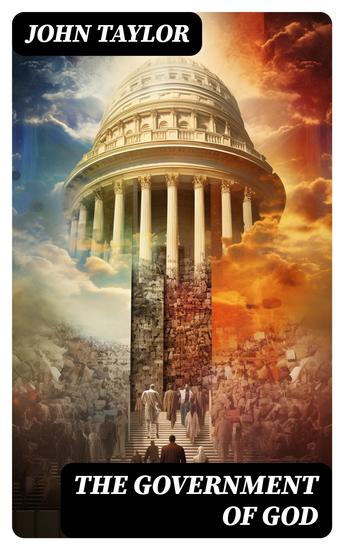
The Government of God - cover

The Government of God

John Taylor

Editorial: DigiCat

  • 0
  • 0
  • 0

Sinopsis

In "The Government of God," John Taylor intricately examines the intersection of divine sovereignty and human governance through a theologically enriched lens. The book is marked by its engaging prose, blending philosophical discourse with scriptural references, all while effectively situating itself within the broader context of 19th-century religious thought. Taylor draws upon historical precedents, allegorical interpretations, and contemporary societal challenges, crafting an argument that advocates for governance aligned with divine principles. This scholarly work not only invites readers into a deep exploration of biblical mandates but also prompts reflection on how such mandates can be actualized in modern political frameworks. John Taylor, an influential figure in the Latter-day Saint movement, was profoundly shaped by the theological debates of his time, as well as his commitment to establishing a society reflective of divine governance ideals. His role as a leader within his religious community and his historical engagements further complemented his pursuit of harmonizing faith with practical administration. Taylor's experiences, coupled with his intellectual rigor, provided a fertile ground for the ideas presented in this compelling text. This thought-provoking study is highly recommended for scholars of theology, political science, and history alike. Readers will find themselves challenged to consider how governance can be effectively rooted in spiritual principles, making this work not only relevant but essential for anyone exploring the interplay between faith and societal organization.
Disponible desde: 10/11/2023.
Longitud de impresión: 121 páginas.

Otros libros que te pueden interesar

  • Democracy and Its Critics: Book Summary & Analysis - cover

    Democracy and Its Critics: Book...

    Briefly Summaries

    • 0
    • 0
    • 0
    This is a concise summary and analysis of Democracy and Its Critics, by Robert A. Dahl.
     
    It is not the original book and is not affiliated with or endorsed by Robert A. Dahl.
    Ideal those seeking a quick and insightful overview.
     
    This insightful book examines the strengths and challenges of democracy, offering a comprehensive analysis of democratic theory and practice. It explores the philosophical foundations of democracy, its historical development, and its practical implications in contemporary politics. The book critically evaluates competing views of democracy, addressing both its achievements and shortcomings, and provides a framework for understanding how democracy can be strengthened in the face of modern challenges such as inequality, populism, and globalization. A compelling read for anyone interested in political theory, governance, and the future of democratic institutions.
    Ver libro
  • No Island of Sanity - Paula Jones v Bill Clinton - The Supreme Court on Trial - cover

    No Island of Sanity - Paula...

    Vincent Bugliosi

    • 0
    • 0
    • 0
    In a series called "The Library of Contemporary Thought," top opinion-makers explore the most provocative, fascinating, and momentous issues that have occurred in the United States. In this first volume, famed Los Angeles prosecutor Vincent Bugliosi takes on the Supreme Court. Considered by some to be an island of sanity surrounded by a sea of insanity that is our society, the Supreme Court has increasingly come under scrutiny for some dubious decisions.
    In this compelling work, Bugliosi puts the Supreme Court on trial for its handling of Paula Jones vs. Bill Clinton. The author argues that the right of a president to be free of a private lawsuit while in office outweighs a plaintiff's interest in having his or her case brought expediently to trial—regardless of a case's supposed merit.
    Ver libro
  • Money Parties and Democracy - Political Finance Between Fat Cats and Big Government - cover

    Money Parties and Democracy -...

    Zim Nwokora, matteo Bonotti

    • 0
    • 0
    • 0
    Democratic politics is expensive. In US presidential elections, for instance, total spending now exceeds $6.5 billion. In the US, election campaigns are largely funded by private donations from individuals and corporate entities, whereas in Germany, the state is the main funder of electoral politics through subventions to parties. In some other countries, parties have been able to raise most of what they need internally by charging membership dues or, more exceptionally, by relying on a wealthy patron. However, there have been numerous scandals and controversies involving political finance, which pose a serious challenge to fundamental democratic principles.Matteo Bonotti and Zim Nwokora analyze the nature of these democratic risks and how they differ across various models of political finance. They argue that political finance rules ought to counterbalance the weaknesses of the party system they are being used alongside. To do so, political finance rules and party systems should be assessed together, in terms of three distinctive normative dimensions—collegiality, systemic voice, and systemic accountability—which capture what parties, at their best, can contribute to democratic politics. Money, Parties, and Democracy sets out a framework for evaluating political finance systems so that they can be designed or reformed to better support good governance.
    Ver libro
  • Creating the KGB and CIA: The Establishment of the World’s Most Famous Intelligence Agencies - cover

    Creating the KGB and CIA: The...

    Editors Charles River

    • 0
    • 0
    • 0
    The KGB is one of the most famous abbreviations of the 20th century, and it has become synonymous with the shadowy and often violent actions of the Soviet Union’s secret police and internal security agencies. In fact, it is often used to refer to the Soviet state security agencies throughout its history, from the inception of the inception of the Cheka (Extraordinary Commission) in 1917 to the official elimination of the KGB in 1992. Whether it’s associated with the Russian Civil War’s excesses, Stalin’s purges, and even Vladimir Putin, the KGB has long been viewed as the West’s biggest bogeyman during the second half of the 20th century. However, the KGB did not appear out of thin air. Naturally, the earliest Soviet leaders utilized intelligence agencies that collected information both abroad and within the Soviet Union, targeting foreign opponents and domestic opponents alike. Lenin did not imagine the scale of the opposition he would have to face after the revolution, and he quickly came to the conclusion that "a special system of organized violence" must be created to implement the dictatorship of the proletariat. 
    Though it might be hard to believe, the Americans did not have a covert operations organization when they joined World War II, and like the British, it took them some time to realize it could be a powerful tool. As a result, the Office of Strategic Services (OSS) was not established until June 13, 1942, six months after the attack on Pearl Harbor. This would all chart a path for the early days of America’s most famous intelligence agency, the CIA. Although plagued by its own share of problems in its early existence during World War II and the early Cold War years, the agency’s early problems, smoothed over by a string of tenured presidents, paled in comparison to those it would face in the coming decades.
    Ver libro
  • Capturing News Capturing Democracy - Trump and the Voice of America - cover

    Capturing News Capturing...

    Mel Bunce, Kate Wright, Martin...

    • 0
    • 0
    • 0
    The Voice of America (VOA) is the oldest and largest US government-funded international media organization. In 2020, Donald Trump nominated Michael Pack, a right-wing documentarian and close friend of Steve Bannon, to lead the US Agency for Global Media—the independent federal agency overseeing US-funded international media. During Pack's seven month tenure, more than thirty whistleblowers filed complaints against him, and a judge ruled that he had infringed journalists' constitutional right to freedom of speech. 


    How did such a major international public service media network become intensely politicized by government allies in such a short time, despite having its editorial independence protected by law? 


    Capturing News, Capturing Democracy puts these events in historical and international context—and develops a new analytical framework for understanding government capture and its connection to broader processes of democratic backsliding. Drawing from in-depth interviews with network managers and journalists, and analysis of private correspondence and internal documents, Kate Wright, Martin Scott, and Mel Bunce analyze how political appointees, White House officials, and right-wing media influenced VOA—changing its reporting of the Black Lives Matter movement, and the 2020 presidential election.
    Ver libro
  • Communist Manifesto The - Karl Marx - cover

    Communist Manifesto The - Karl Marx

    Karl Marx

    • 0
    • 0
    • 0
    The Communist Manifesto (German: Kommunistisches Manifest), originally the Manifesto of the Communist Party (German: Manifest der Kommunistischen Partei), is a political pamphlet written by German philosophers Karl Marx and Friedrich Engels. Commissioned by the Communist League and originally published in London in 1848, the Manifesto remains one of the world's most influential political documents. It presents an analytical approach to class struggle and criticizes capitalism and the capitalist mode of production, without attempting to predict communism's potential future forms. 
    The Communist Manifesto summarises Marx and Engels' theories concerning the nature of society and politics, namely that, in their own words, "[t]he history of all hitherto existing society is the history of class struggles". It also briefly features their ideas for how the capitalist society of the time would eventually be replaced by socialism. In the last paragraph of the Manifesto, the authors call for a "forcible overthrow of all existing social conditions", which served as a call for communist revolutions around the world. 
    In 2013, The Communist Manifesto was registered to UNESCO's Memory of the World Programme along with Marx's Capital.
    Ver libro