Junte-se a nós em uma viagem ao mundo dos livros!
Adicionar este livro à prateleira
Grey
Deixe um novo comentário Default profile 50px
Grey
Assine para ler o livro completo ou leia as primeiras páginas de graça!
All characters reduced
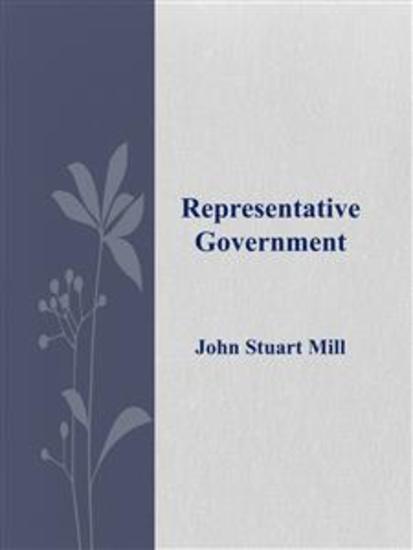
Representative Government - cover
LER

Representative Government

John Stuart Mill

Editora: John Stuart Mill

  • 0
  • 1
  • 0

Sinopse

Philosopher, son of James Mill, born in London, was educated by his father with the view of making him the successor of Bentham and himself, as the exponent of the Utilitarian philosophy. In all respects he proved an apt pupil, and by his 15th year had studied classical literature, logic, political economy, and mathematics. In that year he went to France, where he was under the charge of Sir S. Bentham, a brother of Jeremy. His studies had led him to the adoption of the utilitarian philosophy, and after his return he became acquainted with Grote, the Austins, and other Benthamites.
In 1823 he entered the India House as a clerk, and, like his father, rose to be examiner of Indian correspondence; and, on the dissolution of the Company, retired on a liberal pension. In 1825 he edited Bentham’s Rationale of Judicial Evidence. During the following years he was a frequent contributor to Radical journals, and edited the London Review. His Logic appeared in 1843, and produced a profound impression; and in 1848 he published Principles of Political Economy. The years between 1858 and 1865 were very productive, his treatises on Liberty, Utilitarianism, Representative Government, and his Examination of Sir W. Hamilton’s Philosophy being published during this period. In 1865 he entered the House of Commons as one of the members for Westminster, where, though highly respected, he made no great mark. After this political parenthesis he returned to his literary pursuits, and wrote The Subjection of Women [1869], The Irish Land Question [1870], and an Autobiography. Mill had married in 1851 Mrs. Taylor, for whom he showed an extraordinary devotion, and whom he survived for 15 years. He died at Avignon.
His Autobiography gives a singular, and in some respects painful account of the methods and views of his father in his education. Though remaining all his life an adherent of the utilitarian philosophy, Mill did not transmit it to his disciples altogether unmodified, but, finding it too narrow and rigid for his own intellectual and moral requirements, devoted himself to widening it, and infusing into it a certain element of idealism.
Disponível desde: 07/10/2015.
Outros livros que poderiam interessá-lo

  • Sludge - What Stops Us from Getting Things Done and What to Do about It - cover

    Sludge - What Stops Us from...

    Cass R. Sunstein

    • 0
    • 0
    • 0
    How we became so burdened by red tape and unnecessary paperwork, and why we must do better. 


    We've all had to fight our way through administrative sludge—filling out complicated online forms, mailing in paperwork, standing in line at the motor vehicle registry. This kind of red tape is a nuisance, but, as Cass Sunstein shows in Sludge, it can also also impair health, reduce growth, entrench poverty, and exacerbate inequality. Confronted by sludge, people just give up—and lose a promised outcome: a visa, a job, a permit, an educational opportunity, necessary medical help. In this lively and entertaining look at the terribleness of sludge, Sunstein explains what we can do to reduce it. 


    Because of sludge, Sunstein, explains, too many people don't receive benefits to which they are entitled. Sludge even prevents many people from exercising their constitutional rights—when, for example, barriers to voting in an election are too high. Sunstein takes listeners on a tour of the not-so-wonderful world of sludge, describes justifications for certain kinds of sludge, and proposes "Sludge Audits" as a way to measure the effects of sludge. On balance, Sunstein argues, sludge infringes on human dignity, making people feel that their time and even their lives don't matter. We must do better.
    Ver livro
  • On Liberty: Book Summary & Analysis - cover

    On Liberty: Book Summary & Analysis

    Briefly Summaries

    • 0
    • 0
    • 0
    This is a concise summary and analysis of On Liberty, by John Stuart Mill.
     
    It is not the original book and is not affiliated with or endorsed by John Stuart Mill.
    Ideal those seeking a quick and insightful overview.
     
    On Liberty is a groundbreaking philosophical work that explores the nature and limits of individual freedom in society. This classic text examines the tension between personal autonomy and societal authority, advocating for the protection of individual rights against the tyranny of the majority. With profound arguments on free speech, individuality, and self-expression, it provides a compelling defense of civil liberties that remain relevant in contemporary debates about democracy and personal freedom.
    Ver livro
  • Democracy - A Guided Tour - cover

    Democracy - A Guided Tour

    Jason Brennan

    • 0
    • 0
    • 0
    In this short, accessible book, leading democratic theorist Jason Brennan guides listeners through the evolution of the concept of democracy and actual democratic practice over time to help them understand the foundations of this longstanding and yet newly fragile political system. 


    In his wide-ranging tour of the concept, Brennan will examine what democracy meant to the Greeks who first developed the concept before examining how it changed throughout European and later Western history. This will open up rich and perplexing questions. Over time, democracy shifted from being a fringe idea to the gold standard of political institutions: how did this change occur? How did the question of who counts as part of the ruling "people" change over time? As monarchies were replaced with democracies, what did theorists think the promises and perils of republican democracy were? How did actual democratic practice change the debates? What have we learned about how democracy functions—and in some cases, doesn't function—and what does this mean for future philosophical or empirical work? Brennan provides a curated, guided tour of the most important arguments for and against democracy, looking through the core values of stability, virtue, wisdom, freedom, and equality. The goal is to help listeners understand what is really at stake in democracy and its alternatives.
    Ver livro
  • Communism in Practice - Case Studies of Communist Governments and Their Societal Impact - cover

    Communism in Practice - Case...

    Arlo Holders

    • 0
    • 0
    • 0
    Communism, as an ideology and political movement, seeks to create a classless society where the means of production are owned collectively. Rooted in the works of Karl Marx and Friedrich Engels, communism advocates for the abolition of private property and aims to establish a system where wealth is distributed according to need, not individual ownership. This chapter explores the foundational principles of communism, its historical development, and its responses to capitalism and social inequality. 
    At the heart of communism lies the idea of economic equality. Marx and Engels argued that capitalism inherently exploits workers, who sell their labor for wages while capitalists profit from the value produced. The solution, according to communism, is the overthrow of capitalist systems and the establishment of a proletarian (working class) dictatorship. This revolutionary phase would transition into a classless society in which private property is abolished, and wealth is shared among all members of society. 
    The key principles of communism emphasize collective ownership, state control of resources, and the idea of class struggle. In Marxist theory, history is understood through the lens of class conflict, where different social classes—such as the bourgeoisie (capitalists) and the proletariat (workers)—are in perpetual opposition. The ultimate goal is to establish a society free of these class distinctions, where everyone has access to the same resources and opportunities.
    Ver livro
  • Solidarity Is the Political Version of Love - Lessons from Jewish Anti-Zionist Organizing - cover

    Solidarity Is the Political...

    Alissa Wise, Rebecca...

    • 0
    • 0
    • 0
    Against enormous odds and in the face of fierce pushback, the Palestine solidarity movement has succeeded in transforming the landscape of American politics. The movement has catapulted Palestine from being an untouchable topic in even liberal political circles to a central rallying cry in grassroots progressive organizing, one that is championed by some of the highest profile and beloved members of Congress. 


    In the fall and winter of 2023, with the attention of the world focused on Israel's unprecedented aggression against the people of Gaza, millions across the globe mobilized in solidarity with Palestinians and their struggle for liberation. 


    In this book, two key leaders and former staff of Jewish Voice for Peace (JVP) focus on the important role of anti-Zionist Jewish organizing within the broader Palestine solidarity movement, reflecting on their decade of leadership of JVP and drawing lessons especially relevant to those organizing from a position of solidarity. 


    Their insights help contextualize the intense suppression of activism for Palestinian freedom, while illuminating the roots of today's flourishing Jewish solidarity with Palestinians worldwide.
    Ver livro
  • The Cuban Missile Crisis - Brink of Nuclear War - cover

    The Cuban Missile Crisis - Brink...

    Nova Ashford

    • 0
    • 0
    • 0
    The Cuban Missile Crisis, one of the most critical moments in the Cold War, did not emerge in isolation but was the culmination of a decades-long geopolitical struggle between the United States and the Soviet Union. The context of this crisis lies deeply within the broader Cold War, which began shortly after the end of World War II. This period was marked by intense ideological rivalry, military standoffs, and a nuclear arms race that would define much of the second half of the 20th century. 
    The origins of the Cold War can be traced back to the conflicting political and economic ideologies of the two superpowers. The United States, championing capitalism and democracy, viewed the spread of communism, led by the Soviet Union, as a direct threat to global stability and democratic values. On the other hand, the Soviet Union, under the leadership of Joseph Stalin, sought to expand the reach of communism and solidify its control over Eastern Europe, which had been acquired as a result of the war. This division between the capitalist West and the communist East created a tense geopolitical environment that shaped every diplomatic interaction between the two powers. 
    In the early stages of the Cold War, several key events served to heighten the distrust between the U.S. and the Soviet Union. The Berlin Blockade in 1948, the Korean War in the early 1950s, and the formation of opposing military alliances like NATO (North Atlantic Treaty Organization) and the Warsaw Pact solidified the division of the world into two hostile camps. As both nations escalated their military capabilities, the nuclear arms race emerged as a central aspect of Cold War tensions. The development and stockpiling of nuclear weapons made the Cold War not just an ideological battle but also a dangerous game of survival, with the constant threat of global annihilation hanging over every political and military maneuver.
    Ver livro