¡Acompáñanos a viajar por el mundo de los libros!
Añadir este libro a la estantería
Grey
Escribe un nuevo comentario Default profile 50px
Grey
Suscríbete para leer el libro completo o lee las primeras páginas gratis.
All characters reduced
The Romance of Spanish History - [Illustrated & Engraved & Mapped] - cover

The Romance of Spanish History - [Illustrated & Engraved & Mapped]

John S. C. Abbott

Editorial: E-Kitap Projesi & Cheapest Books

  • 0
  • 0
  • 0

Sinopsis

THE Spanish peninsula, separated from France on the north by the Pyrenees, and bounded on the three remaining sides by the Mediterranean Sea and the Atlantic Ocean, con-tains an area of 225,600 square miles, being a little larger than France. Nature has reared a very formidable barrier between Spain and France, for the Pyrenees, extending in a straight line 250 miles in length, from the Bay of Biscay to the Mediterranean, and often rising in peaks more than ten thou-sand feet in height, offer but three defiles which carriages can traverse, though there are more than a hundred passes which may be surmounted by pedestrians or the sure-footed mule. The soil is fertile; the climate genial and salubrious; and the face of the country, diversified with meadows and mountains, presents, in rare combination, the most attractive features both of loveliness and sublimity.

History does not inform us when and how this beautiful peninsula—called Hispania by the Romans—first became in-habited. Whether the earliest emigrants crossed the straits of Gibraltar from Africa, or came from Asia, coasting the shores of the Mediterranean, or descended from France through the defiles of the Pyrenees, can now never be known. The first glimpse we catch of Spain, through the haze of past ages, reveals to us the country inhabited by numerous barbaric tri-bes, fiercely hostile to each other, and constantly engaged in bloody wars. The mountain fastnesses were infested with robber bands, and rapine and violence everywhere reigned. The weapons grasped by these fierce warriors consisted of lances, clubs, and slings, with sabres and hatchets, of rude fashion but of keen edge. Their food was mainly nuts and ro-ots. Their clothing consisted of a single linen garment, girded around the waist; and a woollen tunic, surmounted by a cloth cap, descended to the feet. As in all barbarous nations, the hard work of life was performed by the women.

The names even of most of these tribes have long since perished; a few however have been transmitted to our day, such as the Celts, the Gallicians, the Lusitanians, and the Iberians. Several ages before the foundations of Rome or of Carthage were laid, it is said that the Phoenicians, exploring in their commercial tours the shores of the Mediterranean, established a mercantile colony at Cadiz. The colonists growing rich and strong, extended their dominions and founded the cities of Malaga and Cordova. About 800 years before Christ, a colony from Rhodes settled in the Spanish peninsula, and established the city of Rosas. Other expeditions, from various parts of Greece, also planted colonies and engaged in successful traffic with the Spanish natives.

Four hundred years before Christ, the Carthaginian republic was one of the leading powers, and Carthage was one of the most populous and influential cities on the globe. The Carthaginians crossed the narrow straits which separate Africa from Spain, landed in great strength upon the Spanish peninsula, and, after a short but severe conflict, subdued the foreign colonies there, brought the native Spaniards into subjection, and established their own supremacy over all the southern coast. Cadiz became the central point of Carthaginian power, from whence the invaders constantly extended their conquests. Though many of the interior tribes maintained for a time a sort of rude and ferocious independence, still Carthage gradually assumed dominion over the whole of Spain.

In the year 235 B.C., Hamilcar, the father of the illustrious Hannibal, compelled nearly all the tribes of Spain to ack-nowledge his sway. For eight years Hamilcar waged almost an incessant battle with the Spaniards. Still it was merely a military possession which he held of the country, and he erected Barcelona and several other fortresses, where his soldiers could bid defiance to assaults, and could overawe the surrounding inhabitants.
Disponible desde: 02/02/2024.
Longitud de impresión: 500 páginas.

Otros libros que te pueden interesar

  • Of Arcs and Circles - Insights from Japan on Gardens Nature and Art - cover

    Of Arcs and Circles - Insights...

    Marc Peter Keane

    • 0
    • 0
    • 0
    A renowned designer of Japanese gardens contemplates wildness, humanity, beauty, the liquid state of the world.
    
     
    From his vantage point as a garden designer and writer based in Kyoto, Marc Peter Keane examines the world around him and delivers astonishing insights through an array of narratives. 
    
     
    How the names of gardens reveal their essential meaning. A new definition of what art is. What trees are really made of. The true meaning of the enigmatic torii gate found at Shinto shrines. Why we give flowers as gifts. The essential, underlying unity of the world.
    Ver libro
  • James Madison - Accomplishments of the President and Founding Father of the United States - cover

    James Madison - Accomplishments...

    Kelly Mass

    • 0
    • 0
    • 0
    James Madison (who lived from March 16, 1751 to June 28th, 1836) was an American statesman, diplomat, expansionist, theorist, and Founding Father who worked as the United States' 4th president from 1809 to 1817. For his essential role in the creation and big promotion of the US Constitution and the US Bill of Rights, he's referred to as the "Father of the Constitution." From 1801 till 1809, he functioned as the 5th Secretary of State of the United States, co-authoring The Federalist Documents and co-founding the Democratic-Republican Party. 
    James Madison has meant a lot to the constitution of the United States of America. Let’s take a look at his actions, his background, and his motives.
    Ver libro
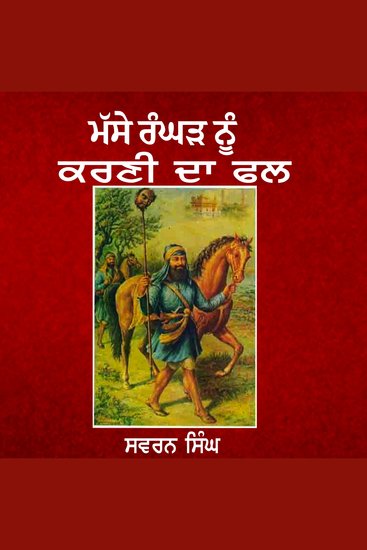
  • Masse Rangar Nu Karni Da Phal - Masse Rangar Da Beadbi lyi Darbar Sahib Dera Laouna - cover

    Masse Rangar Nu Karni Da Phal -...

    Swarn Singh

    • 0
    • 0
    • 0
    Book: Masse Rangar Nu Karni Da Phal  
    Written by : Swaran Singh 
    The book "Masse Rangar nu Karni da Phal" by Swaran Singh tells the story of how Masse Rangar faced punishment for his wrongdoings. It explains how the Mughal rulers tried to suppress the Sikhs and how Masse Rangar disrespected the sacred Amrit Sarovar and Sri Harmandir Sahib. The book also describes how the Sikhs took action to protect their faith and gave Masse Rangar the punishment he deserved for his bad deeds.
    Ver libro
  • Julian of Norwich: The Showings - Uncovering the Face of the Feminine in Revelations of Divine Love - cover

    Julian of Norwich: The Showings...

    Mirabai Starr

    • 0
    • 0
    • 0
    "As a major fan and promoter of Julian of Norwich, whom I call 'my favorite mystic', it is genuinely exciting to find such a faithful but freeing translation of Julian's long-lost Showings. Now they are no longer lost—for anyone!" —Fr. Richard Rohr, O.F.M., Center for Action and ContemplationIn this contemporary translation of one of the most beloved and influential mystical texts of all time, Julian of Norwich: The Showings brings the message and spirituality of this 14th-century mystic to 21st-century readers. Revelations of Divine Love, the first book published in English attributed to a woman, is also included.Julian of Norwich, a contemporary of Geoffrey Chaucer, was an English anchoress in East Anglia. At the age of 30, suffering from a severe illness and believing she was on her deathbed, Julian had a series of intense visions of Jesus, which she recorded and then expanded on later in her life. In her visions, God was not angry and wrathful. Instead, the three properties of God were presented as life, love, and light, and all of His creation was good, including his servant, man. In Julian's version, man is not to blame for his sin; sin is something that he must experience and overcome in his spiritual journey with God.Her message for today's readers is simply this:She reveals the feminine face of the Divine and reminds us to see God there.All our failings are an opportunity to learn and grow; they should be honored, but not dwelled upon.God's love has nothing to do with love and retribution and everything to do with love and compassion.In spite of all appearances, all is well. This book contains some of the most profound spiritual writing ever written and remains a perennial favorite among Christians.This book was previously published as The Showings of Julian of Norwich. This new edition includes a foreword by Richard Rohr, author of Falling Upwards.
    Ver libro
  • The Populist Wave - Understanding the Rise of Populism in Modern Politics - cover

    The Populist Wave -...

    Arlo Holders

    • 0
    • 0
    • 0
    Populism, a term often used in modern political discourse, refers to movements or ideologies that seek to represent the interests of ordinary people, often contrasting with the perceived elite or establishment. Understanding the origins of populism requires exploring both its historical roots and its evolution over time. Though its contemporary forms are often associated with charismatic leaders and mass mobilization, populism has a deep and complex history that spans several centuries. 
    Historically, populism can trace its roots back to the late 19th century, when agrarian movements in the United States and Russia first used the term. The Populist Party, founded in the U.S. in 1891, advocated for the interests of farmers who felt exploited by industrial elites and urban centers. In Russia, the narodniks, or "people's movement," emerged around the same time, focusing on the belief that Russia’s future lay in the empowerment of the peasantry. These early populist movements were fueled by economic and social inequalities, with the central grievance being the concentration of wealth and power in the hands of a few. 
    The core tenet of these early populist movements was the idea of a moral divide between the "pure" common people and the corrupt elites. This populist rhetoric resonated strongly with those who felt neglected by the political establishment, emphasizing a deep distrust of centralized political systems and economic power. Populism, then, was not simply about policy disagreements but a call for a deeper cultural and moral reckoning with societal inequalities.
    Ver libro
  • Stem X - Diversity Equity & Inclusion at the Speed of Thought - cover

    Stem X - Diversity Equity &...

    Malcolm Allen

    • 0
    • 0
    • 0
    This is a book about the fascinating world of STEM subjects — learning them, teaching them, and working in STEM jobs of the future. If you are a student, teacher, or parent, and you want to learn how STEM subjects affect our lives, this is the book to read. If you need to know how diversity, inclusion, equity, and access operate in today’s classrooms and workspaces, you will find out in these pages. 
     
    Malcolm Allen is a veteran STEM professional who learned his first STEM skills in the US Navy. He has used that knowledge to earn advanced degrees, which have helped him achieve success as a businessman and social activist. He has authored more than 30 books covering issues in culture, education, finance, and public policy.
    Ver libro