¡Acompáñanos a viajar por el mundo de los libros!
Añadir este libro a la estantería
Grey
Escribe un nuevo comentario Default profile 50px
Grey
Suscríbete para leer el libro completo o lee las primeras páginas gratis.
All characters reduced
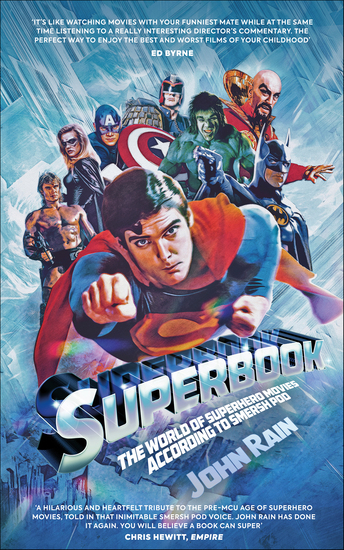
Superbook - The World of Superhero Movies According to Smersh Pod - cover

Superbook - The World of Superhero Movies According to Smersh Pod

John Rain

Editorial: Polaris

  • 0
  • 0
  • 0

Sinopsis

If you mention the word ‘superhero’ these days, everyone and their mum can tell you a potted history of it all, because they’ve sat through numerous phases, extended TV series, and animated side-specials of expansive character-development, culminating in extraordinary final chapters, with the screen literally stacked full of characters battling one another while your eyes bleed with excitement and spectacle.

But before 1997, people would generally only think of a few things: Christopher Reeve smiling as he keeps a watchful eye over Earth’s atmosphere, Michael Keaton running around Gotham while dressed in molded rubber. Nicholas Hammond's Spider-Man being hauled up a wall on a rope, pretending to grip it, while also being a foot away from it. Bill Bixby trying not to get angry, Flash Gordon arriving in another galaxy, that was essentially a soft porn film, Dolph Lundgren mumbling in broken English while Frank Langella hammed behind a mask, and how Michael Crawford dressed like a bird was the closest thing Disney had to a cinematic universe.

Despite starting on a high in 1978, by 1997 there could be no doubt that the genre was dead. Out was the sheen of verisimilitude, and in were Bat-credit-cards, ugly CGI, slashed budgets, rubber nipples and Martin Sheen in a girdle.

So, whatever happened to the heroes? Join John Rain as he walks through every film of note from 1978 to 1997, and examines just what went wrong, and how. Is it a bird? Is it a plane? No, it’s SUPERBOOK.
Disponible desde: 09/01/2024.
Longitud de impresión: 380 páginas.

Otros libros que te pueden interesar

  • German Literary History for Beginners an Exciting and Entertaining Journey Through German Literature From the Middle Ages to the Present Day - cover

    German Literary History for...

    Christian Möhlenkamp

    • 0
    • 0
    • 0
    This book is intended for readers who are looking for an introduction to the confusing diversity of German literature. The chronological order chosen is best suited for this purpose because, in contrast to topic- or genre-oriented ordering procedures, it shows a genesis and traces the genealogy of German literature. The fact that Goethe's novel Wilhelm Meisters Lehrjahre would most likely have looked completely different without Hans Jakob Christoffel von Grimmelshausen's Simplicissimus can be shown most easily and effectively in the context of a chronologically presented journey through time. And this is only one of many examples, especially in the field of poetry quite a few more could be found.
    
    "He who knows how to read holds the key to great deeds, to undreamed-of possibilities," Aldous Huxley once said. This book is intended to open up some of these possibilities for you.
    Ver libro
  • The Will to Power - An Attempted Transvaluation of All Values - cover

    The Will to Power - An Attempted...

    Friedrich Nietzsche

    • 0
    • 0
    • 0
    "The Will to Power: An Attempted Transvaluation of All Values" by Friedrich Nietzsche delves into the profound philosophical exploration of power as the fundamental driving force in human life. Compiled from Nietzsche's notes, this work presents his radical ideas on morality, culture, and the nature of existence. Nietzsche challenges conventional values, advocating for the re-evaluation of societal norms and the embracement of individual strength and creativity. This provocative text remains a cornerstone of existential and philosophical thought, inspiring deep reflection on the essence of human ambition and purpose.
    Ver libro
  • Why the Nineties Matter - cover

    Why the Nineties Matter

    Terry H. Anderson

    • 0
    • 0
    • 0
    In Why the Nineties Matter, Terry Anderson provides a broad-ranging history of America in that decade. Not simply a chronological account, the book focuses on key trends that either began or gained steam then and which have had lasting effects until this day. Threading together politics, economic transformations, and sociocultural trends, he focuses on what mattered most in retrospect. Violent and extremist white nationalism intensified greatly in that decade, evidenced by the Oklahoma City bombing and the rise of the militia movement. The defection of the white working class from the Democratic Party began then as the Democrats expanded free trade and tried to cultivate professional-class Americans. Racial and gender politics transformed, birthing new movements that would grow in influence in the next century. Social media first emerged in the 1990s too, and its impact on all aspects of life cannot be underestimated. In foreign policy, America's long wars in the Middle East and Afghanistan have roots in US policies in the 1990s. And the current standoff between the US and Russia traces back to disagreements over NATO expansion a quarter century ago. 


    A pithy interpretive history of a decade that matters more than most think, this book will be an essential guide to anyone trying to understand that era.
    Ver libro
  • Christian Ethics Collection Signature Classics - A Confession by Leo Tolstoy Orthodoxy by GKChesterton The Problem of Pain by CSLewis - cover

    Christian Ethics Collection...

    Leo Tostoy, Leo Tolstoy, G.K....

    • 0
    • 0
    • 0
    What defines faith in the face of doubt? How do we reconcile human suffering with the existence of a loving God? And what is the essence of spiritual truth in a skeptical world? These timeless questions lie at the heart of Christian Ethics Collection: Signature Classics, a profound and thought-provoking audio anthology.
    Bringing together three literary giants, this collection is more than a discourse on religion; it is a journey into the human soul, wrestling with the complexities of belief and morality. In A Confession, Leo Tolstoy peels back the layers of his own existential crisis, charting a path from despair to spiritual awakening. With unflinching honesty, the great Russian author challenges conventional dogma and searches for meaning in a world often indifferent to human suffering.
    G.K. Chesterton's Orthodoxy offers a spirited defense of Christianity that dazzles with paradox, wit, and logic. Chesterton's playful yet piercing intellect transforms abstract theology into a vibrant exploration of wonder and reason, reframing skepticism as an opportunity for deeper faith.
    Finally, C.S. Lewis's The Problem of Pain confronts one of humanity's most difficult questions: why must we suffer? Combining rational analysis with profound empathy, Lewis bridges the gap between intellectual inquiry and emotional solace, offering a perspective on pain that is as challenging as it is comforting. Together, these works invite listeners into a dialogue that spans continents, centuries, and spiritual traditions. Whether you are a seeker, skeptic, or believer, this collection will ignite reflection and inspire a deeper understanding of the ethical and emotional dimensions of faith.
    Contents:
    1. A Confession by Leo Tolstoy,
    2. Orthodoxy by G. K. Chesterton, 
    3. The Problem of Pain by C. S. Lewis.
    Ver libro
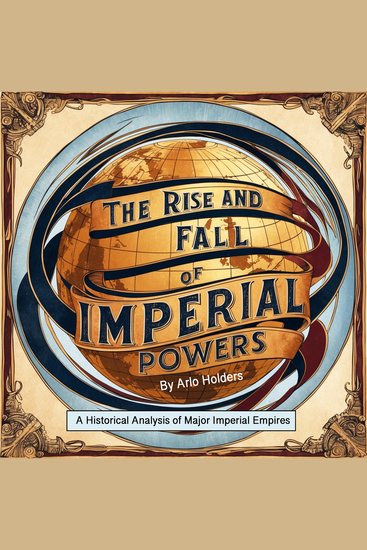
  • The Rise and Fall of Imperial Powers - A Historical Analysis of Major Imperial Empires - cover

    The Rise and Fall of Imperial...

    Arlo Holders

    • 0
    • 0
    • 0
    Imperialism has shaped the course of world history, influencing politics, economics, culture, and warfare across centuries. At its core, imperialism refers to the policy or ideology by which a state extends its rule over other territories, often through military conquest, economic dominance, or political influence. Empires have risen and fallen throughout history, leaving behind legacies that continue to shape modern societies. This chapter explores the fundamental characteristics of imperialism, its driving forces, and its historical significance. 
    An empire typically consists of a dominant power that exerts control over vast regions, governing diverse populations with varying degrees of autonomy. While military conquest has historically been a primary means of expansion, economic incentives and ideological justifications have also played crucial roles in the formation of empires. The pursuit of wealth, resources, and trade routes has often motivated imperial ambitions, as seen in the European colonial empires that sought to control lucrative markets across the world. Political and strategic concerns, such as securing borders or maintaining dominance over rivals, have further fueled imperial expansion. 
    Cultural and ideological factors have also been significant in the spread of empires. Many imperial powers have justified their expansion by claiming to bring civilization, religion, or superior governance to the territories they conquered. The Roman Empire, for example, promoted the spread of Roman law and culture as a means of integrating conquered peoples. Similarly, European colonial empires often framed their dominance as a "civilizing mission," using religion and education as tools to reshape local societies. However, such justifications often masked exploitative economic and political systems that benefited the ruling powers at the expense of the subjugated populations.
    Ver libro
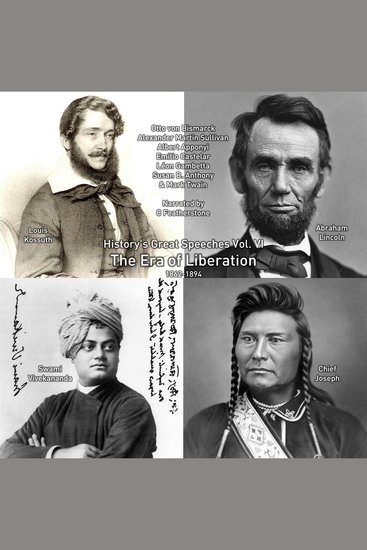
  • The Era of Liberation - 1862-1894 - cover

    The Era of Liberation - 1862-1894

    Louis Kossuth, Abraham Lincoln,...

    • 0
    • 0
    • 0
    The late 19th Century was a time of liberation. After the collapse of empires, people of all creeds demanded their equality.We begin with two speeches that represent the old order, by Bismarck. Between the two speeches he went from being Prussia’s last Minister President to being the Germany’s first Chancellor. A statesman in the oldest mold, he argues for nationalist dominance against forces temporal and religious.The counter is given by Sullivan, who excoriates the British government for the Zulu war, asking why the country supported wars of aggression in foreign lands.From there, we move to the liberation of nations and peoples. Louis Kossuth embodied Hungary’s struggle against imperial oppression, Castelar argues for a Spanish republic, and Gambetta for the education of the peasantry in France. Across Europe, a tide rose demanding the government serve the people rather than use them.In America, Lincoln defined the struggle between the Union and Confederacy as the start of universal emancipation and freedom for all men. In contrast, Chief Joseph’s speech drips with pathos, as he lays down his spear forever, desperate to find what is left of his massacred and desolate peoples in the wilderness. After the Civil War ends, Susan Anthony’s speech demands that women should have the vote, as guaranteed in the constitution for all citizens.A series of speeches by Swami Vivekananda follow, given at the first World’s Parliament of Religions. These speeches brought Buddhism and Hinduism into the Anglosphere, and began a trend of searching for spiritual liberation alongside the more material demands of the time.We finish on a lighter tone, as Mark Twain bemoans the decay of the art of lying. In an age of such seriousness, the tall tale fell out of fashion, and the simple joy of telling a fisherman’s tale was lost.
    Ver libro