Join us on a literary world trip!
Add this book to bookshelf
Grey
Write a new comment Default profile 50px
Grey
Subscribe to read the full book or read the first pages for free!
All characters reduced
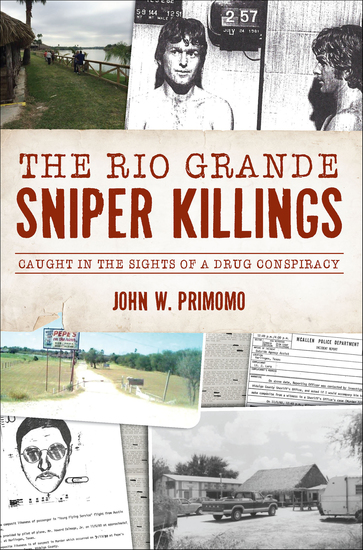
The Rio Grande Sniper Killings - Caught in the Sights of a Drug Conspiracy - cover

The Rio Grande Sniper Killings - Caught in the Sights of a Drug Conspiracy

John Primomo

Publisher: The History Press

  • 0
  • 0
  • 0

Summary

Untangle the complex conspiracy that led to the tragic deaths of Charlotte Kay Elliott and Kevin Edwin Frase on the banks of the Rio Grande. On the night of July 13, 1980, a hitman fired a high-powered rifle into the crowd at Pepe's On the River, an outdoor bar in Mission, Texas. He missed his target, a witness in the Loop 360 drug case, but killed two young bystanders. While state court prosecutions for capital murder inexplicably faltered, a federal court gave the assassin a life sentence for attempted murder of a grand jury witness. A member of the judge's staff who was present throughout the trial, author John W. Primomo revisits the dramatic twists and turns surrounding this murder on the Rio Grande.
Available since: 04/03/2023.
Print length: 146 pages.

Other books that might interest you

  • Yoruba Mythology: Captivating Myths and Legends of the Yoruba and Other West African Peoples - cover

    Yoruba Mythology: Captivating...

    Matt Clayton

    • 0
    • 0
    • 0
    Do you like stories about kings and queens, spirits and monsters, or tricksters and villains? 
    If so, this book is for you. Containing delightful stories from the Yoruba and other West African peoples, this book presents tales of courage and cunning, virtue and vice, and fortunes found and lost. Some of these stories draw upon actual historical persons and events, while others are purely fictional, but each story has something to delight any reader. 
    Here are just a few of the stories you will find inside this book:How Queen Moremi saved her people from their enemiesWhy King Oranyan’s staff still stands in its place todayHow Gassire gave up dreams of a kingdom to become a singer of talesHow a king wanted to know what it was like to be poor and found out the hard wayHow clever commoners outwitted the kings who wanted to kill themHow the Ashanti came to farm yamsHow a baby who was not yet ready to be born defeated the monster SasabonsamHow the wise and clever Kumba saved her village from a man-eating lionHow Kigbo the farmer learned the hard way that it is not wise to play around with spiritsAnd much, much more!                
    Scroll up and click the “add to cart” button to enjoy each of these captivating West African stories!
    Show book
  • The Myth of Left and Right - How the Political Spectrum Misleads and Harms America - cover

    The Myth of Left and Right - How...

    Verlan Lewis, Hyrum Lewis

    • 0
    • 1
    • 0
    A groundbreaking argument that the political spectrum today is inadequate to twenty-first-century America and a major source of the confusion and hostility that characterize contemporary political discourse. 


    As American politics descends into a battle of anger and hostility between two groups called "left" and "right," people increasingly ask: What is the essential difference between these two ideological groups? In The Myth of Left and Right, Hyrum Lewis and Verlan Lewis provide the surprising answer: nothing. As the authors argue, there is no enduring philosophy, disposition, or essence uniting the various positions associated with the liberal and conservative ideologies of today. Far from being an eternal dividing line of American politics, the political spectrum came to the United States in the 1920s and, since then, left and right have evolved in so many unpredictable and even contradictory ways that there is currently nothing other than tribal loyalty holding together the many disparate positions that fly under the banners of "liberal" and "conservative." Cutting against the grain of most scholarship on polarization in America, this book shows why the idea that the political spectrum measures deeply held worldviews is the central political myth of our time and a major cause of the confusion and vitriol that characterize public discourse.
    Show book
  • Plato's Phaedrus - cover

    Plato's Phaedrus

    Plato

    • 0
    • 0
    • 0
    Plato’s dialogues frequently treat several topics and show their connection to each other. The Phaedrus is a model of that skill because of its seamless progression from examples of speeches about the nature of love to mythical visions of human nature and destiny to the essence of beauty and, finally, to a penetrating discussion of speaking and writing. It ends with an examination of the love of wisdom as a dialectical activity in the human mind.
     
    Phaedrus lures Socrates outside the walls of Athens, where he seldom goes, by promising to share a new work by his friend and mentor Lysias, a famous writer of speeches. This dialogue provides a powerful example of the dialectical writing that Plato uses to manifest ideas that are essential to human existence and to living a good life. The Phaedrus shows how oral and written forms of language relate to each other and to philosophy. It simultaneously embodies the entire process in some of the greatest poetry ever written.
    Show book
  • The Time Beneath the Concrete - Palestine Between Camp and Colony - cover

    The Time Beneath the Concrete -...

    Nasser Abourahme

    • 0
    • 0
    • 0
    In The Time beneath the Concrete, Nasser Abourahme argues that settler colonialism is always as much an attempt to conquer time as it is to conquer land. Taking as his primary object  Palestinian refugee camps, created in the fallout of the eliminatory violence of Israel's founding, Abourahme shows how these camps become the primary place where settler colonial attempts to dominate space and time encounter Indigenous refusal. Seen from the camps, Israel becomes a settler colonial project defined by its inability to move past the past—a project stuck at its foundational moment of conquest. At the same time, the Palestinian insistence on return is a refusal to abide by the closure of the past into settler futurity. Palestinian struggle does not just happen in the open time of dispossession; it happens over this time. That struggle, Abourahme demonstrates, is a form of anticolonial refusal that draws its power not from any decisive finality, but precisely from irresolution and keeping time open. 


    Duke University Press Scholars of Color First Book Award
    Show book
  • Expectation of Valor - Planning for the Iraq War - cover

    Expectation of Valor - Planning...

    Colonel Kevin C.M. Benson (Ret),...

    • 0
    • 0
    • 0
    Given the length of time the United States spent in Iraq, there is a perception that there was no consideration before the war of what should be done after coalition forces arrived in Baghdad and removed Saddam Hussein. However as this unofficial history reveals, there was a great deal of planning to address how to achieve the policy objectives for Iraq set by the Bush administration. Kevin Benson—director of plans for the United States Third Army, the ground forces command headquarters for GEN Franks' Central Command, at the start of the war—details the development of the invasion plan and its subsequent execution from D-Day in March 2003 until the change of command of operations in Iraq and the departure of Third Army in June 2003. 


    He addresses the persistent trope that "the Army did no planning" for "Phase IV," revealing that extensive plans were proposed, and were met with very little interest in Washington. The book covers the difficulties encountered in dealing with Secretary of Defense Donald Rumsfeld, from getting his approval on the number of forces requested to conducting the campaign to find the "smoking gun" of WMD; the instructions given to Army, Marine, and coalition forces; and the daily secure video teleconferences with Central Command and the Pentagon, and the rather remarkable conversations and guidance that came from these meetings.
    Show book
  • Oregon Loves New York - A Story of American Unity After 9 11 - cover

    Oregon Loves New York - A Story...

    Sally Bourrie

    • 0
    • 0
    • 0
    A nation in mourning. A city recovering. A unique moment in history when people came together to rebuild hope. 
    When an unimaginable crisis emerged, politically polarized Oregon found a common mission. Three weeks after the September 11th terrorist attacks, airplanes were empty and the New York economy was tanking. So one thousand Freedom Fliers committed to taking sixty-two flights to NYC and infusing local businesses with revenue to show their unwavering support. 
    Arriving en masse to the grief-filled streets, Oregonians from diverse backgrounds and social statuses came to make a difference in their fellow Americans' lives. But beyond the much-needed economic boost, these unsung heroes discovered themselves providing something even more essential... their open hearts. 
    Sally Ruth Bourrie, freelance writer for the Chicago Tribune and The Boston Globe, witnessed firsthand this remarkable phenomenon sparked by the 2001 Flight for Freedom. 
    In a comprehensive and poignant account, she brings this extraordinary and largely unknown story vividly to life. In Oregon Loves New York, you'll discover: 
    - How everyday people can make a huge difference by being present for others in times of need 
    -Ways a divided community can put aside politics, ideologies, and disagreements to achieve amazing things together 
    - Almost 700 pages of tales of courage and humanity, including 200 full-color photographs, 100 personal interviews, 20 years of research, and archival news pieces now lost to history 
    - Heart-touching examples of the healing power of person-to-person contact and how we as a nation can honor each other 
    - Insight into a little-known event with a huge impact, positive messages of hope, and much, much more!
    Show book