Junte-se a nós em uma viagem ao mundo dos livros!
Adicionar este livro à prateleira
Grey
Deixe um novo comentário Default profile 50px
Grey
Assine para ler o livro completo ou leia as primeiras páginas de graça!
All characters reduced
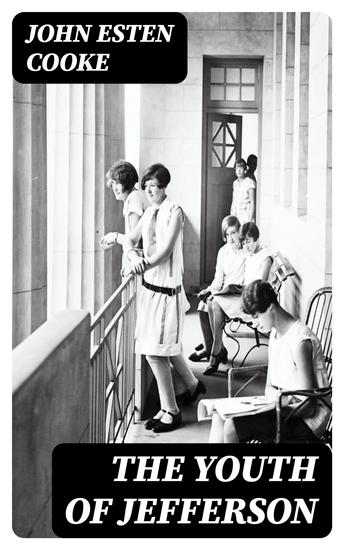
The Youth of Jefferson - Or a Chronicle of College Scrapes at Williamsburg in Virginia AD 1764 - cover
LER

The Youth of Jefferson - Or a Chronicle of College Scrapes at Williamsburg in Virginia AD 1764

John Esten Cooke

Editora: DigiCat

  • 0
  • 0
  • 0

Sinopse

In 'The Youth of Jefferson,' John Esten Cooke explores the formative years of Thomas Jefferson, deftly blending historical narrative with rich character development. The book employs a vivid literary style that captures the atmosphere of 18th-century Virginia, while delving into Jefferson's early influences, education, and burgeoning thoughts on liberty and governance. Cooke's work is positioned within the broader context of antebellum literature, echoing the Romantic idealization of American history, and serves to illuminate the intellectual and moral foundations that shaped one of America's founding fathers. John Esten Cooke, a prominent figure in 19th-century Southern literature, was deeply influenced by his own Virginia roots and the complexities of the Civil War era. Cooke's affinity for history, combined with his experiences as a soldier and writer, instilled in him a passion for portraying noble Southern characters. His inclination to celebrate the American past and its giants like Jefferson is evident in this work, where he evocatively captures the spirit and culture of the time. 'The Youth of Jefferson' is highly recommended for readers interested in American history, literature, and the cultural context of the early Republic. Cooke's engaging narrative not only provides insights into Jefferson's character but also invites reflection on the values that continue to resonate in contemporary society.
Disponível desde: 16/09/2022.
Comprimento de impressão: 143 páginas.

Outros livros que poderiam interessá-lo

  • Apocalypse Television - How The Day After Helped End the Cold War - cover

    Apocalypse Television - How The...

    David Craig, Robert Iger

    • 0
    • 0
    • 0
    On November 20, 1983, a three-hour made-for-TV movie, The Day After, premiered on ABC. Set in the heartland of Lawrence, Kansas, the film depicted the events before, during, and after a Soviet nuclear attack with vivid scenes of the post-apocalyptic hellscape that would follow. The film was viewed by over 100 million Americans and remains the highest rated TV movie in history. 


    The path to primetime for The Day After proved nearly as treacherous as the film's narrative. Battles ensued behind the scenes at the network, between the network and the filmmakers. But these skirmishes pale in comparison to the culture wars triggered by the film in the press, alongside a growing Nuclear Freeze movement, and from a united, pro-nuclear Right. Once efforts to alter the script failed, the White House conducted a full-throttled propaganda campaign to hijack the film's message. 


    Apocalypse Television features a dramatic insider's account of the making of and backlash against The Day After. No other book has told this story in similar fashion, venturing behind-the-scenes of the programming and news divisions at ABC, the backlash from the conservative movement and Religious Right, the challenges encountered by the film's production team, and the experiences of the citizens of Lawrence, Kansas, where the film was set and shot.
    Ver livro
  • Alien Invasion - cover

    Alien Invasion

    Raphael Terra

    • 0
    • 0
    • 0
    This audiobook has been recorded using Text to speech (TTS). 
     
    Across the world thousands of men and women have seen UFOs with their own eyes. They have even seen alien beings. They have even come into contact with them. The fact is there have been hundreds of UFO's crashed onto our planet. And we have witnessed them. 
     
    Across the world people are paralysed, abducted, abused and terrorised. Landscapes are burned and scarred. Towns are closed down, radio stations threatened and lies are spread. 
     
    But the truth can be seen when we expose all the evidence. When we bring the hundreds of UFO crashes together in one story. There is a pattern. But, what are the aliens doing? Why are they crashing? Are we at war? 
     
    Our secretive military and inner-governments know what is happening and they are hiding it from us. They close down every site, cordon off, recover technology and corpses and then cover-up. They have been doing so for decades and we are being fooled. Why? Because we are at war. 
     
    This is the story of Alien Contact. This is the story of the Alien Invasion.
    Ver livro
  • Science and Politics - cover

    Science and Politics

    Ian Boyd

    • 0
    • 0
    • 0
    The recent coronavirus pandemic proved that the time-old notion seems now truer than ever: that science and politics represent a clash of cultures. But why should scientists simply "stick to the facts" and leave politics to the politicians when the world seems to be falling down around us? 


    Drawing on his experience as both a research scientist and an expert advisor at the center of government, Ian Boyd takes an empirical approach to examining the current state of the relationship between science and politics. He argues that the way politicians and scientists work together today results in a science that is on tap for ideological (mis)use, and governance that fails to serve humanity's most fundamental needs. Justice is unlikely—perhaps impossible—while science is not a fully integrated part of the systems for collective decision-making across society. 


    In Science and Politics, Boyd presents an impassioned argument for a series of conceptual and structural innovations that could resolve this fundamental tension, revealing how a radical intermingling of these (apparently contradictory) professions might provide the world with better politics and better science.
    Ver livro
  • Fixing the Fates - An Adoptee's Story of Truth and Lies - cover

    Fixing the Fates - An Adoptee's...

    Diane Dewey

    • 0
    • 0
    • 0
    The secrets, lies, and layers of deception about Diane Dewey’s origins were meant for her protection—but eventually, they imploded. Living with her family in suburban Philadelphia, Diane had grown up knowing she was born in Stuttgart and adopted at age one from an orphanage. She’d been told her biological parents were dead. Then, in 2002, when she was forty-seven years old, Diane got a letter from Switzerland: her biological father, Otto, wanted to bring her into his life. With that, her world shifted on its axis. 
    In the months that ensued, everybody had a different story to tell about Diane’s origins, including Otto when they met in New York City. She struggled to understand what was at stake with the lies. Like a private eye, she sifted through competing versions of the truth only to find that, having traveled throughout Europe and back, identity is a state of mind. As more information surfaced, the myths gave way to a certain elusive peace; Diane discovered a tribe in her mother’s family, found a Swiss husband, gained a voice, and, for the first time, began to trust in the intuition that had nudged her all along. One-part forensic investigation, one-part self-discovery, Fixing the Fates  is a story about seeing behind artifice and living one’s truth.
    Ver livro
  • Aftermath of World War II The: The Political Legal and Technological Ramifications of History’s Deadliest Conflict - cover

    Aftermath of World War II The:...

    Charles River Editors

    • 0
    • 0
    • 0
    At the end of World War II, the world was faced with some sobering statistics. With over 50,000,000 deaths when both military and civilian losses had been accounted for, the death toll was devastating, and for many of those who lived in countries that had been ravaged by war, hunger and financial strain had become parts of daily life. Furthermore, beyond the physical damage was the growing knowledge of the atrocities that had been committed both before and during the war. In fact, the Allies were discussing how to dole out justice for Axis war crimes as early as 1943, and once the war was over, it was time for the nations to turn their attention towards determining the proper punishments.  
    	In the wake of the war, the European continent was devastated, and the conflict left the Soviet Union and the United States as uncontested superpowers. This ushered in over 45 years of Cold War, and a political alignment of Western democracies against the Communist Soviet bloc that produced conflicts pitting allies on each sides fighting, even as the American and Soviet militaries never engaged each other. Though it never truly got “hot” between the two superpowers directly, the Cold War was a tense era until the dissolution of the USSR, and nothing symbolized the split more than the division of Berlin.  
    	If anyone wondered whether the Cold War would dominate geopolitics, any hopes that it wouldn’t were dashed by the Soviets’ blockade of West Berlin in April 1948, ostensibly to protest the currency being used in West Berlin but unquestionably aiming to extend their control over Germany’s capital. By cutting off all access via roads, rail, and water, the Soviets hoped to force the Allies out, and at the same time, Stalin’s action would force a tense showdown that would test their mettle.
    Ver livro
  • Media Circus - A Look at Private Tragedy in the Public Eye - cover

    Media Circus - A Look at Private...

    Kim Goldman, Tatsha Robertson

    • 0
    • 0
    • 0
    Imagine losing a loved one in the public eye.   A media frenzy ensues and spreads your family name through the news. Reporters ambush you, and across the country, strangers gossip about your personal loss.   Welcome to the circus.   No one understands better than Kim Goldman the complex emotions of individuals suffering a personal tragedy under the relentless gaze of the media. During the famed O.J. Simpson trial, Kim, whose brother, Ron Goldman, was brutally murdered, became the public poster child for victims suffering in the public eye.   In Media Circus, Goldman, now a dedicated victims' advocate who works with families across the country, presents the first collective look at these ordinary, grieving victims—forced to manage their very private trauma and despair in a very public way.   Through candid interviews and detailed, original reporting, Media Circus delivers riveting, humanizing, and inspiring stories from the victims and survivors of violent crimes who found themselves the focus of national media attention. Its heartfelt narratives showcase the unique challenges of coping with and healing from grief when the whole world is watching.   In these pages, the families of other victims tell their stories, including:  Esaw And Emerald Garner, wife and daughter of police brutality victim Eric Garner (2014)  Scarlett Lewis, mother of six-year-old Newtown tragedy victim Jesse Lewis (2012)  Debra Tate, sister of Charles Manson murder victim Sharon Tate (1969)  Judy Shepard, mother of gay hate-crime victim Matthew Shepard (1998)  Mildred Muhammad, ex-wife of the DC Sniper (2002)  Tere Duperrault Fassbender, survivor of family's brutal murder at sea (1961)  Collene Campbell, sister of murdered NASCAR driver Mickey Thompson (1988)  Marie Monville, wife of the Amish Shooter (2006)  Dave And Mary Neese, parents of teen murder victim Skylar Neese (2012)  Scott And Kathleen Larimer, parents of Aurora theater shooting victim John Larimer, and  Shirley Wygal, mother of Aurora theater shooting victim Rebecca Wingo (2012)   Media Circus goes beyond the names and faces to show the real victims behind the stories.
    Ver livro