Junte-se a nós em uma viagem ao mundo dos livros!
Adicionar este livro à prateleira
Grey
Deixe um novo comentário Default profile 50px
Grey
Assine para ler o livro completo ou leia as primeiras páginas de graça!
All characters reduced
The The Longest Boundary: How the US-Canadian Border's Line came to be where it is 1763-1910 (Consolidated edition) - Volumes 1 and 2 - cover
LER

The The Longest Boundary: How the US-Canadian Border's Line came to be where it is 1763-1910 (Consolidated edition) - Volumes 1 and 2

John Dunbabin

Editora: Grosvenor House Publishing

  • 0
  • 0
  • 0

Sinopse

A consolidated eBook of Volume one and Volume two of The Longest Boundary by John Dunbabin.
These volumes are firmly based on primary sources but written in a way that should appeal to the general reader as much as to specialised historians. Its chief actors are politicians and administrators, but there is a range of others, extending from First Nations chiefs to goldminers, railway entrepreneurs, prophets, and policemen.  In the concluding chapter the book's general historical approach is supplemented by assessment of the main perspectives of international relations theory. Finally, attention is drawn to small anomalies created by the boundary line.
Disponível desde: 25/04/2024.
Comprimento de impressão: 1148 páginas.

Outros livros que poderiam interessá-lo

  • Beyond the Horizon - How Intelligence Limits Led to The Pearl Harbor Failure - cover

    Beyond the Horizon - How...

    Davis Truman

    • 0
    • 0
    • 0
    Beyond the Horizon: How Intelligence Limits Led to the Pearl Harbor Failure offers a compelling analysis of one of history's most infamous intelligence failures — the surprise attack on Pearl Harbor. Drawing on historical evidence and cognitive science, this thesis explores the systemic issues in U.S. intelligence operations leading up to the attack, including shortcomings in collection, analysis, and management. 
    These failures were not solely the result of institutional flaws but were deeply rooted in human decision-making's inherent cognitive and behavioral limitations. The book highlights how intelligence professionals can learn from the past to anticipate and mitigate future threats by uncovering these constraints. 
    Packed with insightful lessons and actionable recommendations, Beyond the Horizon is a vital resource for intelligence officers, policymakers, and historians. It emphasizes the importance of adapting to human limitations to protect against potential surprises.
    Ver livro
  • Leveraging Latency - How the Weak Compel the Strong with Nuclear Technology - cover

    Leveraging Latency - How the...

    Tristan A. Volpe

    • 0
    • 0
    • 0
    When does nuclear latency—the technical capacity to build the bomb—enable states to pursue effective coercion? 


    In Leveraging Latency, Tristan A. Volpe argues that having greater capacity to build weaponry doesn't translate to greater coercive advantage. Volpe finds that there is a trade-off between threatening proliferation and promising nuclear restraint. States need just enough bomb-making capacity to threaten proliferation, but not so much that it becomes too difficult for them to offer nonproliferation assurances. The boundaries of this sweet spot align with the capacity to produce the fissile material at the heart of an atomic weapon. 


    To test this argument, Volpe includes comparative case studies of four countries that leveraged latency against superpowers: Japan, West Germany, North Korea, and Iran. In doing so, Volpe identifies a generalizable mechanism—the threat-assurance trade-off—that explains why more power often makes compellence less likely to work. This framework illuminates how technology shapes broader bargaining dynamics and helps to refine policy options for inhibiting the spread of nuclear weapons. As nuclear technology continues to cast a shadow over the global landscape, Leveraging Latency provides a systematic assessment of its coercive utility.
    Ver livro
  • Good Tidings and Great Joy - Protecting the Heart of Christmas - cover

    Good Tidings and Great Joy -...

    Anônimo

    • 0
    • 0
    • 0
    In her New York Times bestsellers Going Rogue and America by Heart, Sarah Palin revealed the strong Christian faith that has guided her life and family. In Good Tidings and Great Joy she calls for bringing back the freedom to express the Christian values of the season. She asserts the importance of preserving Jesus Christ in Christmas—in public displays, school concerts, pageants, and our expressions to one another other—and laments the over-commercialization and homogenization of Christmas in today's society. 
    Interwoven throughout are personal memories and family traditions, as well as more than a dozen family photos, which illustrate the reasons why the celebration of Jesus Christ's nativity is the centerpiece of her faith. Palin believes it is imperative that we stand up for our beliefs before the element of faith in a glorious and traditional holiday like Christmas is marginalized and ignored. She also encourages readers to see what is possible when we unite in defense of our religious convictions and ignore the politically correct Scrooges seeking to take Christ out of Christmas. Good Tidings and Great Joy is a call to action to openly celebrate the joys of Christianity, and say Merry Christmas to one another.
    Ver livro
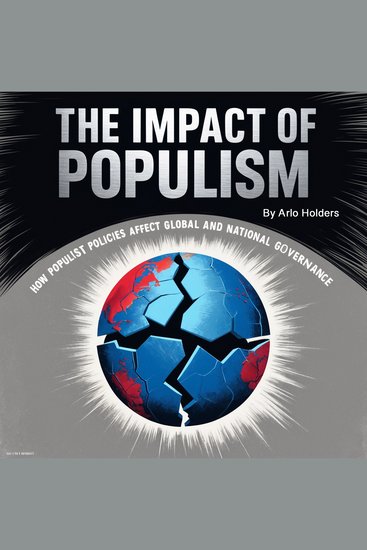
  • The Impact of Populism - How Populist Policies Affect Global and National Governance - cover

    The Impact of Populism - How...

    Arlo Holders

    • 0
    • 0
    • 0
    Populism has become one of the most significant political phenomena of the 21st century, influencing governance on a global scale. The term "populism" has been used to describe a wide range of political movements, parties, and ideologies, but its meaning often remains fluid and context-dependent. At its core, populism is a political approach that seeks to represent the interests of "the people" against a perceived elite or establishment that is seen as corrupt, self-serving, and out of touch with the common citizen. While this core idea is consistent, the ways in which populism is expressed and implemented vary dramatically depending on the political, cultural, and economic context. 
    The roots of populism stretch back to the 19th century, with early movements advocating for the empowerment of ordinary citizens, particularly in agricultural societies. However, the modern manifestation of populism began to take shape in the mid-20th century and accelerated in the 21st century, fueled by growing disillusionment with traditional political elites. The rise of social media, economic inequality, and a globalized world have all contributed to populism's recent resurgence, particularly in Western democracies. 
    Contemporary populism is often characterized by a charismatic leader who claims to speak directly for the people, bypassing traditional political institutions and sometimes challenging the rule of law. These leaders often portray themselves as outsiders, positioned against the political establishment, and frequently use simple, direct rhetoric that resonates with disaffected voters. The populist narrative, which pits the common people against the elite, is one of the most powerful tools in shaping public opinion and driving political discourse.
    Ver livro
  • American Injustice - My Battle to Expose the Truth - cover

    American Injustice - My Battle...

    John Paul Mac Isaac

    • 0
    • 0
    • 0
    As seen on Tucker Carlson Tonight! 


    This is the story of how I tried to get the Hunter Biden laptop evidence to the authorities. 


    My life changed forever on April 12, 2019, when Hunter Biden stumbled into my shop requesting data recovery from one of his liquid-damaged laptops. After his father announced his candidacy for president of the United States, and Hunter failed to pay for and collect his computer, fear for my safety grew. There was paperwork in Hunter's possession giving me permission to examine and copy his data—someone was going to come looking for the laptop, and come looking for me. Concerned that I was sitting on evidence in a criminal investigation, I set out to hand everything over to the FBI. But, feeling betrayed by the FBI's inaction in providing the laptop as evidence during the impeachment trial, I then turned to Congress, and ultimately, to a lawyer for the president, Rudy Giuliani. When the story broke, Big Tech and social and mainstream media blocked the reporting. I was instantly labeled as a hacker and a criminal. My actions were labeled Russian disinformation, and it didn't take long before people started attacking my business and my character, forcing me to close my shop and flee the state.
    Ver livro
  • The Wannabe Fascists - A Guide to Understanding the Greatest Threat to Democracy - cover

    The Wannabe Fascists - A Guide...

    Federico Finchelstein

    • 0
    • 0
    • 0
    Meet today's almost fascists and learn the warning signs to intercept them on the road from populism to dictatorship. 


    With The Wannabe Fascists, historian Federico Finchelstein offers a precise explanation of why Trumpism and similar movements across the world belong to a new political breed, the last outcome of the combined histories of fascism and populism: the wannabe fascists. This new type of populist politician is typically a legally elected leader who, unlike previous populists who were eager to distance themselves from fascism, turns to totalitarian lies, racism, and illegal means to destroy democracy from within. 


    Drawing on almost three decades of research on the histories of fascism and populism around the world, this book lays out in clear language what the author calls the "four pillars of fascism"—xenophobia, propaganda, political violence, and ultimately dictatorship. Finchelstein carefully explains how and why wannabe fascists like Trump, Bolsonaro, and Modi embrace the first three pillars but don't quite succeed in dictatorship and total suppression of the popular vote. The Wannabe Fascists stresses the importance of preventing despots from reaching this tipping point and offers a clear warning for what's at stake.
    Ver livro