¡Acompáñanos a viajar por el mundo de los libros!
Añadir este libro a la estantería
Grey
Escribe un nuevo comentario Default profile 50px
Grey
Suscríbete para leer el libro completo o lee las primeras páginas gratis.
All characters reduced
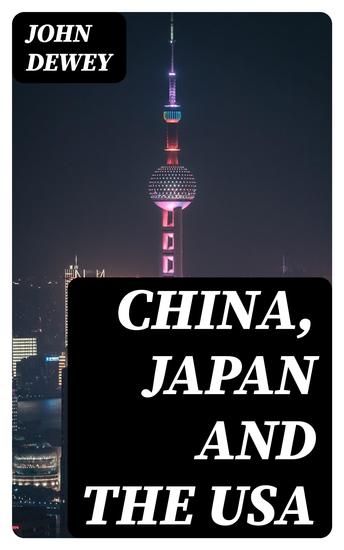
China Japan and the USA - cover

China Japan and the USA

John Dewey

Editorial: DigiCat

  • 0
  • 0
  • 0

Sinopsis

In "China, Japan and the USA," John Dewey navigates the complex interrelations among these three nations during a time marked by rapid political, social, and economic transformations. Combining elements of pragmatism with a keen observational style, Dewey highlights the cultural exchanges and conflicts that shaped modernity in East Asia and the West. His analysis deftly weaves together historical events with philosophical reflections, providing readers with a multifaceted understanding of the shifting dynamics, particularly in the realm of education and democracy, that connect these diverse societies. John Dewey, a pioneering philosopher and educational reformer, was profoundly influenced by his experiences in the early 20th century, where he witnessed the impact of globalization on individual identities and civic responsibility. His commitment to progressive education and democratic ideals propelled him to examine how nations could learn from one another's experiences. This intercultural lens is critical in understanding the underlying currents of thought that inform Dewey's approach in this work, as he seeks not just to critique, but to foster mutual understanding. "China, Japan and the USA" is essential reading for those looking to explore the philosophical and cultural dimensions of international relations. Dewey's insights remain profoundly relevant today, offering valuable perspectives on cooperation, conflict resolution, and the importance of dialogue in a globalized world. This book serves not only as a historical account but as a call to embrace an expansive view of human interaction across cultures.
Disponible desde: 11/10/2022.
Longitud de impresión: 100 páginas.

Otros libros que te pueden interesar

  • What the Anti-Federalists Were For - The Political Thought of the Opponents of the Constitution - cover

    What the Anti-Federalists Were...

    Herbert J. Storing

    • 0
    • 0
    • 0
    The Anti-Federalists, in Herbert J. Storing’s view, are somewhat paradoxically entitled to be counted among the Founding Fathers and to share in the honor and study devoted to the founding. “If the foundations of the American polity was laid by the Federalists,” he writes, “the Anti-Federalist reservations echo through American history; and it is in the dialogue, not merely in the Federalist victory, that the country’s principles are to be discovered.” It was largely through their efforts, he reminds us, that the Constitution was so quickly amended to include a bill of rights.Storing here offers a brilliant introduction to the thought and principles of the Anti-Federalists as they were understood by themselves and by other men and women of their time. His comprehensive exposition restores to our understanding the Anti-Federalist share in the founding its effect on some of the enduring themes and tensions of American political life. The concern with big government and infringement of personal liberty one finds in the writings of these neglected Founders strikes a remarkably timely note.
    Ver libro
  • Best Things First - cover

    Best Things First

    Bjorn Lomborg

    • 0
    • 0
    • 0
    Selected as one of the Best Books of 2023 by The Economist. 
    In this urgent, thought-provoking book, Bjorn Lomborg presents the 12 most efficient solutions for the world's poorest and our global SDG promises. • If you want to make the world better, Best Things First is the book to read. 
    World leaders have promised everything to everyone. But they are failing. The UN’s Sustainable Development Goals are supposed to be delivered by 2030. The goals literally promise everything, like eradicating poverty, hunger and disease; stopping war and climate change, ending corruption, fixing education along with countless other promises. This year, the world is at halftime for its promises, but nowhere near halfway. Together with more than a hundred of the world’s top economists, Bjorn Lomborg has worked for years to identify the world’s best solutions. Based on 12 new, peer-reviewed papers, forthcoming in Cambridge University Press’ Journal of Benefit-Cost Analysis, this book highlights the world’s best policies.
    Ver libro
  • Germany Between the World Wars: The History and Legacy of the Weimar Republic and Nazi Germany in the Interwar Period - cover

    Germany Between the World Wars:...

    Editors Charles River

    • 0
    • 0
    • 0
    The Weimar Republic has become a byword for a failed, tragic, political experiment. The official period of its existence, 1919-1933, marked the inter-war years in Germany and their related uncertainty, chaos and the state’s ultimate collapse. Historians have found the roots of Nazism embedded in the Weimar years and that in the final analysis, Weimar politicians voluntarily handed over power to the man who wrought destruction on an epic scale, Adolf Hitler. Yet the Weimar era encapsulated a number of trends and fissures within German society, as well as the international community. The Weimar Republic was a prisoner of events and in the long run had little power to shape them. Historians are fond of interpreting the past as a tension between human agency, that is to say decision-making, and structural developments that evade individual choices. Both these interpretations are crucial when examining the tumultuous years of Germany’s Weimar Republic. 
    The early 1930s were a tumultuous period for German politics, even in comparison to the ongoing transition to the modern era that caused various forms of chaos throughout the rest of the world. In the United States, reliance on the outdated gold standard and an absurdly parsimonious monetary policy helped bring about the Great Depression. Meanwhile, the Empire of Japan began its ultimately fatal adventurism with the invasion of Manchuria, alienating the rest of the world with the atrocities it committed.  
    It was in Germany, however, that the strongest seeds of future tragedy were sown. The struggling Weimar Republic had become a breeding ground for extremist politics, including two opposed and powerful authoritarian entities: the right-wing National Socialists and the left-wing KPD Communist Party. As the 1930s dawned, these two totalitarian groups held one another in a temporary stalemate, enabling the fragile ghost of democracy to continue a largely illusory survival for a few more years.
    Ver libro
  • Hidden Brilliance - Redefining Genius: The Overlooked Intellectual Giant - cover

    Hidden Brilliance - Redefining...

    John Harpoon

    • 0
    • 0
    • 0
    Genius is often perceived through a narrow lens, typically defined by extraordinary achievements, groundbreaking discoveries, or exceptional skills. However, this traditional view of genius overlooks many individuals whose brilliance remains hidden from the mainstream. The nature of genius is far more complex and multifaceted than society tends to acknowledge. It exists not only in those who are celebrated publicly but also in those whose contributions go unnoticed or unrecognized due to societal limitations or biases. 
    At its core, genius is about exceptional intellectual capacity, but this capacity can manifest in many different ways. It is not always about creating world-changing inventions or becoming a famous name. For many, genius lies in quiet innovation, subtle insights, and the ability to solve problems in unique and unconventional ways. It can be seen in the person who finds creative solutions to everyday challenges or in the thinker who makes a significant impact in a specific, narrow field of knowledge, even if that knowledge doesn’t capture the world’s attention.
    Ver libro
  • COVID Lockdown Insanity - The COVID Deaths It Prevented the Depression and Suicides It Caused What We Should Have Done and What It Shows We Could Do Now to Address Real Crises - cover

    COVID Lockdown Insanity - The...

    Hugh McTavish Ph.D.

    • 0
    • 0
    • 0
    A Ph.D. biochemist and immunologist goes through the data on one of the greatest public policy disasters in human history—the lockdown response to COVID.  How deadly was COVID originally and after it had evolved for a year or two?  How many COVID deaths were prevented by the lockdowns?  How many people did the lockdowns throw into depression? How many people did the lockdowns kill by deaths of despair?  	But the good news from the lockdowns is it shows citizens are willing to make enormous sacrifices for their society and that we can transform society on a dime.  What if we used that for good purposes?  What if we governed for the goal of happiness instead of maximizing GDP? What if we governed to protect the planet, instead of with the exclusive goal of extending the lives of the oldest and sickest people in society, even at the cost of killing the young and middle aged by deaths of despair and destroying the education and lives of children?
    Ver libro
  • Colorado Frontiersmen - Forts Fights and Legacies - cover

    Colorado Frontiersmen - Forts...

    Linda Wommack

    • 0
    • 0
    • 0
    Early Icons and Landmarks As western migration came to the Colorado frontier, forts were established to protect the settlers. These forts were intertwined with the lives of the frontiersmen. Scout Thomas Tate Tobin oversaw the workers who built the adobe fortress known as Fort Garland. Here, Tobin delivered the heads of the murderous Espinosas gang to Colonel Sam Tappan. Fort Sedgwick, originally known as Camp Rankin, was attacked by the Cheyenne Dog soldiers, including George Bent. Fort Lyon, an expanded fortress of William Bent's third fort, became the staging point for Colonel John M. Chivington's march to Sand Creek where peaceful Cheyenne were murdered. Later, Christopher "Kit" Carson died in the fort's chapel. Legendary Jim Beckwourth was associated with both Fort Vasquez and Fort Pueblo. Author Linda Wommack revisits the glory and the mistakes of the frontiersmen who defined Colorado and the forts that dotted the wild landscape.
    Ver libro