¡Acompáñanos a viajar por el mundo de los libros!
Añadir este libro a la estantería
Grey
Escribe un nuevo comentario Default profile 50px
Grey
Suscríbete para leer el libro completo o lee las primeras páginas gratis.
All characters reduced
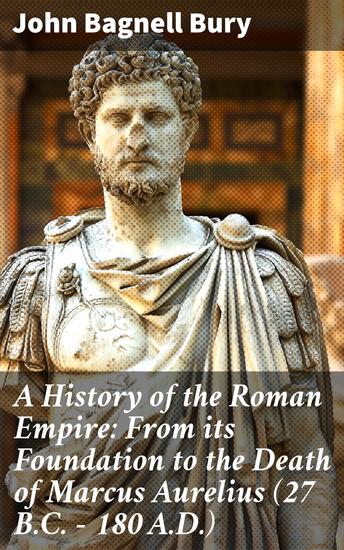
A History of the Roman Empire: From its Foundation to the Death of Marcus Aurelius (27 BC – 180 AD) - Enriched edition Exploring Rome's Rise and Fall with Expert Analysis - cover

A History of the Roman Empire: From its Foundation to the Death of Marcus Aurelius (27 BC – 180 AD) - Enriched edition Exploring Rome's Rise and Fall with Expert Analysis

John Bagnell Bury

Editorial: Good Press

  • 0
  • 0
  • 0

Sinopsis

In "A History of the Roman Empire: From its Foundation to the Death of Marcus Aurelius (27 B.C. 'Äì 180 A.D.)," John Bagnell Bury masterfully chronicles the expansive history of the Roman Empire, blending meticulous research with a captivating narrative style that brings the political, military, and cultural complexities of the era to life. Bury's work is characterized by its analytical rigor and synthetic overview, making it a pivotal contribution to Roman historical scholarship. He delves into the intricacies of imperial governance, social structures, and the socio-political dynamics that influenced the rise and fall of emperors, particularly focusing on how these elements shaped the empire up to the death of one of its most significant emperors, Marcus Aurelius. John Bagnell Bury (1861-1927) was a notable historian and classical scholar whose extensive academic background and expertise in Latin and Greek literature propelled him to examine the intricacies of the Roman Empire with a discerning eye. Educated at Trinity College, Dublin, Bury not only authored this seminal work but also engaged deeply with classical texts, enabling him to contextualize Rome's ancient history within a broader European heritage, ultimately influencing historical perspectives well into the twentieth century. This book is essential reading for anyone interested in the monumental legacy of the Roman Empire and its enduring impact on Western civilization. Bury's eloquent prose and scholarly depth offer readers profound insights into the political philosophies and cultural developments that shaped an empire, making it a cornerstone for scholars, students, and history enthusiasts alike.

In this enriched edition, we have carefully created added value for your reading experience:
- A succinct Introduction situates the work's timeless appeal and themes.
- The Synopsis outlines the central plot, highlighting key developments without spoiling critical twists.
- A detailed Historical Context immerses you in the era's events and influences that shaped the writing.
- A thorough Analysis dissects symbols, motifs, and character arcs to unearth underlying meanings.
- Reflection questions prompt you to engage personally with the work's messages, connecting them to modern life.
- Hand‐picked Memorable Quotes shine a spotlight on moments of literary brilliance.
- Interactive footnotes clarify unusual references, historical allusions, and archaic phrases for an effortless, more informed read.
Disponible desde: 09/12/2023.
Longitud de impresión: 564 páginas.

Otros libros que te pueden interesar

  • How America Dismantled the British Empire - cover

    How America Dismantled the...

    Aaron North

    • 0
    • 0
    • 0
    In "How America Dismantled the British Empire," journey through one of the most transformative periods in modern history, where the balance of global power shifted decisively from the British Empire to the United States. This meticulously detailed account delves into the political machinations, strategic decisions, and international pressures that culminated in the Suez Crisis of 1956—a pivotal event that signaled the end of Britain's imperial dominance and heralded the ascent of American influence. 
    Explore the intricate dynamics between key figures like British Prime Ministers Winston Churchill and Anthony Eden, U.S. Presidents Dwight D. Eisenhower, and Egyptian leader Gamal Abdel Nasser. Uncover the layers of frustration, miscommunication, and strategic realignment that characterized the era. From the corridors of power in London and Washington to the volatile landscapes of the Middle East, this book paints a comprehensive picture of the geopolitical shifts that reshaped the world order. 
    "How America Dismantled the British Empire" offers an in-depth analysis of the decline of British influence and the concurrent rise of American hegemony, set against the backdrop of Cold War tensions and emerging post-colonial movements. The narrative captures the essence of a time when global leadership was contested, alliances were tested, and the future of international relations was irrevocably altered. 
    Whether you are a history enthusiast, a student of international relations, or simply curious about the forces that shaped the contemporary world, "How America Dismantled the British Empire" provides a compelling, insightful, and richly detailed chronicle of an era that defined the trajectory of modern geopolitics.
    Ver libro
  • The Einstein Syndrome - Bright Children Who Talk Late - cover

    The Einstein Syndrome - Bright...

    Thomas Sowell

    • 0
    • 0
    • 0
    The Einstein Syndrome is a follow-up to Late-Talking Children, which established Thomas Sowell as a leading spokesman on the subject of late-talking children. While many children who talk late suffer from developmental disorders or autism, there is a certain well-defined group who are developmentally normal or even quite bright, yet who may go past their fourth birthday before beginning to talk. These children are often misdiagnosed as autistic or retarded, a mistake that is doubly hard on parents who must first worry about their apparently handicapped children and then see them lumped into special classes and therapy groups where all the other children are clearly very different. Since he first became involved in this issue in the mid-90s, Sowell has joined with Stephen Camarata of Vanderbilt University, who has conducted a much broader, more rigorous study of this phenomenon than the anecdotes reported in Late-Talking Children. Sowell can now identify a particular syndrome, a cluster of common symptoms and family characteristics, that differentiates these late-talking children from others; relate this syndrome to other syndromes; speculate about its causes; and describe how children with this syndrome are likely to develop.
    Ver libro
  • Genocides - Historic Details of the Armenian Cambodian Rwandan Yugoslavian Sudanese and Nazi Genocide - cover

    Genocides - Historic Details of...

    Kelly Mass

    • 0
    • 0
    • 0
    This book consists of 6 topics, all selected to describe some of the worst atrocities of mankind: Genocides, mass rapes, abuse, mutilation and murder. It contains these topics: 
    Armenian Genocide: At the time of World War I, the Ottoman Empire committed the Armenian genocide, which led to the organized death of around one million ethnic Armenians. It was primarily achieved by mass executions, death marches resulting in the Syrian Desert, and the pushed Islamization of Armenian women and kids. 
    Cambodian Genocide: The Cambodian genocide was the methodical abuse and death of Cambodians by the Khmer Rouge, led by Pol Pot, the general secretary of the Communist Party of Kampuchea, who pushed Cambodia towards being an entirely self-dependent agrarian socialist state.  
    Genocide in Darfur: The Darfur genocide describes the methodical killing of ethnic Darfuri people in Western Sudan throughout the existing dispute. It's considered the first genocide of the twenty-first century. The International Bad Guy Court (ICC) has prosecuted many individuals for criminal offenses against mankind, rape, mass relocations and deportations, and abuse because of the genocide being committed. 
    Holocaust: At the time of WWII, the Holocaust, was a genocide of European Jews. Between 1941 and 1945, Nazi Germany and its allies killed around 6 million Jews in German-occupied Europe, representing about two-thirds of Europe's Jewish population. 
    Rwandan Genocide: Throughout the Rwandan Civil War, between April seventh and July fifteenth, 1994, the Rwandan genocide happened. Equipped militias murdered members of the Tutsi minority ethnic group, and some moderate Hutu and Twa. 
    Yugoslavian Genocide: Throughout the Bosnian War of 1992-- 1995, the Yugoslavian or Bosnian genocide describes either the Srebrenica massacre or the larger criminal activities against mankind in areas controlled by the Army of Republika Srpska (VRS).
    Ver libro
  • On Poetry - cover

    On Poetry

    Jackie Wills

    • 0
    • 0
    • 0
    We begin with a drive to write something that's never been said before, to protest, to offload, to challenge or catch the zeitgeist. We imagine we write like the poets we admire. Slowly we learn the craft, understanding eventually that a writer is indentured for life.
    Drawing on decades of experience as a poet and tutor, this compelling book is part hands-on guide and part reflection on ways that poetry can make a difference to how we live. It is also a survey of many varied and inspirational writers, especially women poets from the end of the 20th century.
    The final section of this unique book offers starting points and resources that will prove essential for new and experienced poets alike. Jackie Wills is herself one of our most genuine and brilliantly insightful poets; and, as the sections on writing workshops show, she has helped people of all ages find their way into poetry.
    Ver libro
  • Humanoid Robots & Drones: How the Age of Smart Machines Will Revolutionize Our World - cover

    Humanoid Robots & Drones: How...

    Dr. Nick Coman, I. A.I.

    • 0
    • 0
    • 0
    “Humanoid Robots & Drones: How the Age of Smart Machines Will Revolutionize Our World” is a 24‑lecture audio expedition for anyone who likes their wonder with measurements. We chase robots, humanoids, and drones through restaurants, farms, warehouses, hospitals, disaster scenes, stadiums, and city skies—treating each as a solvable puzzle. How does a drone hold position in wind? Why does a humanoid’s shape matter for doors and stairs? When does a non‑humanoid robot beat a humanoid? More often than you’d guess.
     
    You’ll learn the working grammar of the field: motors, cameras, lidar, batteries, and the ugly truth about friction, glare, and radio noise. You’ll see how a drone’s navigation, thermal views, and geofences turn into defect lists, not pretty video; how warehouse robots schedule intersections; why “stop distance” and “payload versus endurance” make or break a plan; and how soft‑skinned humanoids handle the “last ten centimeters” that buildings were designed for human hands. We translate regulation and risk into simple playbooks you can actually use—what the rules permit, what insurers demand, and what keeps neighbors calm.
     
    Expect case studies with receipts: drone light shows that replace fireworks with quiet pixels; roof and bridge inspections before breakfast; farm rigs that spray where plants actually are; hospital runners and delivery bots that save steps and shoulders; telepresence poles and companion robots that help real people on real Tuesdays. The tone is sharp, funny, and unromantic: we puncture hype, celebrate craft, and name failure modes out loud.
     
    By the end, you’ll be able to read a spec sheet like a mechanic, design a credible first deployment, and argue—politely but mercilessly—about the next 10, 25, and 50 years. If you want an operator’s guide to the robots, humanoids, and drones that already work (and the ones that almost do), buckle in. The robots are clocked in, the drones are charged, and class is wheels‑up.
    Ver libro
  • Unchained Minds - Frederick Douglass And The Fight For African American Education - cover

    Unchained Minds - Frederick...

    Davis Truman

    • 0
    • 0
    • 0
    This audiobook is narrated by an AI Voice.   
    *Unchained Minds: Frederick Douglass and the Fight for African American Education* delves into the extraordinary life of Frederick Douglass, a man who defied the shackles of slavery through the transformative power of literacy. Born into bondage, Douglass dared to learn what was forbidden: the ability to read and write. This audacious act set him on a path to freedom and made him one of his time's most influential African American voices. 
    This book examines Douglass's relentless pursuit of education as a means of liberation, not just for himself, but for all African Americans. It examines how Douglass's passion for learning fueled his activism and unyielding belief that education was the key to overcoming the horrors of slavery and achieving true equality.  
    *Unchained Minds* is a biography and a powerful testament to the enduring belief that education is the cornerstone of freedom. This compelling account of Frederick Douglass's life and his fight for educational equality will inspire readers to reflect on the transformative power of knowledge and the ongoing fight for justice.
    Ver libro