Unisciti a noi in un viaggio nel mondo dei libri!
Aggiungi questo libro allo scaffale
Grey
Scrivi un nuovo commento Default profile 50px
Grey
Iscriviti per leggere l'intero libro o leggi le prime pagine gratuitamente!
All characters reduced
Knowing and acting - cover

Knowing and acting

John Alexander Smith

Casa editrice: DigiCat

  • 0
  • 0
  • 0

Sinossi

In "Knowing and Acting," John Alexander Smith presents a thought-provoking exploration of the interplay between knowledge and action in ethical decision-making. Written in a lucid style enriched with philosophical insights, the book examines various epistemological frameworks, arguing for a nuanced understanding of how knowledge influences moral behavior. Smith deftly navigates historical and contemporary philosophical thought, drawing from figures such as Aristotle and Kant, and intertwining this analysis with real-world examples that resonate with today's ethical dilemmas. Through a blend of rigorous argumentation and accessible prose, Smith invites readers to reflect critically on their own beliefs and actions. John Alexander Smith, a prominent philosopher and educator, has dedicated his career to studying the intersections of ethics, knowledge, and social responsibility. Influenced by his extensive research in epistemology and moral philosophy, Smith's perspective is shaped by both his academic training and his personal commitment to fostering a more ethical society. His insights are informed by years of teaching and dialogue with students, where the practical implications of knowledge have continually emerged as a focal point. For readers seeking a deeper understanding of how our knowledge shapes our actions, "Knowing and Acting" offers a compelling framework for examining the moral implications of our beliefs. This book is essential for students, educators, and anyone interested in ethical philosophy, serving as both a guide and a call to action in the pursuit of a more conscientious life.
Disponibile da: 29/05/2022.
Lunghezza di stampa: 23 pagine.

Altri libri che potrebbero interessarti

  • Point of View - cover

    Point of View

    Sandra Gerth

    • 0
    • 0
    • 0
    Point of view (POV) is one of the most powerful tools in a writer's kit, but it's also one of the hardest to understand and master. 


    In this book, Sandra Gerth draws on her experience as an editor and a best-selling author to teach you how to handle point of view in a way that will make your readers identify with your main character, draw them into the story, and keep them captivated until the very last page. 


    The book provides concrete examples and exercises that will hone your writing skills. 


    Whether you're a novice writer working on her first story or an established author, this book will help you to: 


    ● Discover what point of view is and why it's so important. 


    ● Understand the different types of point of view such as first-person, third-person, omniscient, and deep POV. 


    ● Choose the point of view that works best for your story.
    Mostra libro
  • Stalingrad's Crucible - Unveiling the Turning Point of World War II - cover

    Stalingrad's Crucible -...

    History Retold

    • 0
    • 0
    • 0
    Amidst the tapestry of history, a tale of great valor and unyielding spirit unfolds – "Stalingrad´s crucible." Herein, the annals of time are unrolled, revealing the epochal Battle of Stalingrad in its most intricate and captivating detail. 
    Venture beyond the mortal veil and walk among the soldiers, civilians, and leaders who bore witness to this climactic clash. Peer into personal chronicles, wherein courage, sacrifice, and the unquenchable flame of determination burn bright. 
    Allow the hallowed arena of strategic warfare embrace you, where tactics, maneuver, and the weighty choices of commanders dictated destiny. The dance of command, the intricacies of intelligence, and the ever-shifting lines of battle are laid bare. Traverse the corridors of time to comprehend the intricate tapestry of events leading to this monumental confrontation. Peer beyond the battle's borders and uncover the geopolitical forces, alliances, and ambitions that gave birth to this saga. 
    In this book you´ll:Experience an Epic Prose: The words flow as if spun by the quill of ages past, entwining history into a captivating tapestry of narrative.Enjoy a Holistic Odyssey: Beyond the battle's ardor, delve into the lives and dreams of those who walked its fields, forging a profound connection with history's pulse.Unfade Wisdom: Lessons unveiled transcend epochs, resonating as potently in our modern era as in the echoes of yore. 
    Unleash the Power of "Stalingrad´s Crucible" Today! 
    Embark upon a journey through the corridors of time, reliving the clash that indelibly etched its mark upon the annals of humanity. 
    Don´t wait. Scroll up and buy this book now!
    Mostra libro
  • License to Travel - A Cultural History of the Passport - cover

    License to Travel - A Cultural...

    Patrick Bixby

    • 0
    • 0
    • 0
    Discover the surprising global history of how the passport has shaped art, thought, and human experience to define the modern world. 
     
    License to Travel exposes the passport as both an instrument of personal freedom and a tool of government surveillance powerful enough to define our very humanity. 
     
    Patrick Bixby examines the passports of artists and intellectuals, ancient messengers and modern migrants to reveal how these seemingly humble documents implicate us in larger narratives about identity, mobility, citizenship, and state authority. 
     
    This concise cultural history:  
    • Takes the reader on a captivating journey from pharaonic Egypt and Handynasty China to the passport controls and crowded refugee camps of today. 
    • Connects intimate stories of vulnerability and desire with vivid examples drawn from world cinema, literature, art, philosophy, and politics 
    • Highlights the control that travel documents have over our bodies as we move around the globe. 
     
    With unexpected discoveries at every turn, from narrow escapes and new starts, tearful departures and hopeful arrivals, License to Travel shares some of our most memorable experiences involving the passport.
    Mostra libro
  • Farewell Address Oval Office - cover

    Farewell Address Oval Office

    Ronald Reagan

    • 0
    • 0
    • 0
    On January 11, 1989, Reagan gave the following farewell address to the nation from the Oval Office. The two things I’m proudest of are the economic recovery which created 19 million new jobs and that America is respected again in the world.  
    In 1980 pundits said our economic policies would cause inflation and collapse while our foreign policies would lead to war. Instead, tax cuts created “the longest peacetime expansion in our history” and “an explosion in research and new technology.” We knocked “down protectionist walls abroad instead of erecting them at home.” 
    We rebuilt our defenses and saw a new peacefulness around the globe. “Countries across the globe are turning to free markets and free speech and turning away from the ideologies of the past.” 
    I went into politics to protect something precious. “Our Constitution is a document in which ‘We the People’ tell the government what it is allowed to do. In the 1960s the government was taking our freedom with rules and regulations and confiscatory taxes.  
    People are “not free unless government is limited. There's a clear cause and effect here that is as neat and predictable as a law of physics: As government expands, liberty contracts.” 
    Are “we doing a good enough job teaching our children what America is and what she represents in the long history of the world?” “America is freedom -- freedom of speech, freedom of religion, freedom of enterprise. And freedom is special and rare.” Let’s start with more attention to American history. 
    I see America as a “shining city upon a hill” teeming with all kinds of people living in harmony, with ports humming with commerce, with doors open to anyone with the will to get here, a beacon and magnet for all who must have freedom. 
    Audio recording courtesy of the Ronald Reagan Presidential Library. 
    AspenLeafMedia.com
    Mostra libro
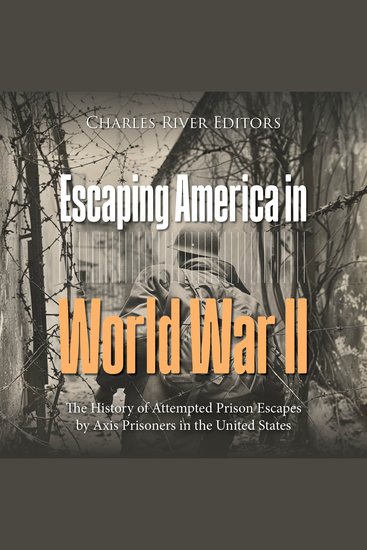
  • Escaping America in World War II: The History of Attempted Prison Escapes by Axis Prisoners in the United States - cover

    Escaping America in World War...

    Editors Charles River

    • 0
    • 0
    • 0
    Though it’s often overlooked today, during World War II, the United States held hundreds of thousands of enemy prisoners of war, and the country was unprepared for the influx, despite the fact that only weeks after the attack on Pearl Harbor, the government started detaining Japanese Americans and foreigners from Axis countries. Some camps, used for training Army recruits, were repurposed as prison camps, and the experience of building camps for the 120,000 Japanese and Japanese Americans was useful in building camps for the POWs. In addition to the Japanese, about 31,000 German, Japanese, and Italian residents were placed in camps.  
    	At first, there were few POWs because it took months for the American military to get ready to participate in campaigns. The first POW was a Japanese sailor who’d survived the sinking of his midget submarine at Pearl Harbor. The first German prisoners were survivors of U-boats sunk off the American coasts. There were also a few hundred German and Italian merchant sailors on ships seized in American ports (these sailors were interned as enemy aliens, not POWs). 
    	Soon, the prisoners came in waves. A sizable number came to the US at the request of Britain, which had too many prisoners and sent tens of thousands to Canada and the US. The first large number of enemy POWs captured by American forces came at the end of the North Africa campaign in May 1943, when the Allied forces trapped most of the vaunted Afrika Korps in Tunisia (then a French colony) and forced it to surrender. About 280,000 German and Italian troops surrendered. These were different from later prisoners; they tended to be volunteers, with many of them fervent Nazis (if German) and diehard Fascists (if Italian). They were generally confident of an ultimate German victory.
    Mostra libro
  • Uncle Tom's Cabin Volume 2 - cover

    Uncle Tom's Cabin Volume 2

    Harriet Beecher Stowe

    • 0
    • 0
    • 0
    In Uncle Tom’s Cabin Volume 2, Harriet Beecher Stowe deepens the exploration of slavery’s brutal realities. Uncle Tom, sold to the cruel Legree, endures unimaginable hardship while clinging to his faith and kindness. Meanwhile, Eliza and George Harris continue their perilous journey to Canada, facing dangers but finding allies in their fight for freedom. Through parallel stories of suffering and resilience, Stowe highlights the moral cost of slavery. As characters confront cruelty and compassion, the novel builds toward a powerful crescendo, emphasizing themes of redemption, hope, and the unbreakable spirit of those who resist oppression.
    Mostra libro