¡Acompáñanos a viajar por el mundo de los libros!
Añadir este libro a la estantería
Grey
Escribe un nuevo comentario Default profile 50px
Grey
Suscríbete para leer el libro completo o lee las primeras páginas gratis.
All characters reduced
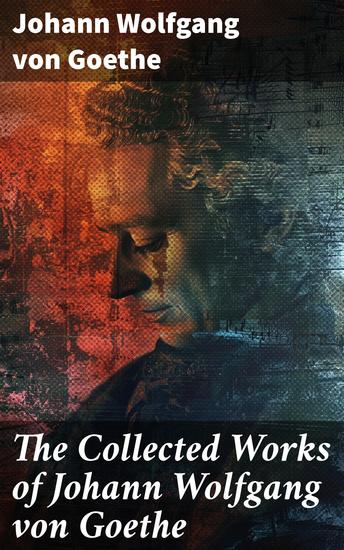
The Collected Works of Johann Wolfgang von Goethe - 200+ Titles in One Edition : Novels Tales Plays Essays Autobiography & Letters - cover

The Collected Works of Johann Wolfgang von Goethe - 200+ Titles in One Edition : Novels Tales Plays Essays Autobiography & Letters

Johann Wolfgang von Goethe

Traductor Samuel Taylor Coleridge, Thomas Carlyle, Bayard Taylor, Anna Swanwick, James Anthony Froude, Julia Franklin, John Oxenford, A. J. W. Morrison, R. Dillon Boylan, Thomas Bailey Saunders, Charles Lock Eastlake, Hjalmar Hjorth Boyesen, Edgar A. Bowring, L. Dora Schmitz, Louis H. Gray, Sir Theodore Martin, Walter Scott

Editorial: Good Press

  • 0
  • 0
  • 0

Sinopsis

The Collected Works of Johann Wolfgang von Goethe is an expansive anthology that encapsulates the full breadth of Goethe's literary genius. This compendium offers readers a diverse spectrum of his writings, including poetry, plays, and philosophical treatises, characterized by a versatile literary style that traverses Romanticism, Enlightenment ideals, and early modern existentialism. Featuring masterpieces such as "Faust," this volume delves into deep philosophical questions of existence, morality, and the human condition, while also integrating vibrant imagery and innovative narrative techniques that showcase Goethe's mastery of language and form. Johann Wolfgang von Goethe (1749-1832), a luminary of German literature, emerged as a pivotal figure during the Sturm und Drang and Romantic movements. His extensive travels and profound engagement with art, science, and philosophy profoundly influenced his writing. Goethe's interdisciplinary approach allowed him to explore the interconnectedness of nature and spirit, reflecting a holistic worldview that permeates his collected works. His correspondence with contemporaries, as well as his fascination with issues of identity and fate, illuminates the intellectual and emotional fabric of his literary contributions. This collected edition is highly recommended for those seeking to engage with Goethe'Äôs transformative ideas and rich prose. It serves as an essential resource for scholars and enthusiasts alike, providing insights into the evolution of modern thought and the timeless inquiries into life and purpose that continue to resonate today.
Disponible desde: 03/12/2023.
Longitud de impresión: 5264 páginas.
Otros libros que te pueden interesar

  • The Man from Steamtown - The Story of F Nelson Blount - cover

    The Man from Steamtown - The...

    James R. Adair, Hannah Goodman

    • 0
    • 0
    • 0
    The throbbing sound of the steam-driven pistons and sight of the flashing drive-rods quickened the boy's pulse. He had heard and seen it all from his bedroom window, but now he had stepped-in person-into the wonderful world of steam. F. Nelson Blount's interest in steam engines began when he was only four. As he grew up, he studied and wrote about them, often traveling many miles to see one. Yet it was years before he was able to pursue his dream of becoming an engineer. With his keen head for business and unyielding perseverance, Nelson became a millionaire in the seafood industry before he was thirty. Over the years, he did stunt flying and deep-sea fishing. He collected old guns, vintage cars, and finally, a railroad with a "thundering herd" of steam locomotives to preserve the wonderful Steam Age. Thus Steamtown, USA, was born, and Nelson fulfilled his lifelong dream. But none of this brought him true happiness or peace. It took his wife's near-fatal automobile accident to make Nelson realize that money has its limits, and there are some things only God can do. This led to Nelson's dramatic conversion and a relationship with Jesus Christ that turned him into a dynamic witness who put hundreds on track for the Lord. Even though Nelson died five years later, he left a legacy that is still impacting people today. The Man from Steamtown tells his amazing story.
    Ver libro
  • I Am Alien to Life - Selected Stories - cover

    I Am Alien to Life - Selected...

    Djuna Barnes, Merve Emre

    • 0
    • 0
    • 0
    Djuna Barnes is rightly remembered for Nightwood, her breakthrough and final novel: a hallmark of modernist literature, championed by T. S. Eliot, and one of the first, strangest, and most brilliant novels of love between women to be published in the twentieth century. Barnes's career began long before Nightwood, however, with journalism, essays, drama, and satire of extraordinary wit and courage. Long into her later life, after World War II, when she published nothing more, it was her short fiction above all that she prized and would continue to revise. 


    Here are all the stories Barnes sought to preserve, in the versions she preferred, as well as a smattering of rarities as selected by critic and New Yorker contributor Merve Emre. These are tales of women "'tragique' and 'triste' and 'tremendous' all at once," of sons and daughters being initiated into the ugly comedy of life, monuments all to a worldview singular and scathing. As Emre writes in her foreword "[Barnes's] themes are love and death, especially in Paris and New York; the corruption of nature by culture; the tainted innocence of children; and the mute misery of beasts . . . her characters may be alien to life, but they are alive—spectacularly, grotesquely alive."
    Ver libro
  • A Fragment of Stained Glass - From their pens to your ears genius in every story - cover

    A Fragment of Stained Glass -...

    D H Lawrence

    • 0
    • 0
    • 0
    David Herbert Lawrence was born on the 11th September 1885 in Eastwood, Nottinghamshire, a coal mining town where the reality of a harsh life was only useful as experiences for future literary works. 
    He was educated at Beauvale Board School and became the first local boy to receive a scholarship to attend Nottingham High School. After 3 years he became a junior clerk in Haywood’s surgical appliances factory. He was also attempting a literary career which, in the short term, led to a teacher training position in Eastwood and later a teaching qualification from University College, Nottingham.  
    Lawrence’s first efforts were poems, short stories and a draft of ‘The White Peacock’. Moving to London and a teaching position in Croydon his writing attracted the attention of Ford Madox Ford, editor of The English Review, and he commissioned him to write ‘Odour of Chrysanthemums’.  
    Wanting to write full-time he now began work on what would become ‘Sons and Lovers.   
    In 1912 he met the older and married mother-of-three Frieda Weekley. They eloped to Germany and here Lawrence could see for himself the growing tensions with France.  So keen was his interest that he was arrested and accused of being a British spy.  
    In early 1914 Frieda obtained her divorce and they returned to Britain to be married just days before the outbreak of war. Owing to her German parentage, and his own public dislike of militarism and violence, the couple were treated with contempt and suspicion throughout the war years.  
    Despite this he continued to write but his reputation in England was so tarnished and, mirrored by his own disdain for the country, he and Frieda left England in November 1919, first for Europe and then America via Ceylon and Australia. 
    They bought a ranch in Taos, New Mexico and visited Mexico several times. The third visit in March 1925 caused a near fatal attack of malaria. To convalesce they moved to Florence. Here he continued work on ‘Lady Chatterley’s Lover’ which for many years would cause controversy. A renewed interest in oil painting resulted in an exhibition in 1929 which was raided by the police and several works were confiscated.  
    D H Lawrence died of complications arising from a bout of tuberculosis on the 2nd of March 1930 in Vence, France.  He was 44.
    Ver libro
  • Dialysis: a Memoir Second Edition - cover

    Dialysis: a Memoir Second Edition

    Lisa Frieden

    • 0
    • 0
    • 0
    Dialysis: a Memoir tells the story of how a young woman’s life is changed forever when her kidneys fail. From hospitalization and hemodialysis to peritoneal dialysis and finally to a transplant, the memoir explores how her experience of illness clashes with the world around her: the buoyant and youthful atmosphere of the San Francisco Bay Area during the dotcom bubble of the late 1990's. The memoir describes how she learns to make sense of what happened and how she ultimately overcomes the physical and emotional challenges of kidney failure to thrive in her new life. The audiobook is read by the author.
    Ver libro
  • The Snake Has All the Lines - cover

    The Snake Has All the Lines

    Jean Kerr

    • 0
    • 0
    • 0
    The #1 New York Times–bestselling author of Please Don’t Eat the Daisies offers another hilarious look at home life, show business, and more. Jean Kerr played many roles in her life, from exasperated mother to Broadway playwright and keen observer of mid-twentieth century suburbia. She also became one of America’s most beloved humorists by sharing her insights and anecdotes in a series of popular newspaper columns. In The Snake Has All the Lines, Kerr explores topics ranging from family vacations and modern convenience to the trials and tribulations of opening a new play. With her inimitable wit, she reminds us that while life may be a day at the beach, a day at the beach with small children can have you questioning your life choices in no time.
    Ver libro
  • A Rich Woman - From their pens to your ears genius in every story - cover

    A Rich Woman - From their pens...

    Katharine Tynan

    • 0
    • 0
    • 0
    Katharine Tynan was born on 23rd January 1859 into a large family in Clondalkin, County Dublin. 
    The family business was cattle rearing and the farmhouse, set with the mountains for a backdrop, was a wonderful world for a young mind to learn and imagine. 
    She was educated at the convent school, St Catherine of Sienna, in Drogheda.  A stubborn streak inhibited her ability to learn as easily as the school wished. However she did learn on her own terms and soon began to take her ‘forbidden literature’, hidden in her clothing, to her loft in a stable hideaway.  
    Until she turned seventeen nothing appeared to point to a literary career.  But some verse printed in a Dublin newspaper changed everything. It led to a sonnet being printed in the Spectator.  Thereafter the Graphic published several others and even paid a half guinea for the privilege.   
    In 1884 Katharine dispatched herself to London and made an abiding friendship in Alice Meynell.  Alice was an established poet and helped, with her husband Wilfred, to publish many poets. The following year it was arranged for the publication of her first poetry volume, ‘Louise de la Vallière’.  
    She formed valuable friendships with the poets Gerard Manley Hopkins, William Butler Yeats and later Francis Ledwidge.  
    As she gathered friends and contacts into her life her literary output began to gather pace. Katharine had begun to write prose for the Speaker and for the Scots and National Observer.  
    In 1892 she married Henry Albert Hinkson, a fellow writer and a barrister.  They moved to England and had five children although two were to tragically die in infancy.   
    By now her output was prolific and ranged from poetry to novels to short stories.  It would later include a biography and further extend to editing and reviewing.   
    In 1912 the family returned to Claremorris, County Mayo, when her husband was appointed magistrate, a post he held until his early death in 1919.     
    Tynan is sometimes grouped amongst the War Poets of the First World War. Her experience was not direct but as a Mother with one son serving in France and another in Palestine, the emotions, fears and doubts are expressed in a beautiful and heart-felt way.  
    Involved in the Irish Literary Revival, Tynan expressed concern for feminist causes, the poor, and the effects of World War I in her work. She also meditated on her Catholic faith. 
    She is said to have written over 100 novels, 12 collections of short stories, plays and many volumes of enduring poetry as well as five volumes of autobiography. 
    Katharine Tynan Hinkson died at age 72 on 2nd April 1931 in London and is buried in Kensal Green Cemetery.
    Ver libro