Junte-se a nós em uma viagem ao mundo dos livros!
Adicionar este livro à prateleira
Grey
Deixe um novo comentário Default profile 50px
Grey
Assine para ler o livro completo ou leia as primeiras páginas de graça!
All characters reduced
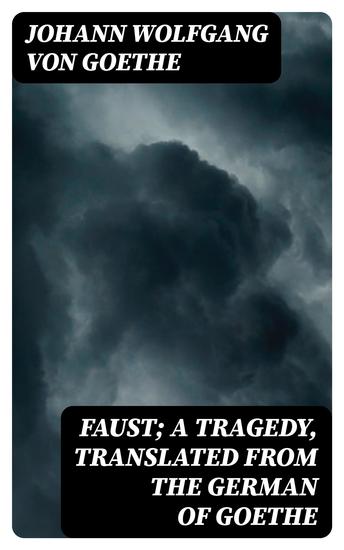
Faust; a Tragedy Translated from the German of Goethe - cover
LER

Faust; a Tragedy Translated from the German of Goethe

Johann Wolfgang von Goethe

Tradutor Charles Timothy Brooks

Editora: DigiCat

  • 0
  • 0
  • 0

Sinopse

In "Faust; a Tragedy, Translated from the German of Goethe," the renowned German literary giant Johann Wolfgang von Goethe explores profound themes of human desire, ambition, and the quest for knowledge. This monumental work, first published in the early 19th century, is characterized by its intricate verse and philosophical depth, merging elements of Romanticism with classical influences. Through the character of Faust, who makes a pact with Mephistopheles in pursuit of ultimate wisdom and earthly pleasures, Goethe delves into the moral dilemmas humans face when confronting the limitations of their existence, thus situating his work within the broader European context of existential inquiry and the struggle between enlightenment and superstition. Goethe, a polymath and pivotal figure of the Sturm und Drang movement, drew upon his diverse experiences in science, philosophy, and politics to craft this profound tragedy. His lifelong fascination with duality and the human spirit's aspirations is reflected in Faust's character. Goethe's own struggles with forgiveness, reconciliation, and the pursuit of self-knowledge shine through his vigilant narrative, adding layers of personal insight to the universal themes embedded in the text. "Faust" is an essential read for anyone seeking to comprehend the complexities of human nature and moral philosophy. Goethe's eloquent prose invites readers into a world where ambition can lead to both enlightenment and despair. Engaging with this tragic masterpiece is not only a literary journey but an exploration of the timeless questions that challenge humanity, making it indispensable for scholars, students, and literary enthusiasts alike.
Disponível desde: 02/06/2022.
Comprimento de impressão: 194 páginas.

Outros livros que poderiam interessá-lo

  • Silas Marner (Legend Classics) - cover

    Silas Marner (Legend Classics)

    George Eliot

    • 0
    • 1
    • 0
    “Nothing is so good as it seems beforehand.” 
    Silas Marner is a simple weaver from Lantern Yard, an impoverished area of Northern England. He is the main protagonist who is wrongly accused of being a robber. Silas loses his sweetheart, reputation, and as a result, has to move out of the town. He dedicates the next fifteen years of his life to earning money. Despite developing an unhealthy obsession, he is still the same just and honest person albeit rather stingy by this time as monetary enrichment became the sole purpose of his being. But when injustice strikes again, Silas is about to change his perception of life forever. What he first considers to be the ultimate disaster of his existence, turns into the thing that gives a new meaning to his life. This moral tale will set things in the right place presenting a picture of justice and love that rise above ignorance and greed. 
    The work is regarded as a pastoral novel and a moral tale with fairytale elements. A notable feature is Eliot's representation of the effects of industrialisation. Indeed, upon Silas's return to his home town in his old age, he can barely recognise the town where new buildings and factories have been erected. The author deploys her signature technique of setting the novel in a more distant past, which gives her the advantage of scope and hindsight. Published a year before Hugo's world-famous Les Misérables, Silas Marner tackles many similar tropes as effectively and authentically but in a more condensed form – in particular, finding the meaning in life when there seems to be nothing left to hold on to. 
    The Legend Classics series:Around the World in Eighty DaysThe Adventures of Huckleberry FinnThe Importance of Being EarnestAlice's Adventures in WonderlandThe MetamorphosisThe Railway ChildrenThe Hound of the BaskervillesFrankensteinWuthering HeightsThree Men in a BoatThe Time MachineLittle WomenAnne of Green GablesThe Jungle BookThe Yellow Wallpaper and Other StoriesDraculaA Study in ScarletLeaves of GrassThe Secret GardenThe War of the WorldsA Christmas CarolStrange Case of Dr Jekyll and Mr HydeHeart of DarknessThe Scarlet LetterThis Side of ParadiseOliver TwistThe Picture of Dorian GrayTreasure IslandThe Turn of the ScrewThe Adventures of Tom SawyerEmmaThe TrialA Selection of Short Stories by Edgar Allan PoeGrimm Fairy TalesThe AwakeningMrs DallowayGulliver’s TravelsThe Castle of OtrantoSilas MarnerHard Times
    Ver livro
  • A Wireless Message - From their pens to your ears genius in every story - cover

    A Wireless Message - From their...

    Ambrose Bierce

    • 0
    • 0
    • 0
    Ambrose Gwinnett Bierce was born on 24th June 1842 at Horse Cave Creek in Meigs County, Ohio. His parents were poor but they introduced him to literature at an early age, instilling in him a deep appreciation of books, the written word and the elegance of language.  
    Growing up in Koscuisko County, Indiana poverty and religion were defining features of his childhood, and he would later describe his parents as “unwashed savages” and fanatically religious, showing him little affection but always quick to punish. He came to resent religion, and his introduction to literature appears to be their only positive effect. 
    At age 15 Bierce left home to become a printer’s devil, mixing ink and fetching type at The Northern Indian, a small Ohio paper. Falsely accused of theft he returned to his farm and spent time sending out work in the hopes of being published. 
    His Uncle Lucius advised he be sent to the Kentucky Military Institute. A year later he was commissioned as an Officer.  As the Civil War started Bierce enlisted in the 9th Indiana Infantry Regiment.  
    In April 1862 Bierce fought at the Battle of Shiloh, an experience which, though terrifying, became the source of several short stories. Two years later he sustained a serious head wound and was off duty for several months. He was discharged in early 1865.  
    A later expedition to inspect military outposts across the Great Plains took him all the way to San Francisco. He remained there to become involved with publishing and editing and to marry, Mary Ellen on Christmas Day 1871.  They had a child, Day, the following year.  
    In 1872 the family moved to England for 3 years where he wrote for Fun magazine. His son, Leigh, was born, and first book, ‘The Fiend’s Delight’, was published.  
    They returned to San Francisco and to work for a number of papers where he gained admiration for his crime reporting. In 1887 he began a column at the William Randolph Hearst’s San Francisco Examiner.  
    Bierce’s marriage fell apart when he discovered compromising letters to his wife from a secret admirer. The following year, 1889 his son Day committed suicide, depressed by romantic rejection. 
    In 1891 Bierce wrote and published the collection of 26 short stories which included ‘An Occurrence at Owl Creek Bridge’.  Success and further works including poetry followed.  
    Bierce with Hearst’s resources helped uncover a financial plot by a railroad to turn 130 million dollars of loans into a handout. Confronted by the railroad and asked to name his price Bierce answered “my price is $130 million dollars. If, when you are ready to pay, I happen to be out of town, you may hand it over to my friend, the Treasurer of the United States”.  
    He now began his first foray as a fabulist, publishing ‘Fantastic Fables’ in 1899.  But tragedy again struck two years later when his second son Leigh died of pneumonia relating to his alcoholism.  
    He continued to write short stories and poetry and also published ‘The Devil’s Dictionary’.  
    At the age of 71, in 1913 Bierce departed from Washington, D.C., for a tour of the battlefields where he had fought during the civil war. At the city of Chihuahua he wrote his last known communication, a letter to a friend. It’s closing words were “as to me, I leave here tomorrow for an unknown destination,” Ambrose Bierce then vanished without trace.
    Ver livro
  • Horror - cover

    Horror

    Alexander Kuprin

    • 0
    • 0
    • 0
    A reminder from the master storyteller Alexander Kuprin - sometimes, there are but a few steps between your own front door and unimaginable horror.
    Ver livro
  • A Fight with a Cannon - From their pens to your ears genius in every story - cover

    A Fight with a Cannon - From...

    Victor Hugo

    • 0
    • 0
    • 0
    Victor Marie Hugo was born on 26th February 1802 in Besançon, France.   
    There can be no doubt that Hugo is ranked as the greatest of French authors and poets. In addition to this he fought against social injustice throughout his life and from his frequent elections to the French Assembly. 
    Hugo published his first novel, Han d’Islande (1823), the year after his marriage and so began an immense canon of fiction and poetry not only for France but to World literature.  
    He was elected to the Académie Française in 1841 and the same year came a peerage and entrance to the Higher Chamber as a pair de France, where he spoke against the death penalty, social injustice and in favour of press freedom.  
    In the years leading up to the Revolution of 1848 Hugo began to lean towards Republicanism and greater freedoms.  With the formation of the Second Republic, he was again elected to the Assembly. 
    When Napoleon III seized power in 1851, and established an anti-parliamentary constitution, Hugo openly declared him a traitor to France. This, of course, meant exile where he remained until 1870.  In exile he published his greatest work ‘Les Misérables’, and further widely honoured collections of poetry. 
    Returning home he was again elected to the National Assembly and the Senate.  It was the time of the Franco-Prussian war and with Paris under siege and food ever more scarce, he wrote in his diary that he was now "eating the unknown". 
    Later he was instrumental in strengthening the rights of artists and copyright, steps which led to the international protections of the Berne Convention.  
    Victor Hugo died on 22nd May 1885, aged 83.
    Ver livro
  • Books which have Influenced Me (Unabridged) - cover

    Books which have Influenced Me...

    Robert Louis Stevenson

    • 0
    • 0
    • 0
    Robert Louis Stevenson was a Scottish novelist, essayist, poet and travel writer. Born and educated in Edinburgh, Stevenson suffered from serious bronchial trouble for much of his life, but continued to write prolifically and travel widely in defiance of his poor health. As a young man, he mixed in London literary circles, receiving encouragement from Andrew Lang, Edmund Gosse, Leslie Stephen and W. E. Henley, the last of whom may have provided the model for Long John Silver in Treasure Island.
    BOOKS WHICH HAVE INFLUENCED ME: It is not, indeed, until after some reconnaissance and review that the writer awakes to find himself engaged upon something in the nature of autobiography, or, perhaps worse, upon a chapter in the life of that little, beautiful brother whom we once all had.
    Ver livro
  • Top 10 Short Stories The - The 18th Century - The top ten short stories written in the 18th century - cover

    Top 10 Short Stories The - The...

    Jonathan Swift

    • 0
    • 0
    • 0
    Short stories have always been a sort of instant access into an author’s brain, their soul and heart.  A few pages can lift our lives into locations, people and experiences with a sweep of landscape, narration, feelings and emotions that is difficult to achieve elsewhere. 
     
    In this series we try to offer up tried and trusted ‘Top Tens’ across many different themes and authors. But any anthology will immediately throw up the questions – Why that story? Why that author?  
     
    The theme itself will form the boundaries for our stories which range from well-known classics, newly told, to stories that modern times have overlooked but perfectly exemplify the theme.  Throughout the volume our authors whether of instant recognition or new to you are all leviathans of literature. 
     
    Some you may disagree with but they will get you thinking; about our choices and about those you would have made.  If this volume takes you on a path to discover more of these miniature masterpieces then we have all gained something. 
     
    This century of literature reveals bold strides in the art of story telling.  Characters and narratives begin a wonderful journey that express themselves on a wider canvas, a more global landscape.  The people and the societies they represent are easily recognisable in our more modern times. 
     
    01 - The Top 10 - The 18th Century - An Introduction 
    2 - Directions to Servants by Jonathan Swift 
    3 - Jeannot and Colin by Voltaire 
    4 - The Apparition of Mrs Veal by Daniel Defoe 
    5 - The New Paris by Johann Wolfgang von Goethe 
    6 - The Female Husband by Henry Fielding 
    7 - The White Pigeon by Maria Edgeworth 
    8 - The Criminal from Lost Honour by Friedrich Schiller 
    9 - The Story of Sir Bertrand by Anna Laetitia Barbauld 
    10 - Betty Brown, the St Giles Orange Girl by Hannah More 
    11 - Fantomina or Love in a Maze - Part 1 by Eliza Haywood 
    12 - Fantomina or Love in a Maze - Part 2 by Eliza Haywood
    Ver livro