Junte-se a nós em uma viagem ao mundo dos livros!
Adicionar este livro à prateleira
Grey
Deixe um novo comentário Default profile 50px
Grey
Assine para ler o livro completo ou leia as primeiras páginas de graça!
All characters reduced
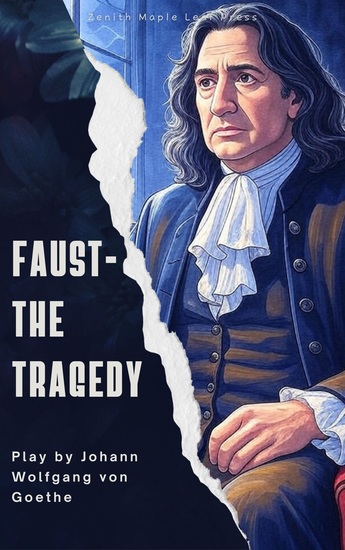
Faust – The Tragedy - The Masterpiece of Ambition Temptation and Redemption - cover
LER

Faust – The Tragedy - The Masterpiece of Ambition Temptation and Redemption

Johann Wolfgang von Goethe

Editora: Zenith Maple Leaf Press

  • 0
  • 0
  • 0

Sinopse

A man who wants everything. A bargain that could cost him his soul.
In Faust – The Tragedy, Johann Wolfgang von Goethe delivers one of the greatest works in world literature—a sweeping dramatic poem that blends romance, philosophy, folklore, and theology.

The brilliant but dissatisfied scholar Faust makes a fateful pact with Mephistopheles, the devil's agent, trading his soul for unlimited knowledge, pleasure, and worldly experience. His journey takes him through love, temptation, despair, and ultimately the search for salvation.

First published in two parts (1808 and 1832), Goethe's Faust is more than a retelling of the classic legend—it is a profound meditation on human ambition, moral struggle, and the eternal quest for meaning.

"The pinnacle of German literature—a universal story of temptation and redemption."
– The Times Literary Supplement

"Faust is the drama of the human soul—restless, striving, and never content."
– The Guardian

✅ Why Readers Love It:
😈 A timeless exploration of the price of ambition

💔 A tragic love story intertwined with moral conflict

📚 A cornerstone of Romantic and philosophical literature

🎯 Click 'Buy Now' to experience Goethe's magnum opus—a spellbinding tale of desire, damnation, and the hope of redemption.
Disponível desde: 11/08/2025.
Comprimento de impressão: 371 páginas.

Outros livros que poderiam interessá-lo

  • The Heathen - cover

    The Heathen

    Jack London

    • 0
    • 0
    • 0
    "The Heathen" is a short story by the American writer Jack London. It was first published in Everybody's Magazine in August 1910.
    In the story, two people, from different cultural and racial backgrounds, are the only survivors of a ship that encounters a hurricane in the Pacific, and they remain together.
    The narrator, a pearl buyer named Charley, is a cabin passenger on a schooner, the Petite Jeanne, sailing from Rangiroa to Tahiti with a Kanaka crew, at the end of the pearling season in the Paumotas. The boat, having eighty-five deck passengers, is overloaded. Several passengers die of smallpox; Charley and the other cabin passengers drink whisky, until it runs out, in the belief that it will kill the smallpox germs.
    The boat is in the direct path of a hurricane. "The second sea filled the Petite Jeanne's decks flush with the rails, and, as her stern sank down and her bow tossed skyward, all the miserable dunnage of life and luggage poured aft. It was a human torrent.... Out of all my experiences I could not have believed it possible for the wind to blow as it did.... It was a monstrous thing, and the most monstrous thing about it was that it increased and continued to increase."
    Ver livro
  • Cup of Gold - cover

    Cup of Gold

    John Steinbeck

    • 0
    • 0
    • 0
    The first novel from American literary great John Steinbeck (Grapes of Wrath) tells the fictionalized story of the illustrious 17th century pirate Captain Henry Morgan  
    Henry Morgan is a young boy growing up in a small town in Wales. One day, a sailor returns to regale Henry with tales of the West Indies, and the glory that awaits those adventuresome enough to go. Henry, dazzled, quickly finds a place aboard a ship heading to the islands, thus setting himself on the path to becoming the brutal and fearsome pirate Captain Morgan.  
    The portrait Steinbeck paints of Morgan (with some artistic license taken) is of a complex, lustful, and largely unhappy man, set in evocative locales that are laced with traces of magical realism. Though Morgan’s life was filled with blood and violence, Steinbeck portrays him as a thoughtful and intelligent commander of men, whose tragic flaw is an unquenchable lust for great accomplishments combined with a misunderstanding of what great accomplishments actually are.  
    Through his cunning he repeatedly attains the ever-grander victories he seeks—but he quickly discovers what so many before and after him have discovered: that achievement is not always as satisfying as the quest to achieve.  
    Publisher's Note: Originally published in 1929, Cup of Gold is a literary work that reflects the time in which it was published—both its good and its ill. The original text contains wording and terminology that represent outdated cultural beliefs regarding race and ethnicity. In the interest of preserving and documenting both the faults and highlights of literary history—an instrumental, crucial function of works entering the public domain—this text is unedited and uncensored in this audiobook recording. Please proceed with discretion.
    Ver livro
  • Other Gods The (Unabridged) - cover

    Other Gods The (Unabridged)

    H. P. Lovecraft

    • 0
    • 0
    • 0
    Barzai the Wise, a high priest and prophet greatly learned in the lore of the "gods of earth", or Great Ones, attempts to scale the mountain of Hatheg-Kla in order to look upon their faces, accompanied by his young disciple Atal. Upon reaching the peak, Barzai at first seems overjoyed until he finds that the "gods of the earth" are not there alone, but rather are overseen by the "other gods, the gods of the outer hells that guard the feeble gods of earth!" Atal flees, and Barzai is never seen again.
    Ver livro
  • A Fight with a Cannon - From their pens to your ears genius in every story - cover

    A Fight with a Cannon - From...

    Victor Hugo

    • 0
    • 0
    • 0
    Victor Marie Hugo was born on 26th February 1802 in Besançon, France.   
    There can be no doubt that Hugo is ranked as the greatest of French authors and poets. In addition to this he fought against social injustice throughout his life and from his frequent elections to the French Assembly. 
    Hugo published his first novel, Han d’Islande (1823), the year after his marriage and so began an immense canon of fiction and poetry not only for France but to World literature.  
    He was elected to the Académie Française in 1841 and the same year came a peerage and entrance to the Higher Chamber as a pair de France, where he spoke against the death penalty, social injustice and in favour of press freedom.  
    In the years leading up to the Revolution of 1848 Hugo began to lean towards Republicanism and greater freedoms.  With the formation of the Second Republic, he was again elected to the Assembly. 
    When Napoleon III seized power in 1851, and established an anti-parliamentary constitution, Hugo openly declared him a traitor to France. This, of course, meant exile where he remained until 1870.  In exile he published his greatest work ‘Les Misérables’, and further widely honoured collections of poetry. 
    Returning home he was again elected to the National Assembly and the Senate.  It was the time of the Franco-Prussian war and with Paris under siege and food ever more scarce, he wrote in his diary that he was now "eating the unknown". 
    Later he was instrumental in strengthening the rights of artists and copyright, steps which led to the international protections of the Berne Convention.  
    Victor Hugo died on 22nd May 1885, aged 83.
    Ver livro
  • Little Boy Lost - cover

    Little Boy Lost

    Marghanita Laski

    • 0
    • 0
    • 0
    Marghanita Laski’s novel Little Boy Lost is as enthralling as it is heart-wrenching. A man grapples with questions of emotional responsibility, fatherhood, and memory. Laski describes a much-changed France, struggling to rebuild its morale after the ruin caused by wartime bombing and occupation.English writer Hilary Wainwright lost all trace of his young son when Lisa, his wife, was killed by the Gestapo in Paris. Several years later, an acquaintance travels to England with news that Hilary’s son may be alive in France. Doubting whether five-year-old Jean is indeed his, and determined not to feel vulnerable to love and tenderness again, Hilary travels to France to find the boy. Amidst a war-torn Northern French town, he gets to know young Jean, as well as the town’s inhabitants. In a matter of days Hilary must decide if this charming and intelligent child could be his own . . . and if he is prepared to take Jean home.Little Boy Lost is part of the Persephone Audiobook Collection, a series of forgotten classics including neglected fiction and non-fiction by women writers. First published in 1949, this edition includes a new afterword by Anne Sebba.
    Ver livro
  • The Gentleman from San Francisco - cover

    The Gentleman from San Francisco

    Ivan Bunin

    • 0
    • 0
    • 0
    The Gentleman from San Francisco is a short story by Ivan Bunin, a Nobel Prize-winning but often overlooked Russian author. It was translated into English by D. H. Lawrence (with Samuil Koteliansky). The story is often hailed as a classic of the genre.
    
    A 58-year-old American from San Francisco, now in possession of a vast fortune, sets off with his wife and daughter on a world tour. A series of events causes laughter, embarassment, and revolt as he and his family travel through Italy and remarkable changes begin to take effect.
    Ver livro