¡Acompáñanos a viajar por el mundo de los libros!
Añadir este libro a la estantería
Grey
Escribe un nuevo comentario Default profile 50px
Grey
Suscríbete para leer el libro completo o lee las primeras páginas gratis.
All characters reduced
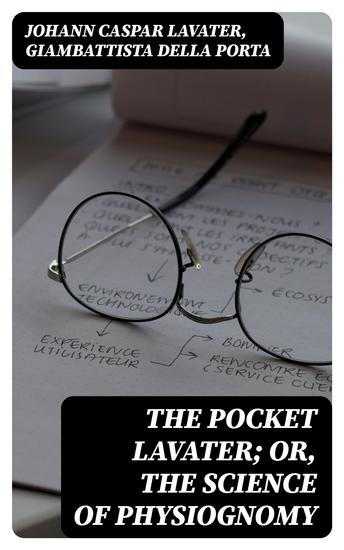
The Pocket Lavater; or The Science of Physiognomy - Enriched edition To which is added an inquiry into the analogy existing between brute and human physiognomy - cover

The Pocket Lavater; or The Science of Physiognomy - Enriched edition To which is added an inquiry into the analogy existing between brute and human physiognomy

Johann Caspar Lavater, Giambattista della Porta

Editorial: DigiCat

  • 0
  • 0
  • 0

Sinopsis

Dive into the intriguing world of physiognomy with 'The Pocket Lavater; or, The Science of Physiognomy,' a compendium presenting a fascinating exploration of the art of reading human features. This anthology brings together diverse writings that interweave scientific inquiry with speculative musings, reflecting the late 18th and early 19th centuries' fervent interest in the correlation between appearance and character. The collection is a rich tapestry of essays and treatises, each piece contributing to a broader understanding of how one's external traits can reveal hidden depths of mind and spirit. Standout compositions elucidate complex ideas with both clarity and nuance, providing a significant snapshot of a pivotal moment in literary and scientific history. The compilation draws from the works of Johann Caspar Lavater and Giambattista della Porta, two enigmatic figures whose ideas shaped the discourse on physiognomy during their time. Lavater's insightful observations and Porta's pioneering studies conjoin to provide a comprehensive narrative on this pseudo-scientific field. Engaging with their collective scholarship reveals much about the cultural and intellectual movements that emerged during the Enlightenment and early modern periods. This anthology thus not only highlights their individual contributions but also showcases the collaborative progression of thought during an era rich with intellectual cross-pollination. Readers are invited to immerse themselves in this thoughtfully curated volume, offering a unique encounter with the historical discourse on physiognomy. As the essays traverse multiple perspectives and styles, they challenge and expand the reader's understanding of human physicality and personality. This anthology is a treasure trove for anyone interested in the intersections of history, science, and literature, promising a rewarding and enlightening journey into the exploration of human identity and perception. Engage with this collection to appreciate its educational merit and the rich dialogue sparked between its diverse voices.

In this enriched edition, we have carefully created added value for your reading experience:
- A succinct Introduction situates the work's timeless appeal and themes.
- The Synopsis outlines the central plot, highlighting key developments without spoiling critical twists.
- A detailed Historical Context immerses you in the era's events and influences that shaped the writing.
- A thorough Analysis dissects symbols, motifs, and character arcs to unearth underlying meanings.
- Reflection questions prompt you to engage personally with the work's messages, connecting them to modern life.
- Hand‐picked Memorable Quotes shine a spotlight on moments of literary brilliance.
- Interactive footnotes clarify unusual references, historical allusions, and archaic phrases for an effortless, more informed read.
Disponible desde: 04/09/2022.
Longitud de impresión: 49 páginas.


Otros libros que te pueden interesar

  • Don't Judge A Prince By His Undergarments - Another MM arranged marriage between a King and Prince - cover

    Don't Judge A Prince By His...

    Lisa Oliver

    • 0
    • 0
    • 0
    The only goal Prince Syrius Fortune of Rosenhip had during his twin sister's "meet the suitors" ball, was to stay quiet and out of the way. His sister's event had been in the planning for five years, and he and his loving father had already agreed trying to seek a wedding contract for himself was not a good idea. Prince Syrius had quirks, and it wasn't as though he needed to open himself up to ridicule from someone else, especially a spouse he would have to get to know. The event was only a week, and being a lot smaller than his older brothers, Syrius was used to not being seen. Until someone saw him. 
    King Mintyn of Marinkaw had been a soldier since he was fifteen years old. He was not impressed to find out the one time of the year he was supposed to be meeting King Fortune to sign their Golden Straits agreement was apparently the one time his friend decided to have a huge event going on.  
    However, his aide told him he had been invited, and it was only one ball. Mintyn could enjoy some good food, network a while, and then leave the following morning once the treaty was signed. That was until he saw a young vision being hassled by an entitled duke. On learning the vision being hassled was his friend's youngest son, Mintyn decided to intervene. It was a nice thing to do. One shortened dance later as Prince Syrius walked away from him after he put his foot in his mouth, Mintyn told his aide to rejiggle his schedule. He had a spouse to woo.   
    This is one of those light stories that my muse weaves sometimes simply to make people smile. There are no deep and meaningful plot lines, just a bit fun between two men who look so unsuited for each other on the surface of things, but their pairing proves opposites do attract and stay together. It is in the same universe as the Infidelity Clause but is totally standalone. Watch for cameo appearances by a cupcake eating dragon, an episode of prince throwing, and potato cuffs.
    Ver libro
  • Ancient Egypt - Pharaohs Pyramids and the Cradle of Civilization - cover

    Ancient Egypt - Pharaohs...

    Rolf Hedger

    • 0
    • 0
    • 0
    The Nile River was the lifeblood of ancient Egypt, shaping its civilization, economy, and culture. Flowing over 4,000 miles from the heart of Africa to the Mediterranean Sea, the river provided a reliable source of water in an otherwise arid landscape. Without the Nile, Egypt as we know it would not have existed. 
    Each year, the river’s annual flooding deposited nutrient-rich silt onto the surrounding land, creating fertile soil ideal for agriculture. This natural cycle allowed the Egyptians to grow crops such as wheat, barley, and flax, sustaining a thriving population. The predictability of the flooding led to the development of an agricultural calendar, which played a crucial role in the organization of society. Farmers planted their crops after the waters receded and harvested them before the next flood, ensuring a steady food supply. 
    Beyond agriculture, the Nile was also Egypt’s main highway. With deserts on either side of the river, travel by land was difficult, but the Nile provided an efficient means of transportation. Boats carried goods, people, and even large stone blocks for temple and pyramid construction. Trade flourished as the Egyptians exchanged gold, papyrus, and linen for exotic products from neighboring regions, including spices from the east and cedarwood from Lebanon.
    Ver libro
  • Rare Recording of Marcus Garvey A - Volume 2 - cover

    Rare Recording of Marcus Garvey...

    Marcus Garvey

    • 0
    • 0
    • 0
    Marcus Garvey (August 17, 1887 - June 10, 1940) was a charismatic Jamaican-born political leader, publisher, journalist, entrepreneur, and orator. He organized the Universal Negro Improvement Association and African Communities League (UNIA-ACL) and acted as its President-General. In 1916 he moved to New York City where his prominence grew. By 1919 he was considered to be the “Black Moses,” and he claimed a following of over 2 million people. This recording is from a speech he gave in the 1920s.
    Ver libro
  • Wage Labor And Capital - cover

    Wage Labor And Capital

    Karl Marx

    • 0
    • 0
    • 0
    Originally written as a series of newspaper articles in 1847, Wage-Labor and Capital were intended to give an overview of Marx’s central theories regarding the economic relationships between workers and capitalists. These theories outlined include the Marxian form of the Labour Theory of Value, which distinguishes “labor” from “labor-power”, and the Theory of Concentration of Capital, which states that capitalism tends towards the creation of monopolies and the disenfranchisement of the middle and working classes. These theories were later elaborated in Volume 1 of Capital, published in 1867. Karl Heinrich Marx FRSA was a German philosopher, a critic of political economy, economist, historian, sociologist, political theorist, journalist, and socialist revolutionary. His best-known titles are the 1848 pamphlet The Communist Manifesto and the four-volume Das Kapital.
    Ver libro
  • The Cryptogram as a Factor in Symbolic Philosophy - cover

    The Cryptogram as a Factor in...

    Manly Palmer Hall

    • 0
    • 0
    • 0
    No treatise which deals with symbolism would be complete without a section devoted to the consideration of cryptograms. The use of ciphers has long been recognized as indispensable in military and diplomatic circles, but the modern world has overlooked the important rôle played by cryptography in literature and philosophy. If the art of deciphering cryptograms could be made popular, it would result in the discovery of much hitherto unsuspected wisdom possessed by both ancient and mediæval philosophers. It would prove that many apparently verbose and rambling authors were wordy for the sake of concealing words. Ciphers are hidden in the most subtle manner: they may be concealed in the watermark of the paper upon which a book is printed; they may be bound into the covers of ancient books; they may be hidden under imperfect pagination; they may be extracted from the first letters of words or the first words of sentences; they may be artfully concealed in mathematical equations or in apparently unintelligible characters; they may be extracted from the jargon of clowns or revealed by heat as having been written in sympathetic ink; they may be word ciphers, letter ciphers, or apparently ambiguous statements whose meaning could be understood only by repeated careful readings; they may he discovered in the elaborately illuminated initial letters of early books or they may be revealed by a process of counting words or letters. If those interested in Freemasonic research would give serious consideration to this subject, they might find in books and manuscripts of the sixteenth and seventeenth centuries the information necessary to bridge the gap in Masonic history that now exists between the Mysteries of the ancient world and the Craft Masonry of the last three centuries.
    Ver libro
  • A Rare Recording of Gertrude Stein Reading Her Own Writing - cover

    A Rare Recording of Gertrude...

    Gertrude Stein

    • 0
    • 0
    • 0
    Gertrude Stein (February 3, 1874 - July 27, 1946) was an American novelist, poet, playwright, and art collector. Born in Allegheny, Pennsylvania, and raised in Oakland, California, Stein moved to Paris in 1903, and made France her home for the remainder of her life. She hosted a Paris salon, where the leading figures of modernism in literature and art, such as Pablo Picasso, Ernest Hemingway, F. Scott Fitzgerald, Sinclair Lewis, Ezra Pound, Sherwood Anderson and Henri Matisse, would meet. The following three recordings are from Stein's novel, The Making of Americans (1925), and her poems, How She Bowed to her Brother (1931) and If I Told Him - A Completed Portrait of Picasso (1923)
    Ver libro