¡Acompáñanos a viajar por el mundo de los libros!
Añadir este libro a la estantería
Grey
Escribe un nuevo comentario Default profile 50px
Grey
Suscríbete para leer el libro completo o lee las primeras páginas gratis.
All characters reduced
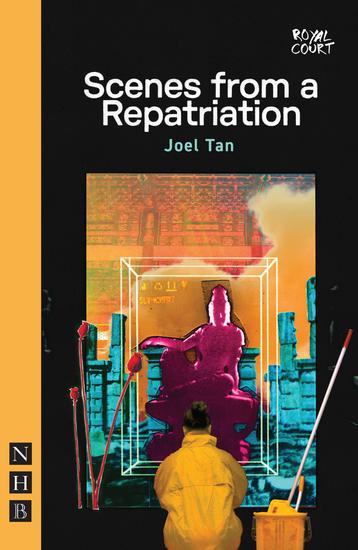
Scenes from a Repatriation - cover

Scenes from a Repatriation

Joel Tan

Editorial: Nick Hern Books

  • 0
  • 0
  • 0

Sinopsis

'All of human history? It's basically people taking things from each other.'
A thousand-year-old statue of the Bodhisattva Guanyin lives in the British Museum. When it emerges that the statue was stolen from its original home, the museum attempts to deflect both the public response and controversial repatriation claims from the Chinese government.
As statesmen scheme and grease their palms, beneath the statue, witches dance, a cleaner prays, and spirits weep.
Joel Tan's daring, shape-shifting play unfolds the statue's journey from China to Britain and back again, stirring up age-old ghosts and asking who can claim cultural artefacts – and why?
Scenes from a Repatriation was first performed at the Royal Court Theatre, London, in 2025, directed by experimental theatre-makers emma + pj.
Disponible desde: 08/05/2025.
Longitud de impresión: 128 páginas.

Otros libros que te pueden interesar

  • Whispers Beneath the Skin - Poetry for the Body - cover

    Whispers Beneath the Skin -...

    Unrepeatable Beauty, Lena Elisabet

    • 0
    • 0
    • 0
    A sensual healing experience narrated by Lena Elisabet. 
    Whispers Beneath the Skin is not erotica—it’s poetry for the body. 
    A journey into softness, safety, and sacred pleasure. 
    Let the words touch you. Let the breath guide you. 
    You are not broken. You are blooming. 
    © Brilliant Woman Studios
    Ver libro
  • From From - Poems - cover

    From From - Poems

    Monica Youn

    • 0
    • 0
    • 0
    LONGLISTED FOR THE 2023 NATIONAL BOOK AWARD FOR POETRY 


    "Where are you from . . . ? No—where are you from from?" It's a question every Asian American gets asked as part of an incessant chorus saying you'll never belong here, you're a perpetual foreigner, you'll always be seen as an alien, an object, or a threat. 


    Monica Youn's From From brilliantly evokes the conflicted consciousness of deracination. If you have no core of "authenticity," no experience of your so-called homeland, how do you piece together an Asian American identity out of Westerners' ideas about Asians? Your sense of yourself is part stereotype, part aspiration, part guilt. In this dazzling collection, one sequence deconstructs the sounds and letters of the word "deracinations" to create a sonic landscape of micro- and macroaggressions, assimilation, and self-doubt. A kaleidoscopic personal essay explores the racial positioning of Asian Americans and the epidemic of anti-Asian hate. Several poems titled "Study of Two Figures" anatomize and dissect the Asian other: Midas the striving, nouveau-riche father; Dr. Seuss and the imaginary daughter Chrysanthemum-Pearl he invented while authoring his anti-Japanese propaganda campaign; Pasiphaë, mother of the minotaur, and Sado, the eighteenth-century Korean prince, both condemned to containers allegorical and actual.
    Ver libro
  • The Two Voices - An autobiographical poem written by Tennyson after his friend committed suicide - cover

    The Two Voices - An...

    Alfred Lord Tennyson

    • 0
    • 0
    • 0
    Alfred Tennyson was born on August 6th, 1809, in Somersby, Lincolnshire, the fourth of twelve children. 
    Most of Tennyson's early education was under the direction of his father, although he did spend four unhappy years at a nearby grammar school.  He also showed an early and burgeoning talent for writing; by the age of twelve he had written a 6,000-line epic poem.  
    In the 1820s, however, Tennyson’s father began to suffer frequent mental breakdowns exacerbated by his alcoholism. One brother had frequent violent quarrels with his father, a second would be confined to an insane asylum, and another was later an opium addict. 
    Tennyson left home in 1827 to join his brothers at Trinity College, Cambridge and with it escape from Somersby. At Trinity he was those who knew little of the problems that clouded his life. Although shy he was keen to make new friends; he was handsome, intelligent, humorous, and a gifted impersonator. 
    That same year, he and his brother Charles published Poems by Two Brothers. It attracted the attention of the “Apostles," a select undergraduate literary club led by Arthur Hallam. They provided friendship and confidence. Hallam and Tennyson became the best of friends. 
    The pair, in the summer of 1830, were involved in a ridiculous jaunt to take money and secret messages to revolutionaries plotting to overthrow the Spanish king. Tennyson's political enthusiasm was marginal compared to Hallam's, but he was glad to make his first trip abroad.  
    The landscape and atmosphere of the Pyrenees generated such wonderful poems as "Oenone," "The Lotus-Eaters;" inspired by a waterfall in the mountains; and "The Eagle;" invoked from the sight of the great hunters circling above them. The small village of Cauteretz and the surrounding valley became a location Tennyson would return to many times over the next sixty years. 
    In 1830, he published Poems, ‘Chiefly Lyrical’ and in 1832 a volume entitled ‘Poems’.  Tennyson, stung by the harshness of several reviews, would not publish again for nine years.  
    In the autumn of 1833, in what was meant as a gesture of gratitude and reconciliation to his father, Hallam accompanied him to the Continent. In Vienna Hallam died suddenly of apoplexy as a result of a congenital malformation of the brain.  
    Hallam’s death, together with that of his father and a myriad of anxieties, stem-ming mainly from the belief that his family were grimly attached to poverty, and fears that he might become a victim of epilepsy, madness, alcohol, and drugs, as others in his family had, or that he might die like Hallam, conspired to upset the delicate balance of Tennyson's emotions.  
    In 1836, he became engaged to Emily Sellwood. From their correspondence it is clear that she was very much in love with him. He seems to excessively worry about not having the financial means to marry.  He was also falling into trances, which he thought were connected with the epilepsy from which other family members suffered. To marry, he thought, would mean passing on the disease to any children he might father. He broke off the engagement. 
    During these years he used the dark feelings and events to write many of his finest works; "Ulysses," "Morte d'Arthur," "Tithonus," "Tiresias," and "Break, break, break."  
    In 1842 Tennyson’s Poems (in two volumes) was a tremendous critical and popular success.  
    In 1845 he was granted a government pension of £200 a year in recognition of his poetic achievements and his financial need.  Despite this financial support his doubts persisted.  
    Life for Tennyson was becoming increasingly productive and more lucrative.  By 1849 ‘The Princess’ had been published. He was now offered a large advance if he would assemble his elegies on Hallam into one complete poem.  
    Tennyson had now also resumed his relationship with Emily Sellwood and by the following year was talking again of marrying her. 
    In the Spring of 1850 the Poet Laureate William Wordsworth died and a new Laureate was
    Ver libro
  • The Top 10 Poets – The Dublin Universities - Five poems each from the best poets to attend university in Dublin - cover

    The Top 10 Poets – The Dublin...

    Oscar Wilde, James Joyce, Thomas...

    • 0
    • 0
    • 0
    The language of Poetry is an art that most of us attempt at some point in our lives.  Although its commonplace exposure has been somewhat marginalised in today’s often fast-paced lives we all recognise good verse that can empathise with our thoughts or open us up to experience new things in new ways, to better understand and to enjoy the many strands of our lives. 
    But finding a starting point can be overwhelming, even off-putting, so in this series we offer up our Top 10 classic poets, who brim with talent and verse, on a range of subjects and themes that we can all enjoy. 
    The dreaming hallowed halls of Dublin may be one of the great educational establishments down the Centuries.  But it is also a place where the Nation’s young learn much more.  Within its walls, courtyards and cloisters these 10 Poets mused and illuminated on the beauty of poetry with eager yet tender words.
    Ver libro
  • The Sun Also Rises - cover

    The Sun Also Rises

    Ernest Hemingway

    • 0
    • 0
    • 0
    A timeless classic of love, longing, and the search for meaning, The Sun Also Rises is Ernest Hemingway’s definitive novel of the Lost Generation. 
    Follow war veteran and journalist Jake Barnes as he navigates the vibrant streets of 1920s Paris and the bullfighting arenas of Spain with his circle of expatriate friends. At the heart of it all is Lady Brett Ashley—beautiful, charismatic, and unattainable—whose complicated relationships fuel the novel’s emotional depth. Against a backdrop of café culture, revelry, and moral disillusionment, Hemingway’s spare, powerful prose captures the emptiness and excess of a postwar world. 
    Now brought to life in this evocative audiobook, The Sun Also Rises immerses listeners in Hemingway’s iconic style and unforgettable characters. Whether you’re discovering it for the first time or returning to an old favorite, this masterful narration delivers the novel’s raw emotion and haunting beauty like never before. 
    Experience the novel that defined a generation—listen today. 
    Cover Photo by Buck Nacho Gomez: https://www.pexels.com/photo/smiling-brunette-woman-in-sombrero-and-red-dress-20625081/
    Ver libro
  • The Poetry of Morning - Beautiful poems to listen to as soon as you wake - cover

    The Poetry of Morning -...

    Alfred Tennyson, D. H. Lawrence,...

    • 0
    • 0
    • 0
    Over the far horizon the blanket of night begins to slowly dissolve.  The sun is once more on its daily journey across the heavens.  The light begins to sharpen and increase in intensity revealing the landscape.  Morning has begun and dazed heads and sleepy faces come to terms with the new day. 
    Our poets capture the mood, the emotions and all manner of other details in their descriptions of this time.  But then with the calibre of wordsmiths such as Tennyson, Wordsworth, Milton, Southey, Donne and many more besides we are almost spoilt. 
     This volume comes to you from Portable Poetry, a specialized imprint from Deadtree Publishing.  Our range is large and growing and covers single poets, themes, and many compilations.
    Ver libro