¡Acompáñanos a viajar por el mundo de los libros!
Añadir este libro a la estantería
Grey
Escribe un nuevo comentario Default profile 50px
Grey
Suscríbete para leer el libro completo o lee las primeras páginas gratis.
All characters reduced
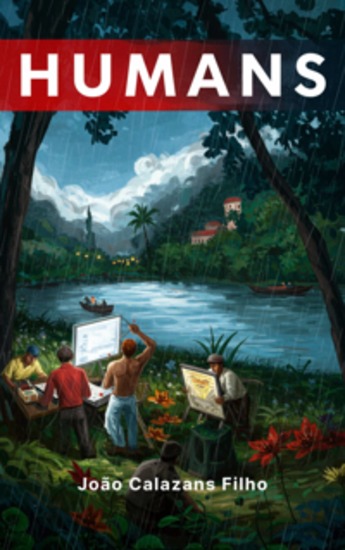
Humans - cover

Humans

João Calazans Filho

Editorial: Babelcube

  • 0
  • 0
  • 0

Sinopsis

          Humans highlights a singular proposal: a work of poetry that goes beyond traditional lyricism, grappling geopolitical topics and contemporary questions with deep sincerity. Although the reflections are not always subtle or romantic, the poetry between these pages brings a unique combination of feelings, realism and philosophy. Reading this will lead to self-awareness and it will invite the reader to ponder on where humankind belongs and it's own fate. 
          This book suggests that poetry, even in times of crisis and uncertainty, remains a powerful tool for questioning behaviors, acquiring new perspectives and finding new ways of transforming the world. After all, change starts in individuals - it is we, humans, that have the power of molding our future. Time itself, wise and relentless, reveals truths and grants reasons, but one's responsible for deciding how to live and how to influence others. 
          Humans is, thereby, a poetic rehearsal that transcends the simple aesthetic pleasure. It instigates, inspires and dares, representing an invitation to introspection and action. 
          Throughout it's pages, we find not only verses, but the essence of a calling for change, real and conscious change, offering the reader a journey of critical thinking and renewed hope.
Disponible desde: 18/03/2025.
Longitud de impresión: 116 páginas.

Otros libros que te pueden interesar

  • Magus - The Art of Magic from Faustus to Agrippa - cover

    Magus - The Art of Magic from...

    Anthony Grafton

    • 0
    • 0
    • 0
    In literary legend, Faustus is the quintessential occult personality of early modern Europe. The historical Faustus, however, was something quite different: a magus—a learned magician fully embedded in the scholarly currents and public life of the Renaissance. And he was hardly the only one. Anthony Grafton argues that the magus in sixteenth-century Europe was a distinctive intellectual type, both different from and indebted to medieval counterparts as well as contemporaries like the engineer, the artist, the Christian humanist, and the religious reformer. Alongside these better-known figures, the magus had a transformative impact on his social world. 


    Magus details the arts and experiences of several learned magicians. Grafton explores their methods, the knowledge they produced, the services they provided, and the overlapping political and social milieus to which they aspired—often, the circles of kings and princes. During the late fifteenth and early sixteenth centuries, these erudite men anchored debates about licit and illicit magic, the divine and the diabolical, and the nature of "good" and "bad" magicians. Over time, they turned magic into a complex art, which drew on contemporary engineering as well as classical astrology, probed the limits of what was acceptable in a changing society, and promised new ways to explore the self and exploit the cosmos.
    Ver libro
  • The Inventions of Ancient Egypt - Pioneering Technologies and Ideas - cover

    The Inventions of Ancient Egypt...

    Omar Khalil

    • 0
    • 0
    • 0
    Ancient Egypt's writing systems stand as a testament to human ingenuity and cultural expression. The development of writing marked a pivotal point in Egyptian civilization, allowing for the documentation of history, religion, and daily life. Among the most significant inventions were hieroglyphs, which evolved into more simplified forms such as hieratic and demotic scripts. These writing systems not only served practical purposes but also played a crucial role in shaping Egypt’s legacy. 
    The invention of hieroglyphs can be traced back to around 3100 BCE. These symbols, composed of pictorial and phonetic elements, were carved into stone monuments and written on papyrus scrolls. Hieroglyphs were primarily used for religious texts, inscriptions on temples, and royal decrees. The complexity and beauty of this script were not just artistic but symbolic, as each symbol held both sound and meaning. Hieroglyphic writing required skilled scribes, who underwent rigorous training to master the hundreds of characters used in various contexts. 
    Over time, the need for quicker, more practical writing gave rise to hieratic script, a simplified and cursive form of hieroglyphs. Hieratic was used mainly for administrative and literary texts, allowing scribes to write more efficiently on papyrus. This new form retained the symbolic power of hieroglyphs but adapted to the demands of record-keeping and correspondence. As hieratic became more widespread, it bridged the gap between the formal, ceremonial writing of hieroglyphs and the everyday needs of administration and commerce.
    Ver libro
  • Digital Pilgrims - Towards a Quantum Humanity - cover

    Digital Pilgrims - Towards a...

    Adrián Sicilia

    • 0
    • 0
    • 0
    The present has the texture of the future. Hyper-digitalization has made all questions outdated, especially: what are we going to do? For decades, we have been inhabiting and moving within the Digital Environment. Today, the unavoidable question is: what and who are we going to be? 
    Digital Pilgrims proposes novel and urgent debates for a society that has been digitalizing itself for over fifty years. Our coexistence with mature artificial intelligences demands definitions. We are cyborgs moving in environments that exceed time and space, humans in search of meaning for this quantum reality.  
    It is not difficult to speculate about possible futures; the real challenge is to find a path forward in the face of the singularity that is starting to reveal itself, and in the face of the social impact we are just beginning to see. In the middle of the explosion, this book outlines the debates we cannot put off any longer. There are no answers here but rather a guide for us to finally discuss how to orient ourselves on this dizzying voyage.
    Ver libro
  • Alternative History of Britain An - The English Civil War - cover

    Alternative History of Britain...

    Timothy Venning

    • 0
    • 0
    • 0
    With hindsight, the victory of Parliamentarian forces over the Royalists in the English Civil War may seem inevitable but this outcome was not a foregone conclusion. Timothy Venning explores many of the turning points and discusses how they might so easily have played out differently. 


    What if, for example, Charles I had capitalized on his victory at Edgehill by attacking London without delay? Could this have ended the war in 1642? His actual advance on the capital in 1643 failed but came close to causing a Parliamentarian collapse—how could it have succeeded and what then? Among the many other scenarios, full consideration is given to the role of Ireland (what if Papal meddling had not prevented Irish Catholics aiding Charles?) and Scotland (how might Montrose's Scottish loyalists have neutralized the Covenanters?). The author analyzes the plausible possibilities in each thread, throwing light on the role of chance and underlying factors in the real outcome, as well as what might easily have been different.
    Ver libro
  • World War II: What We Know Now (That We Didn't Know Then) - cover

    World War II: What We Know Now...

    One Day University

    • 0
    • 0
    • 0
    Learn from five remarkable professors in this set of One Day University presentations exploring the complicated legacy of World War 2. World War II was a global war that lasted from 1939 to 1945 involving the majority of the world's countries—including all of the great powers—forming two opposing military alliances. The major participants threw their entire economic, industrial, and scientific capabilities into the war effort. It was by far the deadliest conflict in human history, resulting in 70 to 85 million fatalities, due to actual battles as well as genocides (The Holocaust), starvation, massacres, and disease. In the wake of defeat, Germany and Japan were occupied, and war crimes tribunals were conducted against German and Japanese leaders.
    Ver libro
  • The Qin Dynasty - Unifying China - cover

    The Qin Dynasty - Unifying China

    Jun Liu

    • 0
    • 0
    • 0
    The Qin state emerged as one of the most formidable powers during the Warring States Period, a time of intense conflict and political fragmentation in ancient China. Situated in the western frontier, Qin was once considered a relatively backward state compared to its eastern rivals. However, through strategic reforms, military innovations, and a firm commitment to Legalist principles, Qin transformed itself into the dominant force that would eventually unify China. 
    One of the key factors in Qin’s rise was the implementation of Legalist policies under the statesman Shang Yang. In the fourth century BCE, Shang Yang introduced a series of reforms that fundamentally reshaped Qin society. These policies emphasized strict laws, centralized authority, and merit-based advancements. Land ownership was restructured to allow farmers more direct control over their land, encouraging agricultural productivity and economic growth. At the same time, a rigid legal code was enforced, ensuring discipline among the population while diminishing the power of aristocratic families. By weakening the influence of hereditary nobles and promoting individuals based on their abilities, Shang Yang’s reforms created a more efficient and loyal administrative system that strengthened Qin’s central government. 
    The military advancements of Qin also played a crucial role in its ascendance. Unlike other states that relied heavily on noble warriors, Qin adopted a professional army system that allowed for greater discipline and efficiency. The state implemented mass conscription, ensuring a steady supply of soldiers trained under strict military codes. Advanced weaponry, including iron swords and crossbows, gave Qin troops a significant advantage on the battlefield. Additionally, the construction of an extensive road network allowed for rapid troop movements, enabling Qin forces to respond quickly to threats and expand their territorial control.
    Ver libro