¡Acompáñanos a viajar por el mundo de los libros!
Añadir este libro a la estantería
Grey
Escribe un nuevo comentario Default profile 50px
Grey
Suscríbete para leer el libro completo o lee las primeras páginas gratis.
All characters reduced
Current and Future Application of Artificial Intelligence in Clinical Medicine - cover

Current and Future Application of Artificial Intelligence in Clinical Medicine

Jie Yang, Shigao Huang

Editorial: Bentham Science Publishers

  • 0
  • 0
  • 0

Sinopsis

Current and Future Application of Artificial Intelligence in ClinicalMedicine presents updateson the application of machine learning and deep learning techniques in medicalprocedures. . Chapters in the volume have been written by outstandingcontributors from cancer and computer science institutes with the goal of providing updated knowledge to the reader. Topics covered in the bookinclude 1) Artificial Intelligence (AI) applications in cancer diagnosis and therapy,2) Updates in AI applications in the medical industry, 3) the use of AI in studyingthe COVID-19 pandemic in China, 4) AI applications in clinical oncology(including AI-based mining for pulmonary nodules and the use of AI inunderstanding specific carcinomas), 5) AI inmedical imaging. Each chapter presents information on related sub topics in areader friendly format. The combination of expert knowledge and multidisciplinary approaches highlightedin the book make it a valuable source of information for physicians andclinical researchers active in the field of cancer diagnosis and treatment(oncologists, oncologic surgeons, radiation oncologists, nuclear medicinephysicians, and radiologists) and computer science scholars seeking tounderstand medical applications of artificial intelligence.
Disponible desde: 02/01/2024.
Otros libros que te pueden interesar

  • Looking Up - A Birder's Guide to Hope Through Grief - cover

    Looking Up - A Birder's Guide to...

    Courtney Ellis, Kay Warren

    • 0
    • 0
    • 0
    "Look at the birds"
    Through the painful days of the pandemic stuck in her home, Courtney Ellis found herself looking down in despair. Soon after, her beloved grandfather died unexpectedly.
    It was around this same time that Ellis took up watching birds. "Took up" might not be exactly right—as she puts it, "the switch flipped," and she's been borderline obsessed with birds ever since.
    Looking Up is a meditation on birding as a practice of hope. Weaving together stories from her own life, including the death of her grandfather, with reflections on birds of many kinds, Ellis invites us to open our eyes to the goodness of God both in the natural world and in our own lives. By "looking up" to the birds, Ellis found the beauty and wonder of these creatures calling her out of her darkness into the light and hope of God's promises.
    Complete with bird songs at the beginning of each track, this audiobook enhances your experience as you look up and listen to the birds.
    Ver libro
  • Clinical Pharmacokinetics - The Movement of Drugs in the Body - cover

    Clinical Pharmacokinetics - The...

    Ava Westwood

    • 0
    • 0
    • 0
    Pharmacokinetics is a fundamental aspect of clinical medicine, shaping the way drugs are administered, absorbed, distributed, metabolized, and eliminated by the body. It provides a scientific basis for determining appropriate drug dosing, optimizing therapeutic efficacy, and minimizing adverse effects. Understanding pharmacokinetics allows healthcare professionals to make informed decisions tailored to individual patients, ensuring safe and effective drug therapy. 
    One of the most significant applications of pharmacokinetics in clinical practice is dose optimization. Drug concentration within the body must remain within a therapeutic window—high enough to produce the desired effect but not so high that it causes toxicity. By considering factors such as bioavailability, volume of distribution, and clearance, clinicians can determine the appropriate dosing regimen. This is particularly critical for drugs with a narrow therapeutic index, such as warfarin, lithium, and certain chemotherapeutic agents, where even small variations in plasma levels can lead to significant clinical consequences. 
    Pharmacokinetics also plays a crucial role in adjusting drug therapy for specific patient populations. Factors such as age, organ function, and genetic variability can influence how a drug is processed. In neonates and elderly patients, metabolic and renal clearance mechanisms are often reduced, requiring dose modifications to prevent accumulation and toxicity. Similarly, patients with renal or hepatic impairment need adjusted dosing regimens to account for altered drug metabolism and elimination. Advances in pharmacogenomics further refine this approach, allowing for individualized treatment based on genetic variations affecting drug-metabolizing enzymes.
    Ver libro
  • Secrets Beneath the Quicksand - Understanding the Science and Mysteries of Treacherous Terrain - cover

    Secrets Beneath the Quicksand -...

    John Harpoon

    • 0
    • 0
    • 0
    Quicksand has captivated human imagination for centuries. The very mention of the word conjures images of perilous, sinking terrain—an unpredictable force of nature that can drag the unsuspecting into its depths. Whether through its portrayal in popular culture or through whispered warnings of its presence in remote areas, quicksand has become synonymous with danger. However, while it holds a certain allure in our collective consciousness, the science behind it remains less understood, adding to its mystique and intrigue. 
      
    Historically, quicksand has been a feature of many adventure tales and thrillers, often depicted as a life-threatening trap that can ensnare anyone who ventures too close. In movies, books, and TV shows, it serves as an almost mythical obstacle, a place where time seems to stand still as one struggles to escape. These portrayals, however, often exaggerate the severity of quicksand’s danger, leading to misconceptions about its true nature. It’s important to acknowledge that while quicksand is indeed dangerous, it is rarely as deadly as it is made out to be in stories. Yet, the fascination it generates is undeniable, and its mysterious qualities continue to inspire both fear and curiosity. 
      
    The allure of quicksand is not just in its danger, but also in the mystery surrounding its behavior. Unlike ordinary land, quicksand behaves in a way that seems to defy common understanding. Its unique blend of sand, water, and clay creates a substance that can feel deceptively solid, only to give way under pressure. This paradox—the appearance of solid ground hiding a treacherous, fluid-like trap—adds to its power to intrigue and intimidate.
    Ver libro
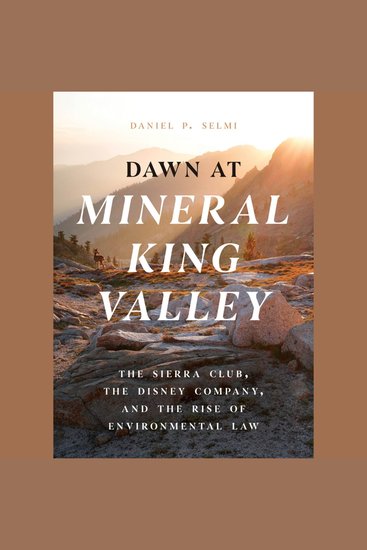
  • Dawn at Mineral King Valley - The Sierra Club the Disney Company and the Rise of Environmental Law - cover

    Dawn at Mineral King Valley -...

    Daniel P. Selmi

    • 0
    • 0
    • 0
    The story behind the historic Mineral King Valley case, which reveals how the Sierra Club battled Disney’s ski resort development and launched a new environmental era in America. 
      
    In our current age of climate change–induced panic, it’s hard to imagine a time when private groups were not actively enforcing environmental protection laws in the courts. It wasn’t until 1972, however, that a David and Goliath–esque Supreme Court showdown involving the Sierra Club and Disney set a revolutionary legal precedent for the era of environmental activism we live in today. 
      
    Set against the backdrop of the environmental movement that swept the country in the late 1960s and early 1970s, Dawn at Mineral King Valley tells the surprising story of how the US Forest Service, the Disney company, and the Sierra Club each struggled to adapt to the new, rapidly changing political landscape of environmental consciousness in postwar America. Proposed in 1965 and approved by the federal government in 1969, Disney’s vast development plan would have irreversibly altered the practically untouched Mineral King Valley, a magnificently beautiful alpine area in the Sierra Nevada mountains. At first, the plan met with unanimous approval from elected officials, government administrators, and the press—it seemed inevitable that this expanse of wild natural land would be radically changed and turned over to a private corporation. Then the scrappy Sierra Club forcefully pushed back with a lawsuit that ultimately propelled the modern environmental era by allowing interest groups to bring litigation against environmentally destructive projects. 
      
    An expert on environmental law and appellate advocacy, Daniel P. Selmi uses his authoritative narrative voice to recount the complete history of this revolutionary legal battle and the ramifications that continue today, almost 50 years later.
    Ver libro
  • Lyme Disease - cover

    Lyme Disease

    Sam Dickinson

    • 0
    • 0
    • 0
    Lyme disease is an infectious disease caused by the bacteria Borrelia burgdorferi. B. burgdorferi is transmitted to humans by biting an infected black-legged or deer tick. The tick becomes infected after feeding on infected deer, birds, or mice.A tick has to be present on the skin for at least 36 hours to transmit the infection. Many people with Lyme disease have no memory of a tick bite.Lyme disease was first recognized in the town of Old Lyme, Connecticut, in 1975. It’s the most common tick-borne illness in Europe and the United States.People who live or spend time in wooded areas known for disease transmission are more likely to get this illness. People with domesticated animals visiting wooded regions also have a higher risk of developing Lyme disease.Cases of Lyme disease have varied yearly but have steadily increased for the past 20 years in the United States.Lyme disease is not common in all United States and is primarily concentrated in the Northeast and upper Midwest regions.
    Ver libro
  • The Physics of Stars - Exploring the Life Cycles and Properties of Stars - cover

    The Physics of Stars - Exploring...

    Mark Hedges

    • 0
    • 0
    • 0
    Stars are the fundamental building blocks of the universe, shaping the evolution of galaxies and influencing cosmic phenomena on vast scales. Understanding their physics requires a detailed study of the forces governing their formation, structure, and lifecycle. Stellar physics combines principles from thermodynamics, nuclear physics, and general relativity to explain the energy production, stability, and eventual fate of stars. Observations across the electromagnetic spectrum, from radio waves to gamma rays, provide insights into stellar composition, temperature, and behavior. 
    At the heart of stellar physics is the balance between gravitational collapse and outward pressure. Gravity continuously pulls the stellar material inward, while nuclear fusion generates energy that radiates outward, maintaining equilibrium. This delicate balance determines the longevity of a star, with more massive stars consuming their fuel rapidly, while lower-mass stars burn slowly over billions of years. The life cycle of a star is deeply connected to its initial mass, which dictates its energy output, structure, and eventual transformation into a white dwarf, neutron star, or black hole. 
    Observing stars has been a cornerstone of astronomy for centuries, but modern telescopes and spectroscopy have revolutionized our understanding. Spectroscopy allows scientists to analyze starlight and determine the elements present in a star’s atmosphere. By studying absorption and emission lines, astronomers can infer a star’s composition, temperature, and motion. Advances in observational technology, such as space-based telescopes and high-resolution imaging, provide detailed views of stellar phenomena, revealing dynamic processes such as stellar flares, mass ejections, and pulsations.
    Ver libro