Unisciti a noi in un viaggio nel mondo dei libri!
Aggiungi questo libro allo scaffale
Grey
Scrivi un nuovo commento Default profile 50px
Grey
Iscriviti per leggere l'intero libro o leggi le prime pagine gratuitamente!
All characters reduced
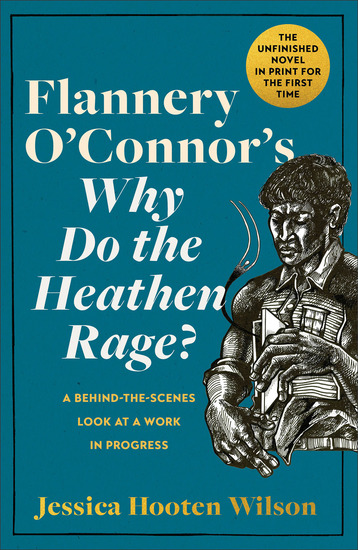
Flannery O'Connor's Why Do the Heathen Rage? - A Behind-the-Scenes Look at a Work in Progress - cover

Flannery O'Connor's Why Do the Heathen Rage? - A Behind-the-Scenes Look at a Work in Progress

Jessica Hooten Wilson

Casa editrice: Brazos Press

  • 0
  • 0
  • 0

Sinossi

Christianity Today 2025 Award of Merit (Culture, Poetry, and the Arts) 
 
"Wilson does a great service in resurrecting one of O'Connor's lesser-known works."--Publishers Weekly 
 
When celebrated American novelist and short story writer Flannery O'Connor died at the age of thirty-nine in 1964, she left behind an unfinished third novel titled Why Do the Heathen Rage? Scholarly experts uncovered and studied the material, deeming it unpublishable. It stayed that way for more than fifty years. 
 
Until now. 
 
For the past ten-plus years, award-winning author Jessica Hooten Wilson has explored the 378 pages of typed and handwritten material of the novel--transcribing pages, organizing them into scenes, and compiling everything to provide a glimpse into what O'Connor might have planned to publish. 
 
This book is the result of Hooten Wilson's work. In it, she introduces O'Connor's novel to the public for the first time and imagines themes and directions O'Connor's work might have taken. Including illustrations and an afterword from noted artist Steve Prince (One Fish Studio), the book unveils scenes that are both funny and thought-provoking, ultimately revealing that we have much to learn from what O'Connor left behind.
Disponibile da: 23/01/2024.
Lunghezza di stampa: 192 pagine.

Altri libri che potrebbero interessarti

  • Phoney War The: The History of the Uneasy Calm along the Western Front at the Start of World War II - cover

    Phoney War The: The History of...

    Editors Charles River

    • 0
    • 0
    • 0
    Though the French would be decisively defeated soon after the Nazi invasion of Belgium and France in early 1940, they had not sat on their hands. As the power of Nazi Germany grew alarmingly during the 1930s, the French sought means to defend their territory against the rising menace of the Thousand Year Reich. As architects of the most punitive measures in the Treaty of Versailles following World War I, France was the most natural target for German retribution, so the Maginot Line, a series of interconnected strongpoints and fortifications running along much of France's eastern border, helped allay French fears of invasion.  
    	The popular legend of the Maginot Line portrays the frontier defenses as a useless “white elephant” project that was prompted by a gross misapprehension of warfare's new realities in the mid-20th century and quickly overwhelmed by the forceful advance of the German blitzkrieg. English idiom today invokes this vision of the Maginot Line as a metaphor for any defensive measure strongly believed in but actually useless. Indeed, usages such as “Maginot Line mentality,” describing an overly defensive, reactive mindset, perpetuate the legend. As a French author and military liaison with the British, Andre Maurois, wrote about his disillusionment with the defensive line he originally enthusiastically supported: “We know now that the Maginot line-complex was a dangerous disease of the mind; but I publish this as it was written in January, 1940.”  
    This was what brought about the stasis along the Western Front near the end of 1939, a short period of time now referred to as the Phoney War, during which the Western Allies awaited some sort of action by the Nazis. Ultimately, the Allies had not expected the Germans would be able to move armored units through the Ardennes Forests, a heavily wooded region spanning parts of Belgium, France and the Netherlands. 
    Mostra libro
  • The Prince - cover

    The Prince

    Niccolo Machiavelli

    • 0
    • 0
    • 0
    The Prince (Italian: Il Principe [il ˈprintʃipe]; Latin: De Principatibus) is a 16th-century political treatise written by the Italian diplomat, philosopher, and political theorist Niccolò Machiavelli in the form of a realistic instruction guide for new princes. As a remarkable general theme, The Prince appears to take it for granted that immoral acts are justified if they can help achieve political glory. 
    From Machiavelli's correspondence, a version was apparently being written in 1513, using a Latin title, De Principatibus (Of Principalities). However, the printed version was not published until 1532, five years after Machiavelli's death. This was carried out with the permission of the Medici pope Clement VII, but "long before then, in fact since the first appearance of The Prince in manuscript, controversy had swirled about his writings". 
    Although The Prince was written as if it were a traditional work in the mirrors for princes style, it was generally agreed as being especially innovative. This is partly because it was written in the vernacular Italian rather than Latin, a practice that had become increasingly popular since the publication of Dante's Divine Comedy and other works of Renaissance literature.  Machiavelli illustrates his reasoning using remarkable comparisons of classical, biblical, and medieval events, including many seemingly positive references to the murderous career of Cesare Borgia, which occurred during Machiavelli's own diplomatic career.
    Mostra libro
  • Washington's Lieutenants - Major versus Brigadier Generals in the Revolutionary War - cover

    Washington's Lieutenants - Major...

    Douglas M. Branson

    • 0
    • 0
    • 0
    As commander-in-chief of the Continental Army, George Washington developed the strategy that won the Revolutionary War, but while Washington directed some battles, his strategy for the most part was carried out by his subordinates. In the spirit of the best military history and biography, Washington's Lieutenants tells the story of the generals who served under Washington from 1775 to 1781. 


    Based on extensive research, the book finds the brigadier generals a laudable group of commanders. A quarter of all brigadiers died in the service of the new nation. 


    Only three served for the war's duration, including the great Nathanael Greene and Henry Knox. Ten resigned. Benedict Arnold turned coat. At least three were involved in the so-called Conway Cabal of 1777–78 to oust General Washington. The controversial Horatio Gates, self-proclaimed victor of Saratoga, was accused of cowardice at the Battle of Camden, South Carolina. 


    At once entertaining information about some of the Revolutionary War's most colorful military commanders and an insightful analysis of how the young nation fought for its independence, Washington's Lieutenants will be essential during the wars 250th anniversary and beyond.
    Mostra libro
  • Crown Jewels: Unpack the misconceptions and uncover the real lives of today’s royal women with this groundbreaking feminist analysis of the British monarchy – new for 2026! - cover

    Crown Jewels: Unpack the...

    Catherine Mayer

    • 0
    • 0
    • 0
    Not Yet Available
    Mostra libro
  • The Crucible of Desegregation - The Uncertain Search for Educational Equality - cover

    The Crucible of Desegregation -...

    R. Shep Melnick

    • 0
    • 0
    • 0
    Examines the patchwork evolution of school desegregation policy. 
     
    In 1954, the Supreme Court delivered the landmark decision of Brown v. Board of Education—establishing the right to attend a desegregated school as a national constitutional right—but the decision contained fundamental ambiguities. The Supreme Court has never offered a clear definition of what desegregation means or laid out a framework for evaluating competing interpretations. In The Crucible of Desegregation, R. Shep Melnick examines the evolution of federal school desegregation policy from 1954 through the termination of desegregation orders in the first decades of the twenty-first century, combining legal analysis with a focus on institutional relations, particularly the interactions between federal judges and administrators. Melnick argues that years of ambiguous, inconsistent, and meandering Court decisions left lower court judges adrift, forced to apply contradictory Supreme Court precedents in a wide variety of highly charged political and educational contexts. As a result, desegregation policy has been a patchwork, with lower court judges playing a crucial role and with little opportunity to analyze what worked and what didn’t. The Crucible of Desegregation reveals persistent patterns and disagreements that continue to roil education policy.
    Mostra libro
  • Louvre and the Hermitage The: The History and Contents of Europe’s Biggest Art Museums - cover

    Louvre and the Hermitage The:...

    Editors Charles River

    • 0
    • 0
    • 0
    The very name of the Louvre conjures up scenes of art and elegance, and of long halls filled with beauty and people strolling through them whispering quietly among themselves about the glories they are witnessing. Even those who have never been to the Louvre know some of its most prized possessions, from ancient statues to Leonardo Da Vinci’s “Mona Lisa”. As the world’s largest museum, the Louvre is unquestionably the cultural highpoint of Paris, a city that has long been considered the cultural center of Europe. 
    However, life is rarely as simple as one imagines, and the life of the Louvre is no different. While just about everyone is familiar with its history as an art museum, the Louvre’s history goes back over 800 years, and it used to have far different purposes, both as a medieval fortress and a palatial residence for French kings. The Louvre bore witness to mass murder during the French Revolution, and there have been countless accusations of theft and other questionable actions since its opening. 
    Catherine the Great came to power in the midst of the Enlightenment, which was flourishing in France and Britain, and she would rule as an Enlightened ruler. A known correspondent of Voltaire’s, Catherine sought to modernize Russia and turn it into a force in its own right, creating a rich and cultured court at the same time. Over the course of nearly 35 years in power, Catherine ushered in the Russian Enlightenment and presided over a period of time known as the Golden Age of the Russian Empire. 
    Moreover, Catherine had an unmatched passion for the arts, and she began a private art collection that would eventually evolve into galleries upon galleries of historical treasures shipped in from all over the world. This fabled museum was none other than the Hermitage, located in the heart of Saint Petersburg, a city founded by the imperial empire's very own Peter the Great.
    Mostra libro