¡Acompáñanos a viajar por el mundo de los libros!
Añadir este libro a la estantería
Grey
Escribe un nuevo comentario Default profile 50px
Grey
Suscríbete para leer el libro completo o lee las primeras páginas gratis.
All characters reduced
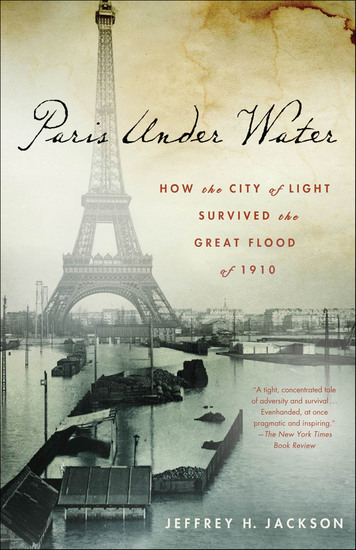
Paris Under Water - How the City of Light Survived the Great Flood of 1910 - cover

Paris Under Water - How the City of Light Survived the Great Flood of 1910

Jeffrey H. Jackson

Editorial: St. Martin's Press

  • 0
  • 0
  • 0

Sinopsis

In the winter of 1910, the river that brought life to Paris quickly became a force of destruction.  Torrential rainfall saturated the soil, and faulty engineering created a perfect storm of conditions that soon drowned Parisian streets, homes, businesses, and museums. The city seemed to have lost its battle with the elements. Given the Parisians' history of deep-seated social, religious, and political strife, it was questionable whether they could collaborate to confront the crisis. Yet while the sewers, Métro, and electricity failed around them, Parisians of all backgrounds rallied to save the city and one another. Improvising techniques to keep Paris functioning and braving the dangers of collapsing infrastructure and looters, leaders and residents alike answered the call to action. This newfound ability to work together proved a crucial rehearsal for an even graver crisis four years later, when France was plunged into World War I. On the occasion of the hundredth anniversary of the flood, Jeffrey H. Jackson captures here for the first time the drama and ultimate victory of man over nature.
Disponible desde: 04/09/2024.
Longitud de impresión: 273 páginas.

Otros libros que te pueden interesar

  • My Life in the News - From Village Fete to the Front Line - cover

    My Life in the News - From...

    Michael Clayton

    • 0
    • 0
    • 0
    Journalist and Editor Michael Clayton worked his way up from local newspapers to BBC war correspondent, with radio and magazine experience inbetween.   
    From the sharp end of the action in Vietnam, to the violence of the Troubles in Belfast and the tragedy of the East Pakistan revolt, Clayton    is well placed to compare the varying challenges of journalism on different media platforms.   
    The rivalry between the BBC and ITV, the bravery of war cameramen, dealing on assignment with corrupt officials, the TV preference for close-to-the action film as opposed to insightful reports of the effects of conflict: Clayton has experienced it all over a 70-year career.
    His insights into the ethos of the BBC, the colourful characters he reported and filmed alongside, and his resulting views of humanity, war and crime – Clayton's autobiography in journalism is honest, wry and full of insight.   
    Ver libro
  • Becoming Batman - The Possibility of a Superhero - cover

    Becoming Batman - The...

    E. Paul Zehr, James Kakalios

    • 0
    • 0
    • 0
    Possessing no supernatural powers, Batman is the most realistic of all the superheroes. His feats are achieved through rigorous training and mental discipline, and with the aid of fantastic gadgets. Drawing on his training as a neuroscientist, kinesiologist, and martial artist, E. Paul Zehr explores the question: Could a mortal ever become Batman? 


    Zehr discusses the physical training necessary to maintain bad-guy-fighting readiness while relating the science underlying this process, from strength conditioning to the cognitive changes a person would endure in undertaking such a regimen. In probing what a real-life Batman could achieve, Zehr considers the level of punishment a consummately fit and trained person could handle, how hard and fast such a person could punch and kick, and the number of adversaries that individual could dispatch. He also tells us what it would be like to fight while wearing a batsuit and the amount of food we'd need to consume each day to maintain vigilance as Gotham City's guardian. 


    A fun foray of escapism grounded in sound science, Becoming Batman provides the background for attaining the realizable—though extreme—level of human performance that would allow you to be a superhero.
    Ver libro
  • Ecce Homo - cover

    Ecce Homo

    Friedrich Nietzsche

    • 0
    • 0
    • 0
    “Without music, life would be a mistake.”“It is not a lack of love, but a lack of friendship that makes unhappy marriages.” ...“That which does not kill us makes us stronger.”“I'm not upset that you lied to me, I'm upset that from now on I can't believe you.” 
    Nietzsche 
     
    The philosopher Friedrich Nietzsche's autobiography, Ecce Homo, was the last prose work that he wrote before his illness in 1889. Coming at the end of an extraordinarily productive year in which he had produced The Twilight of the Idols and The Antichrist, Nietzsche shuns any pretense at modesty with chapter titles include “Why I am so Wise”, “Why I am so Clever” and “Why I Write Such Excellent Books”. His translator Anthony M. Ludovici states, Ecce Homo “is not only a coping-stone worthy of the wonderful creations of that year, but also a fitting conclusion to his whole life, in the form of a grand summing up of his character as a man, his purpose as a reformer, and his achievement as a thinker. 
     
    Friedrich Wilhelm Nietzsche was a German philosopher, cultural critic and philologist whose work has exerted a profound influence on modern intellectual history. He began his career as a classical philologist before turning to philosophy.
    Ver libro
  • After the Flames - A Burn Victim's Battle With Celebrity - cover

    After the Flames - A Burn...

    Jonathan R. Rose

    • 0
    • 0
    • 0
    "A fast-paced, compelling narrative that goes far beyond the headlines." —KEVIN DONOVAN, author of The Billionaire Murders 


    For Joey Philion, surviving the fire was only the beginning. 


    On the morning of March 10th, 1988, in Orillia, Ontario, a house fire engulfed fourteen-year-old Joey Philion in flames. He suffered third degree burns on ninety-five percent of his body. Doctors didn't think he would make it through the night. 


    After the Flames is about one of the world's most famous burn victims: his incredible survival, his nightmarish path to recovery that helped revolutionize medical treatment for burn victims worldwide, the fame thrust upon him after he was declared a hero from the media, and the tumultuous years that followed, most of which were spent under the microscope of an unforgiving public eye. 


    The story also follows Joey's family, including his mother Linda, stepfather Mike, and younger brother Danny, all of whom endured their own tremendous hardships in the wake of a fire that changed their lives forever.
    Ver libro
  • I Am Brave! - cover

    I Am Brave!

    Kim Mitzo Thompson, Karen Mitzo...

    • 0
    • 0
    • 0
    I Am Brave! is a wonderful way for young children to learn social-emotional skills that will help them develop courage in everyday life. Real-life, relatable examples include trying something new, making friends, standing up for what's right, persevering, making wise choices, speaking up, and more. Adorable art sweetly illustrates important life skills. Each book in this delightful series is perfect for home, childcare settings, and schools.
    Ver libro
  • Engineering Hitler's Downfall - The Brains that Enabled Victory - cover

    Engineering Hitler's Downfall -...

    Gwilym Roberts

    • 0
    • 0
    • 0
    While living in Liverpool, Britain's second most heavily bombed city during World War II, the author experienced firsthand the terrible effects of the war on the civilian population and when studying at Cambridge he witnessed the American heavy bombers and their fighter escorts flying to attack targets in Germany and occupied Europe. 


    Serving as an engineering officer in the Royal Navy in HMS Sheffield provided firsthand realization of the importance of engineering and emphasized that victories achieved in the Battle of Britain and other campaigns were made possible by newly-developed machines, equipment, or techniques. These innovations gave the Allied forces a significant advantage and helped ensure eventual victory. 


    Engineering Hitler's Downfall features numerous inventions such as the decoding machines developed at Bletchley Park; the hand-held mine detectors that cleared pathways through enemy minefields, firstly  at the Battle of el Alamein but also in most subsequent actions; the newly-located factories and tanks that enabled the Russians to repulse the German invasion; the escort carriers and long range aircraft that enabled U-boats to be attacked in the mid-Atlantic; and the 4000 plus Bailey bridges that allowed narrow ravines and rivers as wide as the Rhine to be crossed. These and many other examples illustrate what was achieved under such immense pressure.
    Ver libro