¡Acompáñanos a viajar por el mundo de los libros!
Añadir este libro a la estantería
Grey
Escribe un nuevo comentario Default profile 50px
Grey
Suscríbete para leer el libro completo o lee las primeras páginas gratis.
All characters reduced
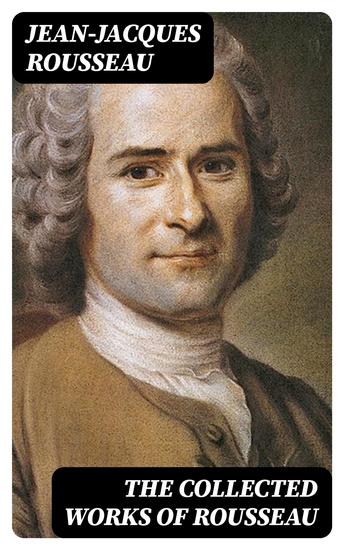
The Collected Works of Rousseau - Enriched edition - cover

The Collected Works of Rousseau - Enriched edition

Jean-Jacques Rousseau

Traductor Barbara Foxley, G. D. H. Cole, Samuel William Orson

Editorial: DigiCat

  • 0
  • 0
  • 0

Sinopsis

The Collected Works of Rousseau presents a comprehensive compilation of the writings of one of the Enlightenment's most pivotal figures. This anthology showcases Rousseau's provocative ideas on social contract theory, education, and the nature of human freedom, melding philosophical rigor with deeply personal reflections. His innovative literary style often blurs the boundaries between autobiography and political treatise, as seen in seminal works such as "The Social Contract" and "Emile, or On Education." The collection captures the essence of 18th-century philosophical discourse, highlighting Rousseau's keen critique of contemporary society and his call for authentic self-expression in a rapidly modernizing world. Jean-Jacques Rousseau, born in Geneva in 1712, was a profoundly influential thinker whose ideas helped lay the groundwork for modern political and educational thought. His tumultuous life, characterized by personal strife and a deep sense of existential inquiry, shaped his views on the corrupting influence of civilization and the innate goodness of humanity. Rousseau's experiences, including his estrangement from society and his passionate writings, bring a unique authenticity and urgency to his works. This collection is indispensable for any reader seeking to understand the complexities of human nature and the social contract's enduring relevance. It not only offers insight into Rousseau's philosophical tenets but also invites contemplation on contemporary issues of individuality and community, making it a vital resource for students, scholars, and anyone interested in the evolution of democratic thought.

In this enriched edition, we have carefully created added value for your reading experience:
- An Introduction draws the threads together, discussing why these diverse authors and texts belong in one collection.
- Historical Context explores the cultural and intellectual currents that shaped these works, offering insight into the shared (or contrasting) eras that influenced each writer.
- A combined Synopsis (Selection) briefly outlines the key plots or arguments of the included pieces, helping readers grasp the anthology's overall scope without giving away essential twists.
- A collective Analysis highlights common themes, stylistic variations, and significant crossovers in tone and technique, tying together writers from different backgrounds.
- Reflection questions encourage readers to compare the different voices and perspectives within the collection, fostering a richer understanding of the overarching conversation.
Disponible desde: 13/11/2022.
Longitud de impresión: 1769 páginas.

Otros libros que te pueden interesar

  • Untangling Critical Race Theory - What Christians Need to Know and Why It Matters - cover

    Untangling Critical Race Theory...

    Ed Uszynski

    • 0
    • 0
    • 0
    What is Critical Race Theory? 


    It may be one of the most widely referenced issues of the day, but it's also one of the least understood. In its translation from the academic world to the general public, Critical Race Theory (CRT) has inaccurately become a catch-all term for anything related to race. But what does it actually mean, and how should Christians engage it? 


    Ed Uszynski—whose PhD in American culture studies navigated readings in Marxism, Critical Theory, and Critical Race Theory—carefully unpacks what critical race theorists seek to accomplish and what Christians can learn from them. Uszynski generously explores CRT's roots, context, and central tenets, revealing how its insights are used and distorted but also how they might benefit the church. With responsible answers to legitimate concerns, Uszynski goes beyond the surface to provide a reliable path of just discernment and cultural engagement.
    Ver libro
  • The Pax Romana - Peace and Prosperity in the Roman Empire - cover

    The Pax Romana - Peace and...

    Rogan Fish

    • 0
    • 0
    • 0
    The Pax Romana, meaning "Roman Peace," was a remarkable period of stability and prosperity that lasted for over two centuries. It began with the rise of Augustus, Rome’s first emperor, following the chaotic years of civil war that had plagued the late Republic. This era saw the establishment of a strong centralized government, economic growth, and the expansion of Rome’s influence across the Mediterranean and beyond. The foundations of this peace were carefully laid through political reforms, military strength, and a redefined vision of Roman leadership. 
    The aftermath of the civil wars that marked the late Republic left Rome in a state of disarray. The assassination of Julius Caesar in 44 BCE triggered a power struggle, culminating in the final confrontation between Octavian—Caesar’s adopted heir—and Mark Antony. With his victory at the Battle of Actium in 31 BCE, Octavian secured his position as the dominant ruler of Rome. In 27 BCE, he formally accepted the title of Augustus from the Senate, marking the beginning of the imperial system. This transition ended the Republic but ushered in an era of stability that would define the next two centuries. 
    Augustus carefully crafted a government that appeared to preserve Republican traditions while consolidating power in his hands. By maintaining the illusion of senatorial authority, he avoided the fate of his great-uncle, Julius Caesar. However, his rule was firmly grounded in the principles of autocracy. He reorganized the military, ensuring its loyalty through direct financial incentives, and established a standing army with permanent stations along the empire’s borders. This professionalization of the military reduced internal conflicts and safeguarded the empire from external threats.
    Ver libro
  • Sacred Texts and Teachings - The Role of Jewish Scriptures in Cultural Practices - cover

    Sacred Texts and Teachings - The...

    Joseph Arston

    • 0
    • 0
    • 0
    The Jewish scriptures, known collectively as the Tanakh, serve as the foundation of Jewish religious and cultural identity. These sacred texts, developed over centuries, provide insight into the beliefs, laws, and traditions that have shaped Jewish communities. The origins of these scriptures trace back to ancient Israel, where oral traditions and early writings formed the basis of what would become the Hebrew Bible. 
    The Torah, also known as the Five Books of Moses, is the most revered section of Jewish scripture. It is believed to have been divinely revealed to Moses on Mount Sinai and encompasses the laws, history, and ethical teachings central to Judaism. The Torah consists of Genesis, Exodus, Leviticus, Numbers, and Deuteronomy, each of which outlines the early history of the Israelites and their covenant with God. These texts were initially passed down through oral tradition before being written and compiled into a unified body of scripture. 
    In addition to the Torah, other ancient Hebrew texts played a significant role in shaping Jewish scripture. The writings of the Prophets (Nevi’im) and the sacred poetry and wisdom literature found in the Writings (Ketuvim) were added over time. The historical context of these texts reflects the struggles, triumphs, and spiritual evolution of the Jewish people. The Book of Judges and the Books of Kings, for example, document the rise and fall of Israelite leaders, while the Psalms offer poetic expressions of devotion and supplication.
    Ver libro
  • The Art of Letting Go - Releasing Past Burdens - cover

    The Art of Letting Go -...

    Fiona Zenith

    • 0
    • 0
    • 0
    In The Art of Letting Go: Releasing Past Burdens, Fiona Zenith offers a compassionate and practical guide to freeing yourself from the emotional weights that hold you back. Through a blend of insightful psychology, mindfulness techniques, and real-life stories, this book provides the tools you need to navigate the complexities of anxiety, depression, and emotional attachments. Whether you're struggling with unresolved past experiences, fear of change, or the challenges of self-doubt, this book will help you cultivate resilience, embrace self-awareness, and build a life of inner peace and balance. With actionable exercises, reflective prompts, and inspiring narratives, The Art of Letting Go is your roadmap to emotional freedom, empowering you to release what no longer serves you and step into a brighter, more fulfilling future. Let this book be your companion on the journey to healing, growth, and lasting joy.
    Ver libro
  • Communist Manifesto The - Karl Marx - cover

    Communist Manifesto The - Karl Marx

    Karl Marx

    • 0
    • 0
    • 0
    The Communist Manifesto (German: Kommunistisches Manifest), originally the Manifesto of the Communist Party (German: Manifest der Kommunistischen Partei), is a political pamphlet written by German philosophers Karl Marx and Friedrich Engels. Commissioned by the Communist League and originally published in London in 1848, the Manifesto remains one of the world's most influential political documents. It presents an analytical approach to class struggle and criticizes capitalism and the capitalist mode of production, without attempting to predict communism's potential future forms. 
    The Communist Manifesto summarises Marx and Engels' theories concerning the nature of society and politics, namely that, in their own words, "[t]he history of all hitherto existing society is the history of class struggles". It also briefly features their ideas for how the capitalist society of the time would eventually be replaced by socialism. In the last paragraph of the Manifesto, the authors call for a "forcible overthrow of all existing social conditions", which served as a call for communist revolutions around the world. 
    In 2013, The Communist Manifesto was registered to UNESCO's Memory of the World Programme along with Marx's Capital.
    Ver libro
  • Relax Get Inspired: The Prince - cover

    Relax Get Inspired: The Prince

    Niccolò Machiavelli

    • 0
    • 0
    • 0
    Step into the ruthless and cunning world of Renaissance politics with Niccolò Machiavelli’s timeless masterpiece, "The Prince." Written in 1513 and still strikingly relevant today, this seminal work offers a pragmatic guide to power, leadership, and the art of governance. 
    Machiavelli, a diplomat and political theorist, draws from his vast experience and keen observations to craft a treatise that has shaped the minds of leaders for centuries. "The Prince" lays bare the often harsh realities of political rule, advocating for pragmatism over idealism and necessity over morality. Machiavelli’s unflinching advice on statecraft, diplomacy, and military strategy has earned the work both admiration and infamy. 
    Discover the enduring insights of a text that explores:The Acquisition and Maintenance of Power: Learn the essential strategies for gaining and retaining authority in a complex political landscape.Leadership and Human Nature: Delve into Machiavelli’s observations on human behavior and the qualities of effective rulers.Realpolitik: Understand the principles of practical politics where the ends justify the means. 
    "The Prince" remains an essential read for anyone interested in politics, history, and the dynamics of power. Its bold and provocative ideas challenge conventional wisdom and continue to spark debate and discussion. 
    Embrace the wisdom of Machiavelli and explore the depths of political strategy with "The Prince," a book that has withstood the test of time and remains a cornerstone of political literature.
    Ver libro