Unisciti a noi in un viaggio nel mondo dei libri!
Aggiungi questo libro allo scaffale
Grey
Scrivi un nuovo commento Default profile 50px
Grey
Iscriviti per leggere l'intero libro o leggi le prime pagine gratuitamente!
All characters reduced
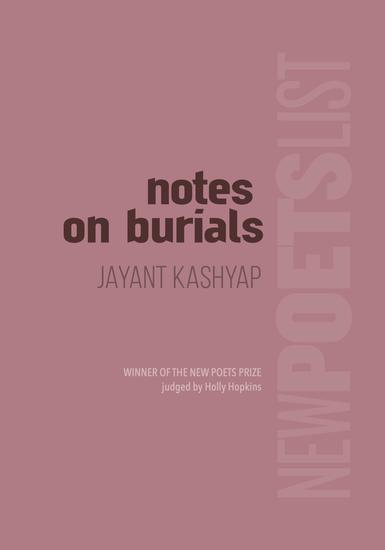
Notes on Burials - cover

Notes on Burials

Jayant Kashyap

Casa editrice: The Poetry Business

  • 0
  • 0
  • 0

Sinossi

Winner of the 2024 New Poets Prize, judged by Holly Hopkins.
An archaeological dig, a visit to an imagined London, puppies that come back from the dead. In Notes on Burials, Jayant Kashyap makes a series of journeys: real, mythological and etymological as he navigates what is lost and what is buried. Kashyap's poems of love and remembrance reach out to collective losses, human and environmental, in a series of disappearing acts and excavations that take us from broken childhood patio to a snowboarder in an avalanche.
Disponibile da: 18/07/2025.
Lunghezza di stampa: 36 pagine.


Altri libri che potrebbero interessarti

  • Erebus - cover

    Erebus

    Elizabeth Lewis Williams

    • 0
    • 0
    • 0
    In 1958, geophysicist A. G. Lewis travelled to the Antarctic to investigate the landscapes and skies of that vast and icy continent.
    Now Elizabeth Lewis Williams traces her father's journeys, from the Peninsula to Mt Erebus. They are real, imagined, and artistic journeys, exploring communication across time and space, and experiments in scientific and poetic measure.
    Erebus transports us to an Antarctic of paradox. A land where perpetual daylight balances months of austral darkness. A land of encounters with the unknown, and with mortality – but where camaraderie and faith are the only defence against catastrophe.
    At its heart, Erebus is a visit to the frozen underworld, and an exploration of how we find a place for ourselves in this vast and often unforgiving world we call home.
    Mostra libro
  • The Language of the Birds - Poems - cover

    The Language of the Birds - Poems

    Amy Nemecek

    • 0
    • 0
    • 0
    According to legend, the language of the birds was a mystical language God used to talk with Adam and Eve when he walked with them in the garden of Eden. Amy Nemecek listens for this divine dialect as she communes with God on her walks along country roads and creek banks, through forests and hayfields. She observes the world around her with expectation, knowing that God still speaks to us as he is at work making all things new. If we have ears to hear, we can catch snippets of his grace in the watercolor silhouette of a bird, the thrum of a tractor engine, the tang of a grapefruit, the curvature of an ampersand. Amy doesn't want to miss any of it, so she remains attentive to the smooth grit of beach sand, the tendrils of a nebula, and the steady gaze of a fossil. She delights in the details, and you will too.
    In this collection of lyric and narrative poems, you are invited to walk with her as she reflects on larger themes of beauty, loss, motherhood, family, and vocation. She contemplates the sacredness of ordinary moments that we usually don't recognize except in hindsight. Twining through every line is an aching hopefulness that ties together her love of words, her devotion to scripture, and her deep gratitude for each of life's joys and griefs.
    
    "Rub dust on your palms, pluck the ripened sunshine, and taste this poetic grace." —Dwight Baker, president and CEO of Baker Publishing Group
    Mostra libro
  • Poetry: A Magazine of Verse Vol 18 April-September 1921 - cover

    Poetry: A Magazine of Verse Vol...

    Harriet Monroe

    • 0
    • 0
    • 0
    Spring through Fall 1921 in Poetry, edited by Harriet Monroe. 2012 is the 100th Anniversary of Poetry magazine. (Summary by BellonaTimes)
    Mostra libro
  • A Vagabond Song - cover

    A Vagabond Song

    Bliss Carman

    • 0
    • 0
    • 0
    LibriVox volunteers bring you fifteen different recordings of A Vagabond Song, by Bliss Carman, to celebrate the Autumnal Equinox. This was the weekly poetry project for the week of September 24th, 2006.
    Mostra libro
  • Enough Rope - cover

    Enough Rope

    Dorothy Parker

    • 0
    • 0
    • 0
    “If I abstain from fun and such, / I'll probably amount to much, / But I shall stay the way I am, / Because I do not give a damn.” 
      
    American poet Dorothy Parker lived a life of heartache and hardship, but her writing became her weapon to fight back. She refused to temper her strong opinions, even at the cost of her editorial position at Vanity Fair. Parker continued to write—unfiltered and unapologetic—and found solidarity in community with other writers. Enough Rope was Parker’s first volume of poetry, featuring poems originally published in Life, Vanity Fair, and The New Yorker. Parker’s poetry has galvanized generations of strong-willed women, and the fire in her voice burns strong even a century after the first publication.
    Mostra libro
  • The Divine Comedy Paradise - cover

    The Divine Comedy Paradise

    Dante Alighieri

    • 0
    • 0
    • 0
    Paradiso (Italian: [paraˈdiːzo]; Italian for "Paradise" or "Heaven") is the third and final part of Dante's Divine Comedy, following the Inferno and the Purgatorio. It is an allegory telling of Dante's journey through Heaven, guided by Beatrice, who symbolises theology. In the poem, Paradise is depicted as a series of concentric spheres surrounding the Earth, consisting of the Moon, Mercury, Venus, the Sun, Mars, Jupiter, Saturn, the Fixed Stars, the Primum Mobile and finally, the Empyrean. It was written in the early 14th century. Allegorically, the poem represents the soul's ascent to God.While the structures of the Inferno and Purgatorio were based around different classifications of sin, the structure of the Paradiso is based on the four cardinal virtues (Prudence, Justice, Temperance, and Fortitude) and the three theological virtues (Faith, Hope, and Charity).
    Mostra libro