Join us on a literary world trip!
Add this book to bookshelf
Grey
Write a new comment Default profile 50px
Grey
Subscribe to read the full book or read the first pages for free!
All characters reduced
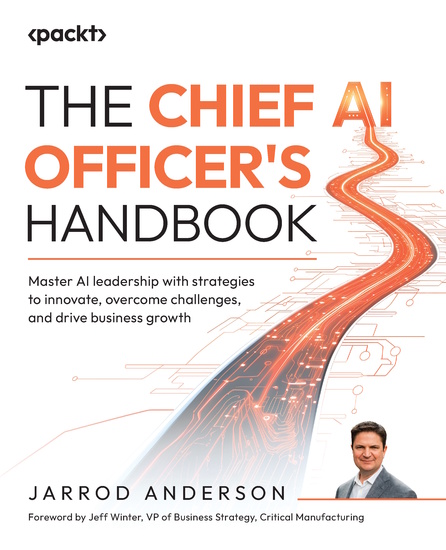
The Chief AI Officer's Handbook - Master AI leadership with strategies to innovate overcome challenges and drive business growth - cover

The Chief AI Officer's Handbook - Master AI leadership with strategies to innovate overcome challenges and drive business growth

Jarrod Anderson

Publisher: Packt Publishing

  • 0
  • 0
  • 0

Summary

Chief Artificial Intelligence Officers (CAIOs) are now imperative for businesses, enabling organizations to achieve strategic goals and unlock transformative opportunities through the power of AI. By building intelligent systems, training models to drive impactful decisions, and creating innovative applications, they empower organizations to thrive in an AI-driven world. Written by Jarrod Anderson, Chief AI Officer at SYRV.AI, this book bridges the gap between visionary leadership and practical execution.This handbook reimagines AI leadership for today’s fast-paced environment, leveraging predictive, deterministic, generative, and agentic AI to address complex challenges and foster innovation. It provides CAIOs with the strategies to develop transformative AI initiatives, build and lead elite teams, and adopt AI responsibly while maintaining compliance. From shaping impactful solutions to achieving measurable business outcomes, this guide offers a roadmap for making AI your organization’s competitive edge.By the end of this book, you’ll have the knowledge and tools to excel as a Chief AI Officer, driving innovation, strategic growth, and lasting success for your organization.
Available since: 01/31/2025.
Print length: 336 pages.

Other books that might interest you

  • The Shocking Truth about Public Health Policies - cover

    The Shocking Truth about Public...

    Zoey Fraisers

    • 0
    • 0
    • 0
    Public health policies are often framed as measures designed to protect the population, improve well-being, and prevent disease. Governments, health agencies, and media outlets present these policies as the result of careful scientific research, public interest, and expert consensus. However, beneath the surface, public health is not just about science—it is deeply entangled with politics, economics, and power structures that influence decisions more than most people realize.  
      
    Many assume that public health guidelines are purely based on the best available data, but the reality is far more complex. Policies are frequently shaped by corporate interests, lobbying efforts, and political agendas rather than unbiased scientific evidence. Pharmaceutical companies, food conglomerates, and other industries wield significant influence over the very institutions meant to regulate them. This raises critical questions: Are these policies truly designed for the benefit of the people, or are they tools for financial and political gain?  
      
    The illusion of safety plays a crucial role in how these policies are accepted by the public. Fear-based messaging, emotional appeals, and selective use of data are commonly employed to justify drastic measures. The COVID-19 pandemic provided a stark example of this phenomenon—governments around the world enforced lockdowns, vaccine mandates, and surveillance measures, all under the banner of public health. Those who questioned the effectiveness or necessity of these policies were often silenced, labeled as spreading misinformation, or even punished. This suppression of dissent not only limits individual freedom but also prevents legitimate scientific debate from taking place. 
    Show book
  • Why Matter Doesn't Matter: Physics Within Consciousness - cover

    Why Matter Doesn't Matter:...

    Samuel Avery

    • 0
    • 0
    • 0
    Expand your mind and shift your vantage point on reality with Why Matter Doesn't Matter — a paradigm-shifting exploration of physics and consciousness.  
     
    Drawing on insights from modern physics like relativity and quantum mechanics, Samuel Avery builds a compelling case that consciousness itself is fundamental — and that space, time, and the familiar dimensions we experience are phenomena arising within consciousness rather than existing as an external physical reality. 
     
    Avery provides a new lens for understanding the greatest enigmas of physics, helping listeners transcend the limitation of seeing the universe as purely material and question the foundations upon which our current paradigms rest. 
    In the final chapter, Avery invites listeners to embark on an experiential journey — a practical approach to directly experiencing the dimensional nature of perception and reality as rooted in consciousness itself.  
     
    Whether you're a curious newcomer, a student of physics, or a spiritual seeker, Why Matter Doesn't Matter offers a paradigm-shifting exploration into the very fabric of existence, shedding new light on the mysteries of the universe and our role within it.
    Show book
  • MACHINE LEARNING AND ARTIFICIAL INTELLIGENCE - A Comprehensive Guide to Understanding and Implementing ML and AI (2023 Beginner Crash Course) - cover

    MACHINE LEARNING AND ARTIFICIAL...

    Carl Dennis

    • 0
    • 0
    • 0
    Machine Learning (ML) and Artificial Intelligence (AI) are two of the most popular and rapidly evolving fields in the technology industry. From self-driving cars and personalized recommendation systems to speech recognition and medical diagnosis, ML and AI are transforming the way we live and work. 
    In this book, you'll learn about the fundamental concepts and practical applications of ML and AI. You'll discover how to build, train, and deploy intelligent systems using popular programming languages and frameworks such as Python, TensorFlow, and PyTorch. 
    Here are some of the topics covered in the book:The basics of ML and AI, including supervised and unsupervised learning, deep learning, and neural networksData preprocessing, feature selection, and dimensionality reduction techniquesModel selection, evaluation, and optimizationComputer vision and image recognitionNatural language processing (NLP) and text analysisReinforcement learning and game theoryEthical considerations and potential biases in AI\ 
    And Much More!... 
    Whether you're a beginner or an experienced programmer, this book will provide you with the knowledge and skills you need to start building intelligent systems with confidence. 
    So, dive into the exciting world of ML and AI and unlock the potential of these cutting-edge technologies! 
     
    Show book
  • ISO IEC 38500: A pocket guide second edition - cover

    ISO IEC 38500: A pocket guide...

    Alan Calder

    • 0
    • 0
    • 0
    Understand ISO 38500: the standard for the corporate governance of IT
    In the 21st century, IT governance has become a much-discussed topic among IT professionals. An IT governance framework serves to close the gap between the importance of IT and the understanding of IT, helping to improve your organisation's competitive position.
    ISO/IEC 38500 is the international standard for the corporate governance of information and communication technology. The purpose of the standard is to create a framework to ensure that the board is appropriately involved, and it sets out guiding principles for governing bodies on how to ensure the effective, efficient and acceptable use of IT within their company.
    This useful pocket guide is an ideal introduction for those wanting to understand more about ISO 38500. It describes the scope, application and objectives of the Standard and outlines its six core principles. It covers:
    
    - What is ISO/IEC 38500?
    - The corporate governance context
    - Scope, application and objectives
    - Principles and model for good governance of it
    - Implementing the six IT governance principles
    - ISO/IEC 38500 and the IT steering committee
    - Project governance
    - Other IT governance standards and frameworks
    - Integrated frameworksImplement an IT governance framework to improve your organisation's competitive position. Buy this pocket guide today!
    About the author
    Alan Calder is a leading author on IT governance and information security issues. He is Group CEO of GRC International Group plc, the AIM-listed company that owns IT Governance Ltd. Alan is a frequent media commentator on IT governance and information security issues, and has contributed articles and expert comment to a wide range of trade, national and online news outlets.
    Show book
  • Crypto and Metaverse Investing Guide - 2 in 1: Crypto Investing guide and Metaverse Investing - cover

    Crypto and Metaverse Investing...

    Noah Herrmann

    • 0
    • 0
    • 0
    Discover how you can invest in Crypto and Metaverse today!Cryptocurrencies and metaverse, are two very popular trend topics at the moment, they are two technologies that already now and in the future will work together.In this collection of two books you will learn how to invest in the best cryptocurrencies, you will also learn everything about the metaverse, from blockchain to crypto art, the information that will be provided to you will allow you to invest in these two technologies in the best and safest way.I want to show you some of the things that we are going to cover together in the book so that you can better understand what we are going to learn.. Here is just some of the topics we will touch together:. Cryptocurrencies. The Common Cryptos. The Meaning of Metaverse. Metaverse Costruction. Much More…If you want to learn an effective way to learn everything about Cryptocurrencies and Metaverse Investments, all you have to do is follow the advice found in this book. So what are you waiting for?
    Show book
  • Heal the Beasts - A Jaunt Through the Curious History of the Veterinary Arts - cover

    Heal the Beasts - A Jaunt...

    Philipp Schott

    • 0
    • 0
    • 0
    “Schott’s animated account moves at a fast clip, is full of colorful anecdotes, and will delight animal lovers of all stripes.” — Publishers Weekly, starred review
    		 
    Sharing the stories of 22 different animal healers and veterinarians from across eras and continents, Dr. Schott examines the always fascinating, often unexpected, and sometimes hilarious veterinary methods employed to treat all manner of creatures. From healing dogs and horses to gorillas and even dragons, at the heart lies the evolution of the human-animal bond, which has been more cyclical than linear.
    		 
    James Herriot will be familiar to many people, but most of the other featured vets will be new. They range from Palakapya, who treated fighting elephants in India almost 3,000 years ago, to Dr. Louis Camuti, who had the first feline house call practice anywhere, tending to the cats of celebrities in mid-twentieth century Manhattan
    		Whether you have a passion for animals, the history of the medical sciences, or just quirky history, this light-hearted exploration of the empathetic relationship between man and beast will entertain and delight.
    Show book