¡Acompáñanos a viajar por el mundo de los libros!
Añadir este libro a la estantería
Grey
Escribe un nuevo comentario Default profile 50px
Grey
Suscríbete para leer el libro completo o lee las primeras páginas gratis.
All characters reduced
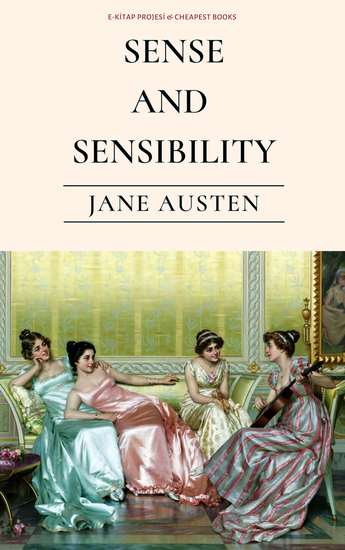
Sense and Sensibility - cover

Sense and Sensibility

Jane Austen

Editorial: E-Kitap Projesi & Cheapest Books

  • 0
  • 0
  • 0

Sinopsis

Sense and Sensibility is a novel by Jane Austen, published in 1811. It was published anonymously; By A Lady appears on the cover page where the author's name might have been.


It tells the story of the Dashwood sisters, Elinor and Marianne, both of age to marry.


The novel follows the young women to their new home with their widowed mother, a meagre cottage on the property of a distant relative, where they experience love, romance and heartbreak. The novel is set in southwest England, London and Sussex between 1792 and 1797.


Book History:


Based on notes left by her sister, Jane Austen's first draft of Sense and Sensibility, titled "Elinor and Marianne," was written as early as 1795 when she was about 19 years old, probably in epistolary form (a novel-in-letters). In November 1797, Austen returned to the manuscript and converted it to the narrative format we know today. But it wasn't until she moved to Chawton that she made a final round of revisions in 1809-1810 and, with her brother Henry as her agent, eventually submitted Sense and Sensibility to publisher Thomas Egerton. 


Believing in her work and determined to be a published author, Jane Austen took a financial risk and published the novel on a commission basis. In this arrangement, she paid for the production and advertising of Sense and Sensibility, gave Egerton a commission for distributing and selling the book, and kept the remaining profit from the sales. Austen chose to remain anonymous because at that time it was not entirely acceptable for a woman of her status to publish for profit. The title page of the novel says simply, "By a Lady." 


We know from her letters that Austen was in the process of correcting proofs in April 1811, hoping the book would be published soon. However, the wait was longer than anticipated; Sense and Sensibility was first advertised for sale in The Star on October 30. Ads ran in newspapers throughout November and also appeared at various times throughout 1812. The book was described variously as an "Extraordinary Novel!" an "Interesting Novel," and, by December 1812, a "Popular New Novel."
Disponible desde: 05/12/2023.
Longitud de impresión: 400 páginas.

Otros libros que te pueden interesar

  • The Written World and the Unwritten World - Essays - cover

    The Written World and the...

    Italo Calvino

    • 0
    • 0
    • 0
    A rich collection of essays offering an extraordinary global view of Calvino’s approach to writing, reading, and interpreting literature. 
     
    An extraordinary collection of essays, forewords, articles, and interviews, The Written World and the Unwritten World displays the remarkable intelligence and razor-sharp wit of prolific Italian writer Italo Calvino as he explores the meaning of literature in a rapidly changing world. From classics to  
    contemporary literature, from tradition to the avant-garde, Calvino masterfully explores reading, writing, and translating through careful and illuminating discussion of the works of Bakhtin, Brecht, Cortázar, Thomas Mann, Octavio Paz, Georges Perec, Salman Rushdie, Gore Vidal, and more. Drawn  
    from Mondo scritto e mondo non scritto (2002), Sulla fiaba (1988), and other uncollected essays, this volume of previously untranslated work—now rendered in English by acclaimed translator Ann Goldstein—is a major statement in literary criticism.
    Ver libro
  • Around The World In Eighty Days - cover

    Around The World In Eighty Days

    Jules Verne

    • 0
    • 0
    • 0
    What begins as a wager among gentlemen at London’s prestigious Reform Club quickly turns into the most thrilling adventure of the 19th century. Phileas Fogg, a punctual and enigmatic Englishman, bets that he can traverse the globe in just eighty days—a feat deemed impossible by many. With his devoted yet impulsive valet, Passepartout, at his side, Fogg races against time across steamships, trains, and even elephants, encountering unexpected obstacles and colorful characters at every turn. 
    Set against the backdrop of a rapidly modernizing world, Around the World in Eighty Days is a spirited tale of daring travel, unshakable resolve, and the clash between logic and chaos. Jules Verne’s iconic novel remains a timeless celebration of curiosity, innovation, and the human drive to explore.
    Ver libro
  • In the Vault (Unabridged) - cover

    In the Vault (Unabridged)

    H. P. Lovecraft

    • 0
    • 0
    • 0
    George Birch, undertaker for the New England town of Peck Valley, finds himself trapped in the vault where coffins are stored during winter for burial in the spring. When Birch stacks the coffins to reach a transom window, his feet break through the lid of the top coffin, injuring his ankles and forcing him to crawl out of the vault. Later, Dr. Davis investigates the vault, and finds that the top coffin was one of inferior workmanship, which Birch used as a repository for Asaph Sawyer, a vindictive citizen whom Birch had disliked, even though the coffin had originally been built for the much shorter Matthew Fenner. Davis finds that Birch had cut off Sawyer's feet in order to fit the body into the coffin, and the wounds in Birch's ankles are actually teeth marks.
    Ver libro
  • Dr Duthoit's Vision - From their pens to your ears genius in every story - cover

    Dr Duthoit's Vision - From their...

    Arthur Machen

    • 0
    • 0
    • 0
    Arthur Llewelyn Jones was born in Caerleon, Monmouthshire on the 3rd March 1863. 
    Machen came from a long line of clergymen, and when he was two, his father became vicar of a small parish about five miles north of Caerleon, and Machen was brought up at the rectory there. 
    In his early years he received an excellent classical education, but family poverty ruled out university, and he was sent to London to sit exams to attend medical school but failed the exams.  He did show literary promise with the publication of the poem ‘Eleusinia’ in 1821.  But life in London was difficult and it was only in 1884 that he published again and was taken on to translate several French works which thereafter became the standard editions for many years. 
    In 1887, his father died.  That same year he married Amelia Hogg, a maverick music teacher with a passion for the theatre.  He also began to receive legacies from Scottish relatives which allowed him to devote more time to writing. 
    After publishing in literary magazines in 1894 he published his first book ‘The Great God Pan’.  Its sexual and horrific content very much helped sales. 
    Over the next decade or so he wrote some of his best work but was unable to find a publisher mainly due to the collapse of the decadent market over Oscar Wilde’s scandalous trial. 
    In 1899, his wife died and during his long recovery he took up acting and travelled around the country as part of a travelling company.  Three years later he was publishing again and had remarried. 
    Re-publishing of earlier works helped anchor both his reputation and his income.  By the time the Great War opened Europe’s wounds he returned to the public eye with ‘The Bowmen’ helped by the publicity around the ‘Angel of Mons’ episode. 
    However, by the late 20’s new works had dried up and his back catalogue was no longer a source of regular income. 
    In 1932 he received a Civil List pension of ₤100 per annum but other work was not forthcoming.  His finances finally stabilised with a literary appeal in 1943 for his eightieth birthday and allowed him to live his remaining years in relative comfort. 
    Arthur Machen died on 15th December 1947 in Beaconsfield. He was 84.
    Ver libro
  • The Crooked Man - cover

    The Crooked Man

    Arthur Conan Doyle

    • 0
    • 0
    • 0
    The Adventure of the Crooked Man, one of the 56 Sherlock Holmes short stories written by Sir Arthur Conan Doyle, is one of 12 stories in the cycle collected as The Memoirs of Sherlock Holmes. Doyle ranked "The Adventure of the Crooked Man" 15th in a list of his 19 favourite Sherlock Holmes stories....He met Nancy that evening, who was shocked to learn he was alive. Unknown to her, however, he followed her home and witnessed the argument, for the blinds were up and the glass door open. He climbed over the low wall and entered the room. An apoplectic fit caused by the sight of him killed the Colonel instantly, and Nancy fainted. Henry's first thought then was to open the inside door and summon help, and he took the key from the now-unconscious Nancy to do so. Realizing that the situation looked very bad for him and that he himself could be charged with murder, he chose instead to flee, stopping long enough to retrieve Teddy, his mongoose that he used in his conjuring acts, which had escaped from the wooden box. However, he did drop his stick, the strange weapon that was later found, and he inadvertently carried the key off with him. An inquest has already exonerated Nancy, having found the cause of the Colonel's death... Famous works of the author Arthur Conan Doyle: A Study in Scarlet, The Sign of the Four, The Adventures of Sherlock Holmes, The Memoirs of Sherlock Holmes, The Hound of the Baskervilles, The Return of Sherlock Holmes, The Valley of Fear, His Last Bow, The Case-Book of Sherlock Holmes, Stories of Sherlock Holmes, The Lost World.
    Ver libro
  • Evil Clergyman The (Unabridged) - cover

    Evil Clergyman The (Unabridged)

    H. P. Lovecraft

    • 0
    • 0
    • 0
    "The Evil Clergyman" is an excerpt from a letter written by American horror fiction writer H. P. Lovecraft in 1933. After his death, it was published in the April 1939 issue of Weird Tales as a short story. The story was later adapted into the unreleased 1987 anthology film Pulse Pounders. The letter, to his friend Bernard Austin Dwyer, recounted a dream that Lovecraft had had. Although Lovecraft frequently based stories on his dreams, An H. P. Lovecraft Encyclopedia notes that " is difficult to say how HPL would have developed this conventional supernatural scenario.
    Ver libro