Begleiten Sie uns auf eine literarische Weltreise!
Buch zum Bücherregal hinzufügen
Grey
Einen neuen Kommentar schreiben Default profile 50px
Grey
Jetzt das ganze Buch im Abo oder die ersten Seiten gratis lesen!
All characters reduced
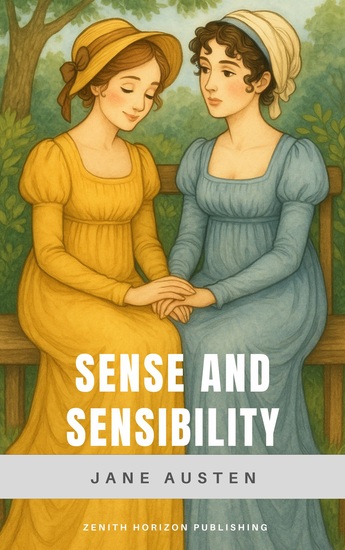
Sense and Sensibility - Jane Austen's Romantic Classic of Sisters Society and Heart  - cover

Sense and Sensibility - Jane Austen's Romantic Classic of Sisters Society and Heart 

Jane Austen

Verlag: Zenith Horizon Publishing

  • 0
  • 0
  • 0

Beschreibung

Two sisters. One society. Countless challenges of the heart.

In Sense and Sensibility, Jane Austen offers a tale of contrasting temperaments, testing the emotional strength of Elinor and Marianne Dashwood as they navigate love, heartbreak, and social expectation in Regency England.

With wit, elegance, and keen insight, Austen explores how reason and emotion shape human lives, crafting one of the first—and finest—novels of manners and romance in literary history.

💐 This beautifully formatted edition includes:

The full, unabridged original text

Period-inspired illustrations throughout

Kindle-optimized design for a seamless reading experience

📚 Ideal for Austen fans, classic literature lovers, and readers of historical romance.

Rediscover a novel where sense meets sensibility—and where love finds its way.
Download your illustrated edition today.
Verfügbar seit: 13.06.2025.
Drucklänge: 196 Seiten.

Weitere Bücher, die Sie mögen werden

  • The Idiot - cover

    The Idiot

    Fyodor Dostoyevsky

    • 0
    • 0
    • 0
    First published in 1869, "The Idiot" is a novel by the renowned Russian author Fyodor Dostoyevsky. It tells the story of Prince Lev Nikolayevich Myshkin, who returns to Russia after spending years in a Swiss sanatorium. Despite being genuinely kind, compassionate, and possessing an almost Christ-like innocence, Myshkin is perceived by the society around him as an "idiot." The novel delves into the complexities of the human soul, exploring themes of goodness, love, society's moral degradation, and the repercussions of unbridled ambition. As the narrative unfolds, Prince Myshkin gets entangled in a love triangle and a series of tragic events that underscore Dostoyevsky's critiques of Russian society and his exploration of the nature of good and evil.
    Zum Buch
  • Horror at Red Hook The (Unabridged) - cover

    Horror at Red Hook The (Unabridged)

    H. P. Lovecraft

    • 0
    • 0
    • 0
    The story begins with Detective Malone describing an on-duty incident in Red Hook, Brooklyn, that gave him a phobia of large buildings. Back-tracking to where it all began, the Brooklyn waterfront slum Red Hook is described in detail, with its gangs and crime, and hinting at an occult underbelly. The "case of Robert Suydam" is then told to be the driving force behind Malone's federally ordered involvement at Red Hook. Suydam's demeanor changes suddenly. Known as a shabby recluse, he is seen around town looking younger and more radiant. News arrives of his engagement to a well-to-do woman, while, at the same time, there is an increase in local kidnappings. A police raid, involving Malone, uncovers nothing useful from Suydam's Red Hook flat save a few strange inscriptions. After Suydam's wedding, he and his bride leave on a ship. Aboard, a scream is heard and, when the crew enter Suydam's stateroom, they find him and his wife dead, with claw-marks on his wife's body. Later, some strange men from another ship come on board and lay claim to Suydam's body. Malone enters Suydam's flat to see what he can find. In the basement, he comes across a door that breaks open and sucks him inside, revealing a hellish landscape. He witnesses human sacrifices and a ritual that reanimates Suydam's corpse. Malone is found in the basement of Suydam's flat, which has caved in inexplicably above him, killing everyone else inside. The tunnels and chambers uncovered in the raids are filled in and cemented, though, as Malone recounts, the threat in Red Hook subtly re-emerges.
    Zum Buch
  • Bizeban - From their pens to your ears genius in every story - cover

    Bizeban - From their pens to...

    Moritz Jokai

    • 0
    • 0
    • 0
    Móric Jókay de Ásva was born on the 18th February 1825 in Komárom, then in the Kingdom of Hungary but now part of Slovakia.  
    Due to his timid and delicate constitution he was educated at home until the age of 10 and then sent away to complete his studies at the Calvinist college at Pápa. 
    At 12 his father died, and he was pushed to honour him by replicating his career as a lawyer.  He studied hard and completed the curriculum at Kecskemét and Pest.  He won his first case as a newly graduated lawyer. 
    But he found a career in law to be dull and, encouraged by the positive reaction to his first play, he moved to Pest in 1845.  There he published, first in a newspaper, and then as a novel ‘Hétköznapok’ (‘Working Days’).  It was acclaimed as a masterpiece.  To add to his promise he was appointed as the editor of Életképek, the leading Hungarian journal. 
    In 1848 he married the actress, Róza Laborfalvi.  That same year Europe was awash with revolutions and Jókai, a moderate Liberal, enthusiastically supported the nationalist cause and its decision to depose the Habsburg dynasty.  The attempt failed. 
    He was now classed as a political suspect and threw himself into his literary career, writing dozens of novels, many of them masterpieces, stories, essays and the like.  In total he wrote several hundred volumes, many of them in the local Magyar language which helped arrest its declining relevance in society.  
    By 1867 the political temperature had cooled, and he entered parliament as well as becoming the editor a government journal he had founded.   His skills were much admired and helped the government navigate through several difficult matters.   
    His wife died in 1886 but although grief-stricken he continued to work and to write.  
    In 1897 the king appointed him a member of the upper house.  Two years later he caused a minor scandal by marrying the young 20-year-old actress, Bella Nagy.  At the time he was 74.
    Zum Buch
  • Thumbelina and Other Stories - cover

    Thumbelina and Other Stories

    Hans Christian Andersen

    • 0
    • 0
    • 0
    Thumbelina was first published in Danish in 1835 as "Tommelise" in the second instalment of "Fairy Tales Told for Children" by Hans Christian Andersen.  A woman, desperate for a daughter, goes to a fairy for help.  The fairy gives her a barleycorn to plant, which grows into a tulip from which a tiny girl, scarcely half as long as a thumb, is born.  Thumbelina soon attracts the attention of a Toad who wants the beautiful little girl as a bride for her son.  This collection also includes "In the Uttermost Parts of the Sea", "The Tinderbox" and "The Swan's Nest".
    Zum Buch
  • Punchkin - cover

    Punchkin

    Mary Frere

    • 0
    • 1
    • 0
    Mary Eliza Isabella Frere (1845–1911) was an English author of works regarding India. She is most famous for her beautiful retellings of Indian fairy tales.  
    "Punchkin" is a traditional fairy tale about a Rajah with seven daughters. When he remarries, the princesses' stepmother is determined to do away with the girls and make her own daughter the heir to the throne. A series of adventures and trials follows which leads to the overthrow of an evil magician.
    Zum Buch
  • A Room with a View - cover

    A Room with a View

    E. M. Forster

    • 0
    • 0
    • 0
    First published in 1908, E. M. Forster’s “A Room with a View” is the story of a young English middle-class girl named Lucy Honeychurch. As the novel opens we find Lucy touring Italy with her overbearing older cousin and chaperone, Charlotte Bartlett. The two are upset over the views from their rooms. Having been promised views that overlook the river Arno, the two instead receive views of the courtyard. Their complaints are overheard by Mr. Emerson, who offers to swap rooms with them, citing the fact that he and his son George both have rooms that overlook the Arno. After a brief romantic encounter between George Emerson and Lucy while they are in Florence, the two travel on to Rome where Lucy is wooed by her friend from England Cecil Vyse. When Lucy learns from the vicar that a local cottage has been rented she discovers that the Emersons have arrived in Rome. Again the prospect of romance with George entices Lucy but she is torn between the more acceptable prospect of a union with Cecil. “A Room with a View” is the classic human struggle of choosing a partner who is the most socially acceptable versus the desire for true love.
    Zum Buch