Junte-se a nós em uma viagem ao mundo dos livros!
Adicionar este livro à prateleira
Grey
Deixe um novo comentário Default profile 50px
Grey
Assine para ler o livro completo ou leia as primeiras páginas de graça!
All characters reduced
Sanditon - Enriched edition - cover
LER

Sanditon - Enriched edition

Jane Austen

Editora: DigiCat

  • 0
  • 0
  • 0

Sinopse

In "Sanditon," Jane Austen crafts an unfinished novel that embodies her signature wit and keen social observation, set against the backdrop of an emerging seaside resort in early 19th-century England. The narrative follows the spirited Charlotte Heywood, who finds herself entangled in the lives of a disparate cast of characters, each vying for status and social recognition. Known for her incisive commentary on class dynamics and gender roles, Austen's style here melds vibrant dialogue with a sharp critique of societal aspirations, highlighting the contrast between the genteel pretensions of the British upper class and the burgeoning new society of the spa town, revealing both humor and poignancy in her social tapestry. Jane Austen, one of the most revered authors in English literature, was known for her exploration of themes such as love, marriage, and economic stability. Written in the summer of 1817, "Sanditon" was her last completed work before her death, reflecting her evolving perspectives on social issues and the changing landscape of British society, influenced by her own experiences and observations of the period's cultural shifts. Readers who appreciate astute narrative and character-driven plots will find "Sanditon" a compelling exploration of ambition and the complexities of human relationships. This novel remains a vital contribution to Austen's oeuvre, serving as a thought-provoking commentary on a society in transition and inviting scholars and fans alike to ponder the unfinished legacy of one of literature's great masters.

In this enriched edition, we have carefully created added value for your reading experience:
- A succinct Introduction situates the work's timeless appeal and themes.
- The Synopsis outlines the central plot, highlighting key developments without spoiling critical twists.
- A detailed Historical Context immerses you in the era's events and influences that shaped the writing.
- An Author Biography reveals milestones in the author's life, illuminating the personal insights behind the text.
- A thorough Analysis dissects symbols, motifs, and character arcs to unearth underlying meanings.
- Reflection questions prompt you to engage personally with the work's messages, connecting them to modern life.
- Hand‐picked Memorable Quotes shine a spotlight on moments of literary brilliance.
- Interactive footnotes clarify unusual references, historical allusions, and archaic phrases for an effortless, more informed read.
Disponível desde: 22/11/2022.
Comprimento de impressão: 57 páginas.
Outros livros que poderiam interessá-lo

  • The Interlopers - From their pens to your ears genius in every story - cover

    The Interlopers - From their...

    Saki Saki

    • 0
    • 0
    • 0
    Hector Hugh Munro, more familiarly known by his pen-name ‘Saki’ was born in what was then Akyab in British Burma on 18th December 1870. His father was an Inspector General for the Indian Imperial Police, and his mother the daughter of a Rear Admiral. 
    When he was 2 his mother died and he and his siblings were sent back to England to be raised by their grandmother and paternal maiden aunts in a strict, puritanical household near Barnstaple, Devon. Educated by governesses Saki used many of these women as character models for his later writing. 
    At 17 his father retried and returned to England and then embarked on a series of European travels with Saki and his siblings. 
    After a short stint working in Burma with the Indian Imperial Police Saki decided to move to London to make a living as a writer. Initially he wrote as a journalist for a number of newspapers and magazines before attempting an historical study, ‘The Rise of the Russian Empire’, whose real value lay in directing him to writing short stories instead, the first of which, ‘Dogged’, he published in 1899. 
    From here it was a short stab of the pen to writing political satire before in 1902 he became the foreign correspondent for The Morning Post, first in the Balkans, then Russia, Paris and back to London in 1908, where 'the agreeable life of a man of letters with a brilliant reputation awaited him.'  
    Collections of his short stories full of witty, mischievous and often macabre stories that satirized Edwardian society and two novels now appeared in the years up to the Great War.  At its’ outbreak he was 43 but managed to join as an ordinary trooper. More than once he returned to the battlefield when officially too sick or injured.  
    On 14th November 1916 Hector Hugh Munro was sheltering in crater during the Battle of the Ancre, when he was shot and killed by a German sniper. According to several sources, his last words were "Put that bloody cigarette out!"
    Ver livro
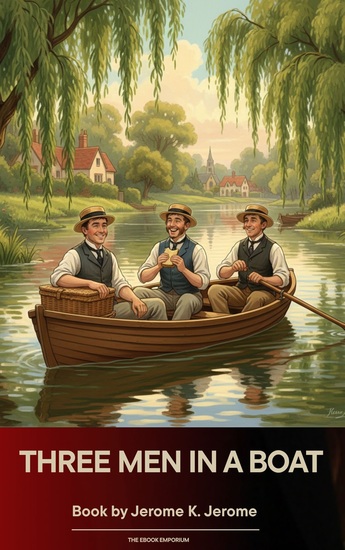
  • Three Men in a Boat - cover

    Three Men in a Boat

    Jerome K. Jerome

    • 0
    • 0
    • 0
    "I like work: it fascinates me. I can sit and look at it for hours."
    
    Meet J., Harris, and George—three quintessential Victorian gentlemen who convince themselves they are suffering from "overwork" and every malady in the medical dictionary (except housemaid's knee). Their cure? A leisurely rowing trip up the River Thames from Kingston to Oxford. Accompanied by the world's most cynical fox terrier, Montmorency, the trio embarks on a journey filled with disastrous cooking, tangled tow-lines, unreliable barometers, and the eternal struggle of opening a tin of pineapple without a tin-opener.
    
    The Comedy of the Everyman: Jerome K. Jerome's genius lies in his ability to find the universal in the mundane. Whether it's the chaotic attempt to hang a picture by Uncle Podger or the legendary "Cheese" story that drives an entire train carriage to madness, the humor is as fresh and relatable today as it was in the 1880s.
    
    A Love Letter to the Thames: Between the slapstick and the satire, the novel contains beautiful, lyrical descriptions of the river. It captures a specific moment in British history when the Thames was transitioning from a commercial highway to a place of leisure and "messing about in boats."
    
    A Timeless Remedy for Stress: Three Men in a Boat remains the perfect antidote to the "seriousness" of modern life. It celebrates friendship, the absurdity of human nature, and the idea that the best stories come from the things that go spectacularly wrong.
    
    Pack your bags (but leave the heavy cheeses behind). Purchase "Three Men in a Boat" today and laugh your way up the river.
    Ver livro
  • Porch Swings Parlors & Pryin’ Eyes - Gossip Gumption and the Glories of Small-Town Life - cover

    Porch Swings Parlors & Pryin’...

    Anne Warner, Edna Ferber, Booth...

    • 0
    • 0
    • 0
    In the towns where the porch lights glow late, the screen doors creak often, and no secret stays secret for long, life unfolds with charm, chatter, and more than a touch of mischief. 
    Porch Swings, Parlors & Pryin’ Eyes invites you into parlors both prim and peculiar, where romances are whispered behind teacups, rivalries simmer at choir practice, and widows form committees with suspicious speed. Within these sixteen short stories, you’ll find aging sopranos and checker champions, tangled telegrams and moonlit deacons, poker parties gone sideways and gossip spun tighter than a handmade scarf. 
    Each tale captures the distinct rhythms of small-town American life in the late 19th and early 20th centuries—with all its humor, heartbreak, and sly subversion of social norms. These are stories not just of people, but of places—of communities that cradle, confine, and sometimes surprise those who call them home. 
    Pull up a chair, pour something sweet, and don’t be surprised if someone starts talkin’ about you next. 
    Featuring the work of renowned authors and some hidden gems of classic American fiction, including: 
    The Gay Old Dog, by Edna Ferber 
    Melinda's Humorous Story, by May McHenry 
    Friends in San Rosario, by O. Henry 
    The Associated Widows, by Katharine M. Roof 
    The Tale of the Tangled Telegram, by Wilbur D. Nesbit 
    A Village Singer, by Mary E. Wilkins Freeman 
    A New England Nun, by Mary E. Wilkins Freeman 
    The Scarf, by Madeline Yale Wynne 
    The Champion Checker-Player of Ameriky, by James Whitcomb Riley 
    How The Widow Won The Deacon, by William James Lampton 
    Evan Anderson's Poker Party, by Benjamin Stevenson 
    A Rivermouth Romance, by Thomas Bailey Aldrich 
    Not According to Schedule, by Mary Stewart Cutting 
    A Reward of Merit, by Booth Tarkington 
    Sand Flat Shadows, by Carl Sandburg 
    Mrs. Lathrop's Love Affair, by Anne Warner
    Ver livro
  • The Scaremongerer - From their pens to your ears genius in every story - cover

    The Scaremongerer - From their...

    Ford Maddox

    • 0
    • 0
    • 0
    Ford Madox Ford was born Ford Hermann Hueffer on 17th December 1873 in Wimbledon, London, England.    
    Today he is best known for one book, ‘The Good Soldier’, which is regularly held to be one of the 100 greatest novels of all time.  But, rather unfairly, the breadth of his career has been overshadowed.  He wrote novels as well as essays, poetry, memoirs and literary criticism. Today he is well-regarded but known only for a few works rather than the grand arc of his career. 
    Ford collaborated with Joseph Conrad on three novels but would later complain that, as with all his collaborators, and those he so readily championed, his contribution was overshadowed by theirs.  
    He founded The English Review and The Transatlantic Review which were instrumental in publishing and promoting the works of so many authors and movements. 
    During WWI he initially worked on propaganda books before enlisting. Ford was invalided back to Britain in 1917, remaining in the army and giving lectures until the War’s end. After a spell recuperating in the Sussex countryside he lived mostly in France during the 1920s.  
    He published the series of four novels known as Parade’s End, between 1924 and 1928. These were particularly well-received in America, where Ford spent much of his time from the later 1920s to his death in 1939. 
    His last years were spent teaching at Olivet College in Olivet, Michigan. 
    His poetry is an excellent example of his talents.  His evocation of the horrors of War are outstanding examples of the time and have become greatly admired.  
    Ford Madox Ford died on 26th June 1939 at Deauville, France at the age of 65.
    Ver livro
  • Evening Guest An - From their pens to your ears genius in every story - cover

    Evening Guest An - From their...

    Alexander Kuprin

    • 0
    • 0
    • 0
    Alexander Kuprin was born in Narovchat, Penza in Russia on 7th September 1870. 
    At 3 his Father died and he and mother moved to Moscow. By 10 he was enrolled at the Second Moscow Military High School and there his interest in literature began. The Alexander Military Academy followed and two years later he was a sub-lieutenant and posted to an Infantry Regiment for a further four years. 
    Despite his duties he was a now a keen writer and published his first short story at this time. His military duties also garnered him experiences for his breakthrough work ‘The Duel’.  Leaving the military he left for Kiev to work for local newspapers.  He continued to publish both stories and novels and by 1901 he was in St Petersburg becoming part of a group that included Chekhov, Ivan Bunin, Maxim Gorky and Leonid Andreyev.  
    In the years that followed further controversial works and acclaim followed.  His comments on the regime meant he was also put under secret police surveillance.   
    As World War I erupted, Kuprin opened a military hospital but was then given command of an infantry company in Finland. He was soon discharged on grounds of ill health.  
    The October Revolution saw him praise Lenin, but he warned that the Bolsheviks threatened Russian culture and might cause further widespread suffering to the peasants.  As Civil War raged he took his family to Helsinki and then on to Paris. 
    Exile saw his talents decline further and his succumbing to alcoholism. He became lonely and withdrawn. The family's poverty increased his malaise.   
    In May 1937, the Kuprin’s returned to Moscow.  He now saw his work published but wrote almost nothing new.  In 1938 his health rapidly deteriorated.  Already suffering from a kidney problems and sclerosis, he had now developed cancer of the oesophagus.  
    Alexander Kuprin died on 25th August 1938.
    Ver livro
  • American Notes - Full Cast Drama - cover

    American Notes - Full Cast Drama

    Charles Dickens

    • 0
    • 0
    • 0
    In "American Notes," Charles Dickens embarks on a captivating journey across the Atlantic in the 19th century to offer his keen observations and critiques of the young United States. Published in 1842, this travelogue chronicles Dickens' experiences during his tour of the United States and Canada, showcasing his unique ability to blend sharp social commentary with vivid narrative storytelling. 
     
    The narrative begins with Dickens setting sail from Liverpool to Boston, and from the moment he arrives on American soil, he is met with great enthusiasm and anticipation. Yet, his initial enthusiasm gradually gives way to a critical exploration of American society, culture, and institutions. Dickens paints a picture of a nation marked by stark contrasts – the raw, untamed beauty of the American landscape juxtaposed with the bustling cities, and the democratic ideals of freedom and equality set against the glaring issues of slavery and inequality. 
     
    Throughout the journey, Dickens encounters a wide array of characters and situations that highlight the complexities of American life. He offers poignant insights into the horrors of slavery, the shortcomings of the prison system, and the social divisions that permeate American society. His narrative serves as a powerful indictment of these injustices and an impassioned call for reform. 
     
    However, "American Notes" is not solely a critique of the United States. Dickens also portrays the genuine hospitality and kindness of many Americans he meets along the way, and he highlights their eagerness to embrace and engage with the ideas and literature of the Old World. The travelogue ultimately reflects Dickens' conviction that positive change is possible through the exchange of ideas and the continuous dialogue between nations.
    Ver livro