Junte-se a nós em uma viagem ao mundo dos livros!
Adicionar este livro à prateleira
Grey
Deixe um novo comentário Default profile 50px
Grey
Assine para ler o livro completo ou leia as primeiras páginas de graça!
All characters reduced
The River's End - cover
LER

The River's End

James Oliver Curwood

Editora: Interactive Media

  • 0
  • 0
  • 0

Sinopse

"The River's End" by James Oliver Curwood is an exhilarating adventure novel. It follows the daring Cameron, a fugitive wrongly accused of murder, who escapes into the rugged Canadian wilderness. There, he battles the elements, encounters wild animals, and falls in love with a brave Indigenous woman, Nada. As he fights for survival, Cameron is determined to clear his name and find the real murderer. This gripping tale combines romance, wilderness exploration, and the pursuit of justice, making it a thrilling and unforgettable adventure in the untamed North.
Disponível desde: 14/09/2023.
Comprimento de impressão: 164 páginas.

Outros livros que poderiam interessá-lo

  • A Journey of Little Profit - From their pens to your ears genius in every story - cover

    A Journey of Little Profit -...

    John Buchan

    • 0
    • 0
    • 0
    The Scottish novelist John Buchan enjoyed a remarkable career as politician, historian and Governor General. He was born John Buchan on 26th August 1875 and later added 1st Baron Tweedsmuir PC GCMG GCVO CH to his name.  
    Buchan studied at Hutchesons’ Grammar School, Glasgow and at seventeen won a scholarship to the University of Glasgow to study classics. There he began to write poetry. In 1895 he transferred to Oxford to continue his study of Classics and in 1896 ‘Sir Quixote of the Moors’ was published followed by the non-fiction ‘Scholar-Gipsies’. His prolific literary output now hardly faltered. 
    He graduated in 1900 and became the private secretary to Alfred Milner, the High Commissioner for Southern Africa and other colonies. Buchan found the same inspiration in the African landscape as he had in the Scottish Borders, and would later set many works here. Returning to London he became a partner in a publishing house, and garnered an editorial role at The Spectator. He also completed his law studies. He was called to the bar in 1901 but never practiced.  
    On 15th July 1907 Buchan married Susan Charlotte Grosvenor, the cousin of the Duke of Westminster. In 1910 he wrote ‘Prester John’, the first of a series set in South Africa.  
    In 1911 Buchan entered politics as a Unionist candidate in the Scottish Borders advocating the support of free trade, women’s suffrage, national insurance, and reducing the power of the House of Lords.  
    The Great War saw Buchan writing for the War Propaganda Bureau and as Times correspondent in France. In 1915, he published ‘The Thirty-Nine Steps’, his most famous book and a follow-up Richard Hannay novel, ‘Greenmantle’, in 1916.  
    In 1916 Buchan enlisted in the Intelligence Corps which included writing speeches for Sir Douglas Haig. By 1917 he was Director of Information under Lord Beaverbrook. Buchan called it “the toughest job he ever took on”. He somehow found time to assist in a history of the war magazine. This was later published in 24 volumes: Nelson’s History of the War. 
    After the war his writing focused on historical studies. In 1927 Buchan became the Unionist Party Member of Parliament for the Combined Scottish Universities. In a speech to Parliament he said “I believe every Scotsman should be a Scottish nationalist. If it could be proved that a Scottish parliament were desirable… Scotsmen should support it.”  
    Over the next decade he continued to distinguish himself politically and in literature.  On the 1st June 1935 he became 1st Baron Tweedsmuir of Elsfield in the County of Oxford.  
    He was now also given the position of Governor General in Canada and resolved to travel all over Canada to gain a better insight of the country. Having crossed both length and breadth he saw the cultural shift between areas and their common ground and helped bring about a clear national Canadian identity. 
    On the 6th February 1940 he collapsed from a stroke and sustained a very serious head injury in falling. Two rounds of surgery to stabilise his condition were unsuccessful and Buchan died on the 11th February. After a state funeral in Ottawa his ashes were returned to his estate in Oxfordshire.
    Ver livro
  • My Financial Career - From their pens to your ears genius in every story - cover

    My Financial Career - From their...

    Stephen leacock

    • 0
    • 0
    • 0
    Stephen P H Butler Leacock FRSC was born on 30th December 1869 in Swanmore, near Southampton, England.  He was the third of eleven children. 
    The family emigrated to Canada in 1876, settling on a 100-acre farm in Sutton, Ontario.  There Leacock was home-schooled until, funded by his grandfather, he was enrolled into the elite private school Upper Canada College in Toronto.  Academically he was very strong.  In 1887, at age 17, he became head boy and then proceeded on to the University of Toronto to study languages and literature.  Despite completing two years of study in only one, he was obliged to leave the university because his father, an alcoholic, had abandoned the family and finances could not be stretched to continue his attendance.  Leacock now enrolled in a three-month course at Strathroy Collegiate Institute to become a qualified high school teacher with a regular income. 
    He worked at Upper Canada College from 1889 through 1899 and later resumed his studies part-time at the University of Toronto, graduating with a B A in 1891.  It was during this period that he was first published in The Varsity, a campus newspaper.  But his passion was now economics and political theory.  In 1899 he enrolled for postgraduate studies at the University of Chicago and earned his PhD in 1903. 
    Leacock had married Beatrix Hamilton in 1900 and 15 years later the couple had their only child, Stephen.  In time father and son developed a love-hate relationship, partially caused by his son’s diminutive stature of only four feet.  
    Accepting a post at McGill University Leacock would remain there until he retired in 1936.  In 1906, he wrote ‘Elements of Political Science’, quickly adopted as a standard textbook for the next two decades and his most profitable book.  He also began public speaking and lecturing, and took a year's leave of absence in 1907 to speak throughout Canada on the subject of national unity.  
    Leacock had submitted humourous articles to the Toronto magazine Grip in 1894, and was soon published in other Canadian and US magazines.  In 1910, he printed privately a collection of these as ‘Literary Lapses’.  Acquired by the British publisher, John Lane, it was released in London and New York.   He was now a commercially successful writer.  There soon followed ‘Nonsense Novels’ (1911) and the sentimental favourite, ‘Sunshine Sketches of a Little Town’ (1912).  His ‘Arcadian Adventures with the Idle Rich’ (1914) is a darker collection that satirizes city life.  Collections of sketches continued to be published almost annually, filled with a mixture of light-hearted whimsy, parody, nonsense, and satire. 
    In later life, he wrote on the art of humour writing and published biographies on Twain and Dickens.  Together with continued speaking tours he also added to his non-fiction with many well-regarded and award-winning volumes on Canada. 
    Politically Leacock was a social conservative and a partisan Conservative.  He opposed women’s right to vote and had a varied record on non-English immigration.  He was a champion of Empire but an advocate of social welfare legislation and wealth redistribution, but he often caused friction with his racist views towards blacks and Indigenous peoples. 
    Leacock has for some time been forgotten as an economist, but it’s often quoted that in 1911 more people had heard of him than had heard of Canada.  For the decade after 1915 Leacock was the most popular humorist in the English-speaking world. 
    Stephen Leacock died on 28th March 1944 of throat cancer in Toronto, Canada.  He was 74.  He was buried in the St George the Martyr Churchyard, Sutton, Ontario.
    Ver livro

  • Rip Van Winkle - Classic Tales Edition - cover

    Rip Van Winkle - Classic Tales...

    Washington Irving

    • 0
    • 0
    • 0
    Rip Van Winkle lived in a quiet colonial town, and had a habit of attending to everyone else's chores. Henpecked and poor, he goes squirrel hunting in the woods one day, only to exit twenty years later.
    Ver livro
  • The Metamorphosis - The Lost Manuscript - cover

    The Metamorphosis - The Lost...

    Franz Kafka

    • 0
    • 0
    • 0
    The Metamorphosis is a story, about a man who wakes up transformed into a bug and the repercussions it has on his life and the people around him. What does it all mean? It is most probably an autobiography of how Kafka himself experienced early life living with his parents. Kafka describes how he endured his mother and father's financial and emotional exploitation's, to the point of detaching from them and thereby ceasing to be their son (the real metamorphosis). Gregor’s metamorphosis is that of Kafka’s being an obedient son, subserviently paying for his parents’ narcissistic needs with his own life, into being a disobedient one—as if he had become a ‘piece of vermin’. Gregor’s parents possessed a large sum of money which symbolizes the needlessness of Gregor’s exploitation. Thus the parents did not love him for who he was, but for his loyal willingness to undergo this exploitation. Reduced to vermin, Gregor can no longer financially benefit his parents. It is the parents that caused Gregor’s/Kafka’s metamorphosis. The debt Gregor intended to repay his parents symbolizes the emotional debt many adult children continue to feel towards their elderly parents for the love and care they provided. 
    Ver livro
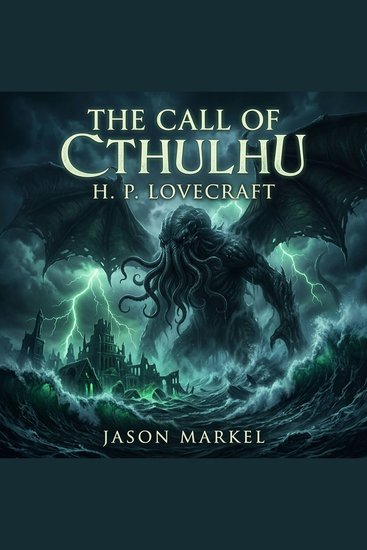
  • The call of Cthulhu - Unearth the dread of an ancient god global cults and a sanity-shattering mystery in this Cosmic Horror masterpiece about the monsters waiting beneath the waves - cover

    The call of Cthulhu - Unearth...

    H. P. Lovecraft

    • 0
    • 0
    • 0
    "The most merciful thing in the world, I think, is the inability of the human mind to correlate all its contents." 
    Following the mysterious death of his grand-uncle, Francis Wayland Thurston inherits a puzzling collection of research papers, unearthly clay sculptures, and frantic global news clippings. As he attempts to piece together these seemingly unrelated fragments, Thurston uncovers a terrifying reality: a shadowy, worldwide cult worshipping an ancient, slumbering entity hidden beneath the Pacific Ocean. From the fevered dreams of a young artist in Providence to the blood-curdling swamps of Louisiana and a doomed sea voyage in uncharted waters, Thurston's investigation draws him closer to an apocalyptic truth. The stars are aligning, and the Great Old Ones are waiting to reclaim the earth. 
    If you crave creeping tension, psychological dread, and mind-bending lore, you will be mesmerized by this definitive piece of Cosmic Horror. Blending detective fiction, dark fantasy, and eerie maritime adventure, this audiobook masterfully explores the fragility of human sanity against the vast, indifferent universe, delivering an atmosphere dripping with primordial terror and eldritch abominations. 
    About the Author: H. P. Lovecraft was an American writer whose groundbreaking blend of science fiction and gothic horror forever changed the literary landscape. Often regarded as the father of weird fiction, his mythos continues to inspire generations of writers, filmmakers, and artists.
    Ver livro
  • A Room with a View - cover

    A Room with a View

    E. M. Forster

    • 0
    • 0
    • 0
    "A Room with a View" is a 1908 novel by English writer E. M. Forster, about a young woman in the restrained culture of Edwardian era England. The novel  is both a romance and a humorous critique of English society at the beginning of the 20th century.
    Ver livro