Junte-se a nós em uma viagem ao mundo dos livros!
Adicionar este livro à prateleira
Grey
Deixe um novo comentário Default profile 50px
Grey
Assine para ler o livro completo ou leia as primeiras páginas de graça!
All characters reduced
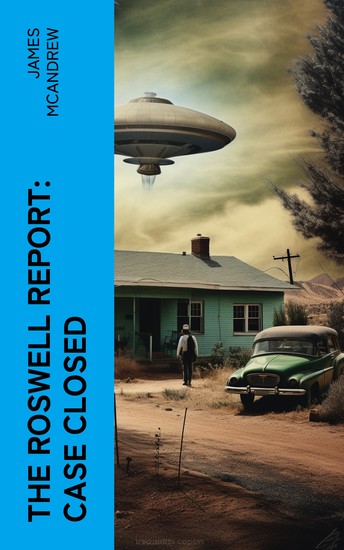
The Roswell Report: Case Closed - cover
LER

The Roswell Report: Case Closed

James McAndrew

Editora: e-artnow

  • 0
  • 0
  • 0

Sinopse

"The Roswell Report: Case Closed" by James McAndrew. Published by e-artnow. e-artnow publishes a wide range of titles that encompasses every genre. From well-known classics & literary fiction and non-fiction to forgotten−or yet undiscovered gems−of world literature, we issue the books that need to be read. Each e-artnow edition has been meticulously edited and formatted to boost readability for all e-readers and devices. Our goal is to produce eBooks that are user-friendly and accessible to everyone in a high-quality digital format.
Disponível desde: 10/12/2023.
Comprimento de impressão: 265 páginas.


Outros livros que poderiam interessá-lo

  • A Darker Shade of Blue - A Police Officer’s Memoir - cover

    A Darker Shade of Blue - A...

    Keith Merith

    • 0
    • 1
    • 0
    A transparent first-hand account of a Black officer maneuvering through three terrifying yet rewarding decades of policing, all while seeking reform in law enforcement
    		 
    When 16-year-old Keith Merith finds himself pulled over, berated, and degraded by a white police officer, he’s outraged. He’s done nothing wrong. But the officer has the power, and he doesn’t. From that day on, he vows to join a police service and effect change from within.
    		 
    Twelve years and a multitude of infuriating applications later, Merith is finally hired by York Regional Police. Subjected to unfair treatment and constant microaggressions, he perseveres and gradually rises through the ranks, his goal of systemic change carrying him through. After a stellar career, Merith retires at the rank of superintendent, but his desire for sustained and equitable reform is stronger than ever.
    		 
    In A Darker Shade of Blue, Merith shares both his gut-wrenching and heart-warming experiences and advocates for immediate police reform in a balanced and level-headed manner. He praises the people in blue, but he also knows on a visceral level that there are deep issues that need to be rectified — starting with recruitment. He knows that law enforcement agencies should reflect the communities they serve and protect, and that all citizens should be treated equally. Entrusted with the duty to serve, Merith delivers an evocative perspective of policing by providing the opportunity to walk in his shoes, as a Black man, and as a police officer on the front lines.
    Ver livro
  • Meditations - cover

    Meditations

    Marcus Aurelius

    • 0
    • 0
    • 0
    Meditations is a series of personal writings by Marcus Aurelius, Roman Emperor from 161 to 180 AD, recording his private notes to himself and ideas on Stoic philosophy.Marcus Aurelius wrote the 12 books of the Meditations in Koine Greek as a source for his own guidance and self-improvement. It is possible that large portions of the work were written at Sirmium, where he spent much time planning military campaigns from 170 to 180. Some of it was written while he was positioned at Aquincum on campaign in Pannonia, because internal notes tell us that the first book was written when he was campaigning against the Quadi on the river Granova (modern-day Hron) and the second book was written at Carnuntum.It is unlikely that Marcus Aurelius ever intended the writings to be published and the work has no official title, so "Meditations" is one of several titles commonly assigned to the collection. These writings take the form of quotations varying in length from one sentence to long paragraphs.The Meditations is divided into 12 books that chronicle different periods of Aurelius' life. Each book is not in chronological order and it was written for no one but himself. The style of writing that permeates the text is one that is simplified, straightforward, and perhaps reflecting Aurelius' Stoic perspective on the text. Depending on the English translation, Marcus' style is not viewed as anything regal or belonging to royalty, but rather a man among other men, which allows the reader to relate to his wisdom.
    Ver livro
  • Biggest Tank Battles of World War II The: The History of the Most Decisive Tank Encounters between the Allies and Axis - cover

    Biggest Tank Battles of World...

    Editors Charles River

    • 0
    • 0
    • 0
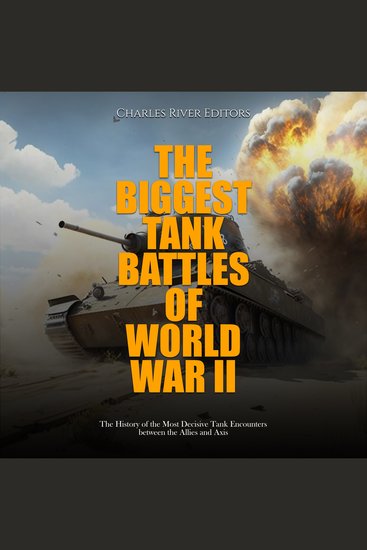
    The tank was first developed by the British and French during World War I as a means to break the deadlock on the Western Front. More so than any previous war, the balance of power lay with the defense, as machine guns, trenches, bunkers, barbed wire, and rapid-firing rifles all made frontal assaults on established positions prohibitively costly. In the closing months of the war, the tank partially evened up that balance, even as the war’s commanders initially proved unsure of how to use them. While it cannot be said that the tank won the war, it contributed to its end and if the fighting had continued another year, the mass production that had started in Allied countries may have proved decisive. 
    	World War II was the culmination of a quarter century of tank development, and it would also be the first major test of tanks in mobile warfare during which they had to face other tanks. However, many of the tanks were constructed with the static warfare of the Western Front in mind and were thus slow and had short operational ranges. Others were too light to face opposing tanks or the new generation of anti-tank weapons that hadn’t existed in World War I. The unsuitability of these tank models for this new kind of warfare was quickly recognized, and the belligerent powers scrambled to create better designs. As each new, improved model came off the assembly lines, the opposing powers rushed to create a tank that could beat it. In that regard, World War II was also a war between rival engineers. 
    	The beginning of World War II found the major powers developing tanks to some extent, but lingering ideas from World War I affected the development of tanks during the Interwar period.
    Ver livro
  • Death on a Distant Frontier - A Lost Victory 1944 - cover

    Death on a Distant Frontier - A...

    Charles Whiting

    • 0
    • 0
    • 0
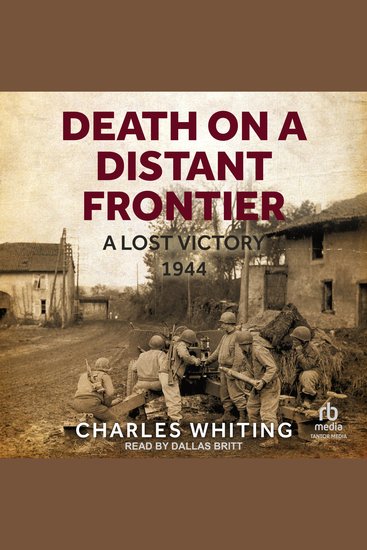
    By September 1944 the Germany army in France had been decimated and survivors were streaming back to the Reich. The British SAS commanders were clearing the way for the American armies of George S. Patton, Alexander Patch, and Courtney Hodges. By the afternoon of September 11, 1944, men of the US 5th Armored Division penetrated the poorly defended Siegfried Line. Yet just when the Rhine was ripe for the taking General Dwight D. Eisenhower ordered all further advances to be halted. Could combination of American forces supported by the British SAS have crossed the Rhine and thrust into the heart of Germany in the autumn of 1944? Did Eisenhower's rigid adherence to his strategy delay the end of the war by several months and cause thousands of men to lose their lives during the Battle of the Bulge? 


    Death on a Distant Frontier is a hard-hitting reappraisal of Eisenhower's tactics. Through extensive research Charles Whiting shines a light on the conflicts between the various generals and explores how Eisenhower conducted the war to ensure that his insiders reaped the glory of being the first American army to cross the Rhine. As a veteran of this campaign, Whiting was a witness to the turmoil that reigned during this period, yet through his fast-paced narrative and informed analysis he is able to provide vivid insight into this much-overlooked period of WWII.
    Ver livro
  • Economic Crises in Argentina - A Historical Perspective - cover

    Economic Crises in Argentina - A...

    Anya Solace

    • 0
    • 0
    • 0
    Argentina's economic history is a complex and dynamic narrative marked by periods of growth, instability, and deep financial crises. Understanding the evolution of Argentina’s economy requires an examination of its historical context, social dynamics, and key events that have shaped its economic trajectory. From its colonial beginnings to its role in the global economy today, Argentina's economy has been influenced by various internal and external factors, ranging from agricultural production and international trade to political movements and international debt. 
    At the time of its independence in 1816, Argentina had a relatively underdeveloped economy, largely reliant on agriculture, particularly the production of beef and grain. The country’s early economic struggles were compounded by frequent political instability and power struggles, which hindered the development of a cohesive economic strategy. The 19th century witnessed Argentina's agricultural sector become a central pillar of its economy, with exports to Europe fueling growth. However, the country faced several economic setbacks, including trade imbalances, debt accumulation, and conflicts over territorial disputes. 
    The 20th century brought about significant shifts in Argentina’s economic landscape. The country experienced a wave of industrialization, which was supported by government policies aimed at reducing dependency on foreign markets. However, despite periods of prosperity, Argentina’s economy remained vulnerable to global economic trends and the volatility of international trade. The early decades of the 20th century saw periods of rapid growth alongside recurring recessions, and in the mid-1900s, Argentina began experiencing the first of many major economic crises.
    Ver livro
  • The Creative Self - Beyond Individualism - cover

    The Creative Self - Beyond...

    Mari Ruti, Gail M. Newman

    • 0
    • 0
    • 0
    "Be the best you can be!" Practically from the moment we are born, we are taught to optimize our lives—to devote ourselves to increasing our productivity and efficiency, which, we are told, will make us happier and more successful. The imperative of constant self-improvement, however, drains us dry even as it promises to build us up. 


    The Creative Self delves into the hegemony of neoliberal self-optimization and turns to psychoanalysis in search of an alternative. In paired chapters, Mari Ruti and Gail M. Newman examine the works of the psychoanalysts Marion Milner and Donald W. Winnicott. They provide deeply personal accounts of how these thinkers resonate with day-to-day life, exploring modes of selfhood that subtly but profoundly resist the lure and escape the trap of competitive individualism. Milner urges us to relinquish the ego in the face of loss and lack, and Winnicott asks us to accept the paradoxes of the self instead of demanding their resolution. Together, their insights help us flourish where neoliberal self-improvement would stifle us. Combining the intellectual, the personal, and the political from two perspectives that converge and diverge in striking ways, this book offers an antidote to transactional individualism and envisions forms of creative living beyond its confines.
    Ver livro