Rejoignez-nous pour un voyage dans le monde des livres!
Ajouter ce livre à l'électronique
Grey
Ecrivez un nouveau commentaire Default profile 50px
Grey
Abonnez-vous pour lire le livre complet ou lisez les premières pages gratuitement!
All characters reduced
Ulysses - cover

Ulysses

James Joyce

Maison d'édition: Bygone Books

  • 0
  • 0
  • 0

Synopsis

A revolutionary literary masterpiece that transformed the way stories are told.

Discover "Ulysses" by James Joyce, one of the most influential and celebrated novels of the 20th century, renowned for its innovative style, rich language, and profound exploration of human life.

Set over the course of a single day in Dublin, this groundbreaking novel follows the thoughts, experiences, and encounters of its unforgettable characters. Through a remarkable range of literary techniques, Joyce explores themes of identity, memory, relationships, ambition, and the complexity of everyday existence.

First published in 1922, "Ulysses" became a defining work of modernist literature and a landmark achievement in the history of fiction. Its experimental structure, creative use of language, and deep psychological insight have inspired generations of writers, scholars, and readers around the world.

Celebrated for its artistic ambition and literary brilliance, this classic is an essential addition for those interested in modern literature, Irish fiction, and the evolution of storytelling.

Experience one of the greatest achievements in literary history. Add "Ulysses" by James Joyce to your Kindle library today and explore a novel that continues to challenge, inspire, and captivate readers worldwide.
Disponible depuis: 29/06/2026.
Longueur d'impression: 710 pages.
D'autres livres qui pourraient vous intéresser

  • Ancient Rome’s Most Important Civil Wars: The History of the Conflicts that Destroyed the Roman Republic and Split the Roman Empire - cover

    Ancient Rome’s Most Important...

    Editors Charles River

    • 0
    • 0
    • 0
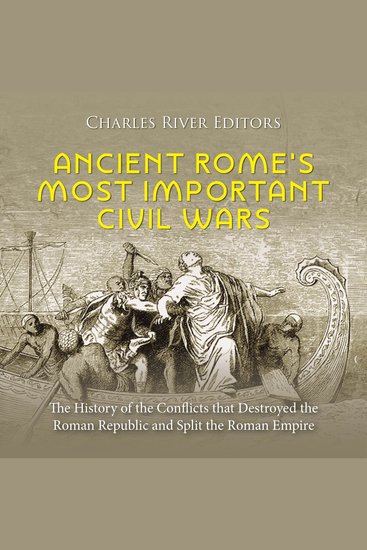
    Caesar is still remembered for winning a civil war and helping bring about the end of the Roman Republic, leaving a line of emperors in its place, but it’s quite possible that none of what Caesar did would’ve happened without the template for such actions being set 40 years earlier. At the time, when Caesar was in his teens, war was being waged both on the Italian peninsula and abroad, with domestic politics pitting the conservative, aristocratic optimates against the populist, reformist populares, and this tension ultimately escalated into an all-out war. One of the leading populares was Caesar’s uncle, Gaius Marius, a military visionary who had restructured the legions and extended the privileges of land ownership and citizenship to legionaries on condition of successful completion of a fixed term of service. In the late 2nd century B.C., Marius had waged a successful campaign against several Germanic tribes, and after earning eternal fame in the Eternal City, Marius was appointed a consul several times. In 88 B.C., he entered into conflict with his erstwhile protégé, the optimate Sulla, over command of the army to be dispatched against Mithridates VI of Pontus, a long-time enemy of Rome and its Greek allies.   
    	The 50 years following the assassination of Severus Alexander on March 19, 235 A.D. has been generally regarded by academics as one of the lowest points in the history of the Roman Empire. This stands in stark contrast to the previous 150 years, which included the reigns of the Five Good Emperors and has been universally praised as one of the high points of the empire. Severus Alexander was the last of the Severan emperors, and the subsequent years of crisis were characterized by a series of short reigns, usually ending in the violent death of the reigning emperor.
    Voir livre
  • The Unbiased Self - The Psychology of Overcoming Cognitive Bias - cover

    The Unbiased Self - The...

    Erin Devers

    • 0
    • 0
    • 0
    A Christian Perspective on Overcoming Cognitive Bias
    So much human behavior can be explained by two motives: we want to be right, and we want to feel good about ourselves. But the tension between these two motives makes us especially vulnerable to bias—and bias distorts our view of the world and of ourselves and can keep us from doing even what we know is right.
    In The Unbiased Self, social psychologist Erin Devers lays out what psychology has discoveredabout bias and selfishness. To truly overcome cognitive bias, we need a vision of what an unbiased self could look like, stemming from a solid sense of identity—an identity available in Christian faith. Devers explains how a Christian concept of theself can provide the combination of humility with self-confidence that enables unbiased thinking. Using current research and illuminating stories, this book
    
    - describes how "fast" and "slow" thinking work together in everyday life;
    - diagnoses when we're most vulnerable to distorted thinking;
    - considers how regarding every person as a child of God counteracts implicit bias;
    - reveals psychological insights into spiritual formation; and
    - recommends practices for slowing our thinking to seek God's wisdom about ourselves and others.
    The social sciences offer rich resources for understanding how to reduce stereotyping and prejudice. By thoughtfully integrating them with biblical perspectives on human worth and sin, we gain hopeful, practical guidance on how to perceive the world more accurately and love others more generously.
    Voir livre
  • Takka Takka Bom Bom - An Intrepid War Correspondent's 50 Year Odyssey - cover

    Takka Takka Bom Bom - An...

    Al J. Venter

    • 0
    • 0
    • 0
    The world’s oldest still-active war correspondent shares the real stories behind half a century of headlines from the front lines.
    
    The world’s oldest still-active war correspondent, Al J. Venter, has reported from the front lines for well over half a century, witnessing the horrors humanity visits upon itself in twenty-five conflict zones across Africa, the Middle East, and Central Asia.
    
    In this memoir, Venter masterfully recounts his experiences, sharing the real stories behind the headlines and the sharp lessons he learned that enabled him to survive his countless exploits, ranging from exposing a major KGB operative in Rhodesia entirely by accident, and accompanying an Israeli force led by Ariel Sharon into Beirut, to gun-running into the United States.
    Voir livre
  • The Architecture of Disability - Buildings Cities and Landscapes beyond Access - cover

    The Architecture of Disability -...

    David Gissen

    • 0
    • 0
    • 0
    Disability critiques of architecture usually emphasize the need for modification and increased access, but The Architecture of Disability calls for a radical reorientation of this perspective by situating experiences of impairment as a new foundation for the built environment. With its provocative proposal for "the construction of disability," this book fundamentally reconsiders how we conceive of and experience disability in our world. 


    Stressing the connection between architectural form and the capacities of the human body, David Gissen demonstrates how disability haunts the history and practice of architecture. Examining various historic sites, landscape designs, and urban spaces, he deconstructs the prevailing functionalist approach to accommodating disabled people in architecture and instead asserts that physical capacity is essential to the conception of all designed space. 


    By recontextualizing the history of architecture through the discourse of disability, Gissen presents a unique challenge to current modes of architectural practice, theory, and education. Envisioning an architectural design that fully integrates disabled persons into its production, it advocates for looking beyond traditional notions of accessibility and shows how certain incapacities can offer us the means to positively reimagine the roots of architecture.
    Voir livre
  • Finding Your Third Place - Building Happier Communities (and Making Great Friends Along the Way) - cover

    Finding Your Third Place -...

    PhD Richard Kyte

    • 0
    • 0
    • 0
    Do you have a Third Place? Your first place is home, your second place is work, and your third place is where you go to socialize. As more of our lives are spent online and in digital spaces, these often overlooked "Third Places" play a crucial role in keeping our communities vibrant. In a timely and thoughtful examination, Richard Kyte, PhD, explores the places that nurture our souls and make up the bedrock of our communities. Third Places can range from a neighborhood tavern, to a community center, to a local bookstore or coffee shop. They are the critical gathering spaces where friendships are formed, relationships are nurtured, and the tapestry of community is woven. Yet, for an ever-growing list of reasons, many people today find themselves without a third place of their own. At a time when our nation is facing an epidemic of loneliness, when communities are suffering from loss of trust, low levels of engagement, despair, and political polarization, what if the answer to many of our problems lies in a simple idea? What if we just need to pay attention to the places where we find ourselves?
    Voir livre
  • Wise Men not so Wise - Investigation into the Constitutional Council - cover

    Wise Men not so Wise -...

    Yvan Stefanovitch

    • 0
    • 0
    • 0
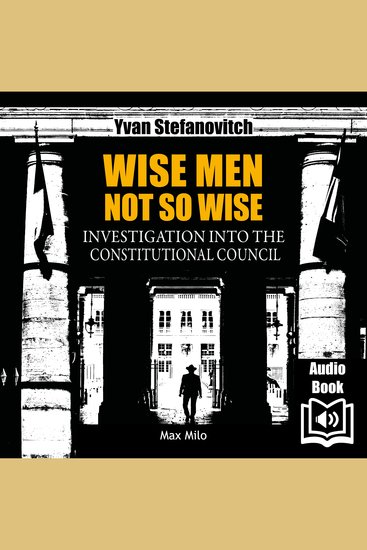
    The Constitutional Council is the embodiment of wisdom and is responsible for defending the rule of law and the individual freedoms of the French people, by censuring a law if it considers it unconstitutional. Discretionarily appointed by the three highest authorities of the State for a non-renewable nine-year term, its members are nevertheless the subject of much controversy: - This Institution is in fact the watchdog of the Head of State, and not of the rule of law; - Since its creation by General De Gaulle, its 92 members, most of them in their seventies, have been appointed based solely on political criteria or reasons of simple cronyism, old friendship, in gratitude for services rendered or simply on a whim. The General, Georges Pompidou, François Mitterrand, Jacques Chirac and Emmanuel Macron have appointed their close friends, often even their confidants (such as Richard Ferrand in 2025), to head the Constitutional Council. A pinnacle of insiders that does not bode well for the impartiality and independence of the nine judges. - To facilitate “the constitutional passage by force” or to validate campaign accounts that have been greatly exceeded, the head of state relies on the “Sages”. A reading of the archives of the minutes of the plenary sessions of the Constitutional Council now makes it possible to state that the nine “Sages” have regularly flouted the law for 67 years. France is the only country in the world where former heads of state sit on a Constitutional Court as ex officio and life members. Three parliamentary attempts have mysteriously failed to put an end to this incredible tradition. Nicolas Sarkozy, still “Wise” for life, is now wearing an electronic bracelet because of his multiple convictions. It has also come to light that the remuneration of the Wise Men, whether or not they sit on the court, has remained illegal for 24 years. The “Sages” perform a moderate job with a comfortable income (22,000 to 32,000 euros), which they can combine with several pensions, completely illegally. This serious journalistic investigation, written by one of the most renowned journalists in this field, reveals an impressive number of worrying and aberrant dysfunctions of this supreme and very “political” regulator of our democracy. Protected by a court spirit violently hostile to any transparency, the “Wise Men” dangerously fuel the ambient populism and the growing lack of confidence of the French in their elites.
    Voir livre