Junte-se a nós em uma viagem ao mundo dos livros!
Adicionar este livro à prateleira
Grey
Deixe um novo comentário Default profile 50px
Grey
Assine para ler o livro completo ou leia as primeiras páginas de graça!
All characters reduced
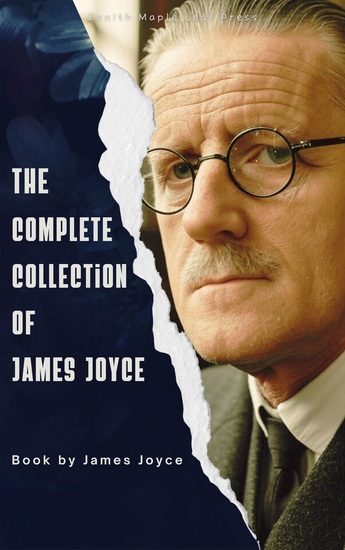
The Complete Collection of James Joyce - cover
LER

The Complete Collection of James Joyce

James Joyce

Editora: Zenith Maple Leaf Press

  • 0
  • 0
  • 0

Sinopse

Revolutionary, challenging, unforgettable — James Joyce reshaped modern literature.

From the intimate streets of Dublin to the stream-of-consciousness epic of Ulysses, James Joyce transformed the way stories are told. The Complete Collection of James Joyce brings together all of his groundbreaking works — novels, short stories, poetry, and essays — in one definitive volume.

Why readers love it:

Every work in one edition. All novels, stories, and poems collected in a single comprehensive volume.

Modernist innovation. Joyce's experimental style changed the course of world literature.

Timeless relevance. Themes of identity, love, exile, and language still resonate today.

A literary landmark
Joyce's works — from Dubliners and A Portrait of the Artist as a Young Man to Finnegans Wake — are celebrated worldwide for their daring artistry and depth. This collection is indispensable for students, scholars, and lovers of literature who want to experience the full range of one of the 20th century's greatest minds.

✨ Enter Joyce's Dublin, and explore the imagination that redefined fiction.

👉 Click "Buy Now" and own The Complete Collection of James Joyce—a definitive library of modernist genius.
Disponível desde: 27/08/2025.
Comprimento de impressão: 5992 páginas.
Outros livros que poderiam interessá-lo

  • What Is Art? - A Profound Exploration of Creativity Morality and the Purpose of Art - A Modern Translation - Adapted for the Contemporary Reader - cover

    What Is Art? - A Profound...

    Leo Tolstoy

    • 0
    • 0
    • 0
    What if art was not just for pleasure—but for the transformation of society? 
    In What Is Art?, Leo Tolstoy delivers a radical and deeply personal exploration of the meaning and value of art. Written in his later years, this philosophical essay critiques the artistic trends of his time, condemning works that prioritize beauty over moral and emotional depth. He argues that true art should inspire, educate, and connect people across class, culture, and history. 
    Through sharp analysis, Tolstoy critiques renowned artists such as Wagner, Shakespeare, and Beethoven, accusing them of creating art that serves the elite rather than the common man. Instead, he advocates for art that is simple, sincere, and universally understood—an art that speaks directly to the soul. 
    What You’ll Discover in This Modern Translation:A Revolutionary Perspective on Art’s Role – Explore Tolstoy’s argument that art should unite, not divide, society.A Fierce Critique of the Art World – Discover why Tolstoy rejects many of history’s most celebrated artistic figures.A Fresh, Accessible Translation – This modern adaptation ensures Tolstoy’s philosophical depth remains clear and engaging for today’s readers.A Timeless Debate on Beauty vs. Purpose – Reflect on the eternal question: Should art exist for art’s sake, or should it serve a higher function? 
    More than just a critique, What Is Art? is a call to artists, critics, and audiences to reconsider the power of creativity as a force for good. 
    Is great art defined by skill—or by its ability to touch the human spirit? 
    Get your copy today and explore Tolstoy’s bold and transformative vision of art.
    Ver livro
  • Emma - cover

    Emma

    Jane Austen

    • 0
    • 0
    • 0
    Emma, is a novel about youthful hubris and romantic misunderstandings. It is set in the fictional country village of Highbury and the surrounding estates of Hartfield, Randalls and Donwell Abbey, and involves the relationships among people from a small number of families. The novel was first published in December 1815, with its title page listing a publication date of 1816. As in her other novels, Austen explores the concerns and difficulties of genteel women living in Georgian–Regency England. Emma is a comedy of manners, and depicts issues of marriage, sex, age, and social status.Before she began the novel, Austen wrote, "I am going to take a heroine whom no one but myself will much like." In the first sentence, she introduces the title character as "Emma Woodhouse, handsome, clever, and rich, with a comfortable home and a happy disposition... had lived nearly twenty-one years in the world with very little to distress or vex her." Emma is spoiled, headstrong, and self-satisfied; she greatly overestimates her own matchmaking abilities; she is blind to the dangers of meddling in other people's lives; and her imagination and perceptions often lead her astray.Emma, written after Austen's move to Chawton, was her last novel to be published during her lifetime, while Persuasion, the last complete novel Austen wrote, was published posthumously.The novel has been adapted for a number of films, television programmes and stage plays.Jane Austen was an English novelist known primarily for her six major novels, which interpret, critique, and comment upon the British landed gentry at the end of the 18th century. Austen's plots often explore the dependence of women on marriage in the pursuit of favorable social standing and economic security. Her works critique the novels of sensibility of the second half of the 18th century and are part of the transition to 19th-century literary realism.
    Ver livro
  • Casting the Runes - From their pens to your ears genius in every story - cover

    Casting the Runes - From their...

    M R James

    • 0
    • 0
    • 0
    Montague Rhodes James is cited as perhaps the greatest English writer of ghost stories, an opinion few would disagree with. 
    James was born on 1st August 1862 at Goodnestone Parsonage in Kent, where his father was Curate but at age 3 the family went to live at Livermere, near Bury St Edmunds in East Anglia.  
    From early childhood he had a passion for mediaeval books and antiques. He was educated initially as a boarder at Temple Grove School in East Sheen, west London, before gaining a scholarship to Eton and thence Cambridge where he gained a double first, becoming a distinguished linguist and mediaevalist.  
    Before the Great War vacations were usually spent touring Europe absorbing cultures and references for his later writing. 
    A man of enormous knowledge it was said he timed his breakfast egg whilst he completed the Times crossword.  
    Many of his elegant yet terrifying tales were created by discarding the prevailing gothic cliches and placing his characters and narrative in a realistic setting.  Thereby the stories gained atmosphere and menace on a grand scale and he was famed as the originator of the antiquarian ghost story. 
    Although story-telling and writing these 30 or so tales was a hobby, when published their effect transformed the genre and still chill the bones in our more modern times. 
    James was also a medievalist scholar and translator whose work remains highly respected. He was also Provost of Eton College between 1918 and 1936. 
    M R James died on 12th June 1936 at Eton in Buckinghamshire.  He was 73.
    Ver livro
  • The Scarlet Pimpernel - cover

    The Scarlet Pimpernel

    Baroness Emmuska Orczy

    • 0
    • 0
    • 0
    "The Scarlet Pimpernel" is a historical adventure novel first published in 1905. Written by Baroness Emmuska Orczy, the story is set during the early phase of the French Revolution and introduces the character of Sir Percy Blakeney, a daring English nobleman who disguises himself as the mysterious Scarlet Pimpernel. Under this alter ego, he daringly rescues French aristocrats from the guillotine. The novel also explores the tension and romance between Sir Percy and his French wife, Marguerite, who is initially unaware of her husband's secret identity. The book has been adapted into numerous stage and film productions and has spawned sequels and a whole series of Pimpernel books.
    Ver livro
  • A Voice from the Pit - From their pens to your ears genius in every story - cover

    A Voice from the Pit - From...

    Bernard Capes

    • 0
    • 0
    • 0
    Bernard Edward Joseph Capes was born on the 30th August 1854 in London.  He was one of 11 children. 
    His early work was as a journalist and this developed into writing many short stories for the periodicals of the time including Blackwood's, Cassell's, Cornhill Magazine, Illustrated London News, Macmillan's Magazine, Mall Magazine, Pearson's Magazine, The Idler, and The Queen. 
    It took him many years to decide that writing full-time could be a sustainable career path.  His initial success came with ‘The Mill of Silence’.  As well as being published it garnered second prize at a competition sponsored by the Chicago Record.  He exceeded that by winning it the following year with ‘The Lake of Wine’.   
    Capes quickly became both prolific and popular.  As well as his stories and articles for the periodicals he wrote around 40 volumes across novels, poetry, history as well as romance and mystery novels. 
    Bernard Capes died on 2nd November 1918 in the flu epidemic.
    Ver livro
  • The Ghost and the Bone Setter - From their pens to your ears genius in every story - cover

    The Ghost and the Bone Setter -...

    Sheridan Le Fanu

    • 0
    • 0
    • 0
    Joseph Sheridan Le Fanu was born on 28th August 1814 in Dublin into a literary family with Huguenot, Irish and English roots.   
    For a time he and his siblings were tutored but Le Fanu would often immerse himself in the books of his father’s library. 
    In 1833 Le Fanu began his Law studies at Trinity College, Dublin and graduated in 1839. Although called to the bar he instead began a career in journalism.   
    He was also writing. His first fiction story ‘The Ghost and the Bonesetter’ was published in 1838.  In 1843 came the novella ‘Spalatro: From the Notes of Fra Giacomo’, a hero with a particular necrophiliac passion for an undead blood-drinking beauty, a forerunner to his later female vampire ‘Carmilla’.  
    In 1844 Le Fanu married Susanna Bennett with whom he had 4 children. The following year his first novel ‘The C'ock and Anchor’ was published. Works now flowed from his pen and with a rapid increase in family finances they moved, in 1851, to Merrion Square, Dublin, where he remained until his death.  
    In 1858 Susanna died and Le Fanu became reclusive. It was during this period that he produced some of his best work.  Working only by candlelight he wrote through the night, burnishing his reputation as a major figure of 19th Century supernaturalism with many classics including; ‘Green Tea’, ‘Mr Justice Harbottle’, and ‘In a Glass Darkly’.  
    Joseph Thomas Sheridan Le Fanu died in Merrion Square in his native Dublin on February 7th, 1873, at the age of 58.
    Ver livro