¡Acompáñanos a viajar por el mundo de los libros!
Añadir este libro a la estantería
Grey
Escribe un nuevo comentario Default profile 50px
Grey
Suscríbete para leer el libro completo o lee las primeras páginas gratis.
All characters reduced
The Civil War (Classicus Edition) - cover

The Civil War (Classicus Edition)

James I. Robertson

Editorial: Classicus

  • 0
  • 0
  • 0

Sinopsis

James I. Robertson’s The Civil War is a clear, thoughtful, and deeply informed introduction to the American Civil War, written by one of the most respected historians of the conflict. Originally prepared for the U.S. Civil War Centennial Commission, this short work distills the causes, events, and consequences of the war into an accessible narrative that captures both its complexity and human cost.     Organized around eleven key themes, the book covers the road to secession, the structure of the Union and Confederate governments, the major campaigns and turning points, and the experiences of soldiers and civilians alike. Robertson explores not only battlefield strategy and military leadership, but also the war’s broader social and political impact, particularly its role in ending slavery and redefining the United States. His writing is careful, balanced, and grounded in a lifetime of scholarship, offering readers a concise yet comprehensive understanding of the war’s lasting significance.     James I. Robertson, who served as executive director of the U.S. Civil War Centennial Commission and later taught at Virginia Tech, was widely regarded as a leading expert on the Civil War era. In The Civil War, he brings his expertise to a general audience with clarity and purpose, avoiding sensationalism while never losing sight of the war’s scale or tragedy. For readers seeking a reliable, engaging overview of the American Civil War—its origins, major events, and enduring legacy—this book remains a trusted and enduring resource.
Disponible desde: 31/03/2025.
Otros libros que te pueden interesar

  • Hillbilly Nationalists Urban Race Rebels and Black Power - Interracial Solidarity in 1960s-70s New Left Organizing - cover

    Hillbilly Nationalists Urban...

    James Tracy, Amy Sonnie

    • 0
    • 0
    • 0
    Some of the most important and little-known activists of the 1960s were poor and working-class radicals. Inspired by the Civil Rights movement, the Black Panthers, and progressive populism, they started to organize significant political struggles against racism and inequality during the 1960s and into the 1970s. 


    Historians of the period have traditionally emphasized the work of white college activists who courageously took to the streets to protest the war in Vietnam and continuing racial inequality. Poor and working-class whites have often been painted as spectators, reactionaries, and, even, racists. But authors James Tracy and Amy Sonnie disprove that narrative. 


    Through over ten years of research, interviewing activists along with unprecedented access to their personal archives, Tracy and Sonnie tell a crucial, untold story of the New Left. Their deeply sourced narrative history shows how poor and working-class individuals from diverse ethnic, rural and urban backgrounds cooperated and drew strength from one another. The groups they founded redefined community organizing, and transformed the lives and communities they touched.
    Ver libro
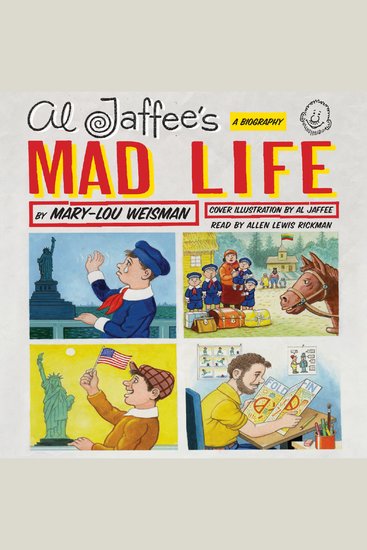
  • Al Jaffee's Mad Life - A Biography - cover

    Al Jaffee's Mad Life - A Biography

    Mary-Lou Weisman

    • 0
    • 0
    • 0
    “One of the great cartoonists of our time.” –New Yorker cartoonist Arnold Roth The remarkable story of one of America’s most prolific and beloved cartoonists, Al Jaffee, with dozens of original color illustrations. Jaffe’s career in cartooning stretches back to 1941—with early humor pieces for Timely Comics, a precursor to Marvel Comics—but the iconic artist remains best known for the brilliant Fold-In cartoons he invented at Bill Gaines’s Mad magazine in 1964. The cerebral and sardonic illustrations have inspired generations of Mad readers—including Stephen Colbert, R. Crumb, Gary Larson and Charles Shultz—to embrace a firm and healthy irreverence towards the status quo. New York Times columnist and bestselling author Mary-Lou Weisman (My Middle-Aged Baby Book) helps Jaffe tell his remarkable story.
    Ver libro
  • The Prince of Evolution - cover

    The Prince of Evolution

    David R. Wood

    • 0
    • 0
    • 0
    The Prince of Evolution is the evolutionary reframing of one of the most important and 
    controversial political texts in history. It reframes Machiavelli’s The Prince as a text expressing a revolutionary political theory that expresses an evolutionary ‘best practice’ framework for political competition. 
     
    By applying the two patterns of evolution, natural and artificial, discovered by Charles Darwin and David R. Wood. In doing so it reveals new insights and value to be derived from Machiavelli’s original text. Most importantly, by providing an evolutionary framework for every human
     relationship that has ever existed, and reframes Machiavelli, the man, to be just as human as you or I.
     
    The Prince of Evolution is a groundbreaking work that will disrupt the entire field of political 
    science. And the way we all look at organizations, communities, and ourselves.
    Ver libro
  • Camilla - From Outcast to Queen Consort - cover

    Camilla - From Outcast to Queen...

    Angela Levin

    • 0
    • 0
    • 0
    For many years, Camilla was portrayed in a poor light, blamed by the public for the break-up of the marriage between Prince Charles and Lady Diana. Initially, Queen Elizabeth refused to see or speak to her, but, since the death of Prince Philip, Camilla had become one of the Queen's closest companions. Her confidence in Camilla and the transformation she had seen in Prince Charles since their wedding resulted in her choosing the first day of her Platinum Jubilee year to tell the world that she wanted Camilla to be Queen Consort, not the demeaning Princess Consort suggested in 2005. 


    Angela Levin uncovers Camilla's rocky journey to be accepted by the royal family and how she coped with her brutal portrayal in Netflix's The Crown. The public have witnessed her tremendous contribution to help those in need, especially during COVID. Levin has talked to many of Camilla's long-term friends, her staff, and executives from the numerous charities of which Camilla is patron. She reveals why Camilla concentrates on previously taboo subjects, such as domestic violence and rape. Most of all, Levin tells the story of how Camilla has changed from a fun-loving young woman to one of the senior royals' hardest workers. She has retained her mischievous sense of humor, becoming a role model for older women and an inspiration for younger ones.
    Ver libro
  • US Army 1960s Polygraph Training - cover

    US Army 1960s Polygraph Training

    US Army

    • 0
    • 0
    • 0
    The primary mission of military intelligence in the United States Army is to provide timely, relevant, accurate, and synchronized intelligence and electronic warfare support to tactical, operational and strategic-level commanders. The Army’s intelligence components produce intelligence both for Army use and for sharing across the national intelligence community. The military will subject someone to a polygraph for several reasons: If that person needs to access confidential files; if they are accused of leaking government secrets; if they are accused of terrorism or of being a spy; if they are a foreign national who needs access to classified material, and several other reasons. The following is a 1960s Army training recording with information on administering a lie detector test.
    Ver libro
  • Inca Empire The: An Enthralling Overview of the Incas Their Civilization in Ancient Peru and the Spanish Conquest - cover

    Inca Empire The: An Enthralling...

    Billy Wellman

    • 0
    • 0
    • 0
    Did you know that the Incas worshiped the mummies of their emperors? 
    For the Incas, death didn’t exist; it simply took the dead to a different plane of life. So, the mummies of their emperors were treated as people; they were given food and drink and even visited each other ceremoniously. They also owned country estates, which generated enough profits to keep them in the style to which they were accustomed. 
    This might sound like a curiosity, but this form of ancestor worship was central to the Inca culture and to the history of the Inca Empire, which stretched from Ecuador and Colombia in the north to Chile in the south. 
    Everyone has seen pictures of one of the Incas’ greatest achievements: the mountain-top wonder of Machu Picchu. But Inca history has always been told by the Spanish colonizers who conquered them since the Inca had no formal writing. Now, archaeology is giving us more information on how the Inca really lived, helping us differentiate real history from myth and propaganda. 
    In this audiobook, you will discover how the Inca created an expansive empire in just a century and why that civilization crumbled so fast once the Spanish arrived. 
    You’ll also discover the following:How the Inca civilization developed out of a number of preceding cultures in the Andes and Peruvian coast;How quickly the Incas were able to expand and why they needed to;How the empire was administered and how runners were able to take messages from one end of it to the other with remarkable speed;The amazing Inca infrastructure program, which included building roads through mountain ranges and across raging rivers;Why Inca cuisine included tasty guinea pigs and llama jerky;And so much more! 
    Scroll up and click the “add to cart” button to learn more about the fascinating Inca Empire!
    Ver libro