¡Acompáñanos a viajar por el mundo de los libros!
Añadir este libro a la estantería
Grey
Escribe un nuevo comentario Default profile 50px
Grey
Suscríbete para leer el libro completo o lee las primeras páginas gratis.
All characters reduced
A Dance Called America - The Scottish Highlands the United States and Canada - cover

A Dance Called America - The Scottish Highlands the United States and Canada

James Hunter

Editorial: Birlinn

  • 0
  • 0
  • 0

Sinopsis

Journey from the Isle of Skye to the Deep South, to the Rockies and beyond.
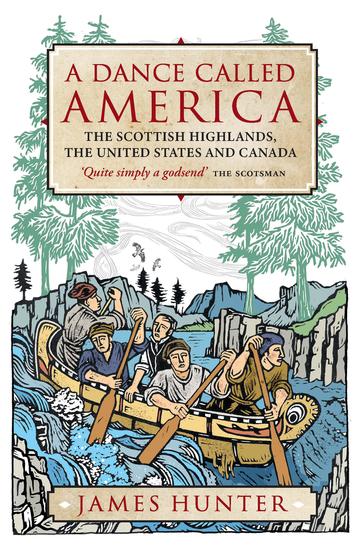
A dance was devised in eighteenth-century Skye. An exhilarating dance. A dance, a visitor reports, 'the emigration from Skye has occasioned'. The visitor asks for the dance's name. 'They call it America,' he's told.
Over a period of three centuries, many thousands of people left the islands and wider north of Scotland to make new lives across the sea. In this new edition of his acclaimed book, historian James Hunter follows in their footsteps – from the Deep South to the Rockies and beyond – to tell the story of the Highland impact on the New World.
In doing so, he reveals how soldiers, explorers, guerrilla fighters, fur traders, lumberjacks, railways builders and settlers from Scotland's glens and islands contributed much to the USA and Canada. It is the story of how a hard-pressed people found in North America a land of opportunity.
In this edition features a new introduction from James Hunter, where he reflects on what led him to embark on travels and researches that took him across a continent.
Disponible desde: 27/06/2022.
Longitud de impresión: 489 páginas.

Otros libros que te pueden interesar

  • First Inaugural Address - cover

    First Inaugural Address

    Ronald Reagan

    • 0
    • 0
    • 0
    On January 20, 1981, Reagan began his first presidential inauguration address by thanking Carter for his “gracious cooperation in the transition process”. 
    Reagan notes “one of the worst sustained inflations in our national history. It distorts our economic decisions, penalizes thrift, and crushes the struggling young and the fixed-income elderly alike.” “In this present crisis, government is not the solution to our problem; government is the problem.” 
    “For decades we have piled deficit upon deficit, mortgaging our future and our children's future for the temporary convenience of the present.” “It is my intention to curb the size and influence of the Federal establishment and to demand recognition of the distinction between the powers granted to the Federal Government and those reserved to the States or to the people.” 
    “If we look to the answer as to why for so many years we achieved so much, prospered as no other people on Earth, it was because here in this land we unleashed the energy and individual genius of man to a greater extent than has ever been done before.” “It is time to reawaken this industrial giant, to get government back within its means, and to lighten our punitive tax burden.” 
    “As for the enemies of freedom, … [w]e will maintain sufficient strength to prevail if need be, knowing that if we do so we have the best chance of never having to use that strength.” 
    “[T]ogether with God's help we can and will resolve the problems which now confront us. And after all, why shouldn't we believe that? We are Americans. God bless you, and thank you. 
    aspenleafmedia.com
    Ver libro
  • Playing Possum - How Animals Understand Death - cover

    Playing Possum - How Animals...

    Susana Monsó, Mark Rowlands

    • 0
    • 0
    • 0
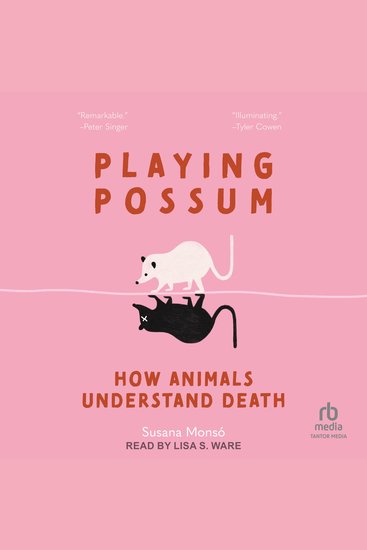
    When the opossum feels threatened, she becomes paralyzed. Her body temperature plummets, her breathing and heart rates drop to a minimum, and her glands simulate the smell of a putrefying corpse. Playing Possum explores what the opossum and other creatures can teach us about how we and other species understand mortality, and demonstrates that the concept of death, far from being a uniquely human attribute, is widespread in the animal kingdom. 


    With humor and empathy, Susana Monsó tells the stories of ants who attend their own funerals, chimpanzees who clean the teeth of their dead, dogs who snack on their caregivers, crows who avoid the places where they saw a carcass, elephants obsessed with collecting ivory, and whales who carry their dead for weeks. Monsó, one of today's leading experts on animal cognition and ethics, shows how there are more ways to conceive of mortality than the human way, and challenges the notion that the only emotional reactions to death worthy of our attention are ones that resemble our own. 


    Blending philosophical insight with new evidence from behavioral science and comparative psychology, Playing Possum dispels the anthropocentric biases that cloud our understanding of the natural world, and reveals that, when it comes to death and dying, we are just another animal.
    Ver libro
  • Archaeology of the Anunnaki Sumerians - Revealing Strange Artifacts and Mesopotamia Mysteries - cover

    Archaeology of the Anunnaki...

    Faruq Zamani

    • 0
    • 0
    • 0
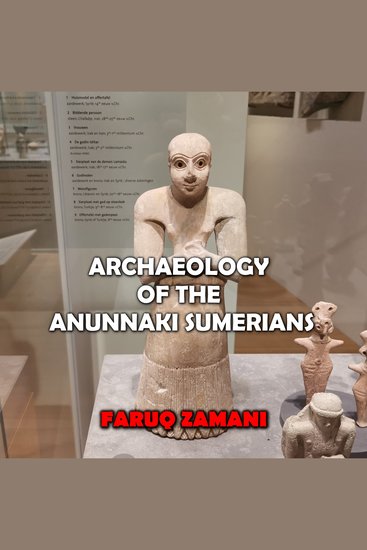
    Leonard Woolley, an archaeologist from Britain, returned to Iraq in 1922, almost 4,000 years after the nuclear ancient catastrophe, to uncover ancient Mesopotamia.An imposing ziggurat standing out in the desert plain drew him to the nearby site of Tell el-Muqayyar, where he began excavating. As old walls, artifacts, and inscriptions were unearthed, he realized he was digging up ancient Ur-Ur of the Chaldees. 
    Twelve years of his work were conducted through a joint expedition between the British Museum in London and the University of Pennsylvania Museum in Philadelphia. For those institutions, Sir Leonard Woolley found some of the most dramatic objects and artifacts in Ur. However, what he discovered may well surpass anything ever exhibited before. 
    In the course of removing layers of soil deposited by desert sands, the elements, and time from the ruins, the ancient city began to take shape-here were the walls, there were the harbors and canals, the residential quarters, the palace, and the Tummal, the elevated sacred area. Woolley's discovery of a cemetery dated thousands of years ago included unique 'royal' tombs discovered by digging at its edge is the find of the century.
    Ver libro
  • Karl Marx on Society and Social Change - With Selections by Friedrich Engels - cover

    Karl Marx on Society and Social...

    Karl Marx

    • 0
    • 0
    • 0
    This volume presents those writings of Marx that best reveal his contribution to sociology, particularly to the theory of society and social change. The editor, Neil J. Smelser, has divided these selections into three topical sections and has also included works by Friedrich Engels. 
     
    In his comprehensive Introduction to the selections, Professor Smelser provides a biography of Marx, identifies the various intellectual traditions which formed the background for Marx’s writings, and discusses the selections which follow. The editor describes Marx’s conception of society as a social system, the differences between functionalism and Marx’s theories, and the dynamics of economic and political change as analyzed by Marx.
    Ver libro
  • Hunting the Seven - How the Gugulethu Seven assassins were exposed - cover

    Hunting the Seven - How the...

    Beverley Roos-Muller

    • 0
    • 0
    • 0
    In 1986, seven young men were shot and killed by police in Gugulethu in Cape Town. The nation was told they were part of a 'terrorist' MK cell plotting an attack on a police unit. An inquest followed, then a dramatic trial in 1987 and a second inquest in 1989 that again exonerated the police. Finally, ten years later, Eugene de Kock's Vlakplaas unit was exposed at the Truth and Reconciliation Commission for having planned and executed the cold-blooded killings. Yet their real agenda remained a mystery.
    In Hunting the Seven, Beverley Roos-Muller reveals her own decades-long connection to the case and her search for the truth of their deaths that has been shrouded in lies and mystery. Sifting through the evidence, and interviewing many of those involved, Roos-Muller reveals that it was Vlakplaas's only operation in the Western Cape and behind it lay a shocking secret.
    Ver libro
  • Princes in the Tower The: The History of the Mysterious Disappearances of King Edward V and the Duke of York - cover

    Princes in the Tower The: The...

    Editors Charles River

    • 0
    • 0
    • 0
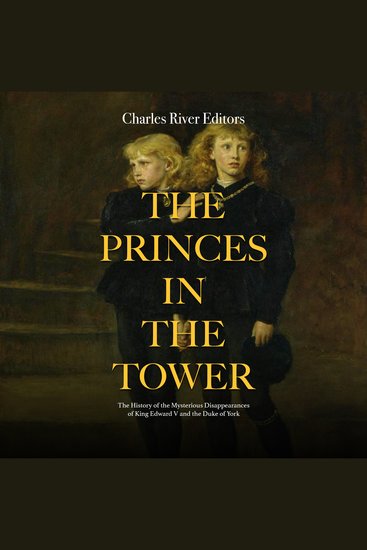
    When England’s King Edward IV fell ill at Easter 1483 after coming back from a fishing trip and died shortly after on April 9, it threw a country that had already suffered a series of wars into a state of chaos. What exactly killed him is unclear, and though some people would later speculate that he had been poisoned, there is every reason to believe that he died of natural causes. Disease was common in medieval England, and doctors lacked much of the medical knowledge now taken for granted. The king's spectacular lifestyle had taken its toll, and he was significantly overweight, so it seems the lifestyle which he thought he had earned as king, and which he used to remind everyone of his status, was probably his undoing. 
    	Recognizing that death was coming, the 40-year-old Edward IV had tried to make arrangements for how the kingdom would be ruled during his son's minority. His aim was for Rivers to continue running the young king's household while Richard, Duke of Gloucester, became protector and took responsibility for running the country until Edward V was old enough to do so for himself. It was an arrangement designed to prevent any one person from gaining total authority during his son's childhood reign, and thus to protect the young king. 
    	At first, everything seemed to be going smoothly, but behind the scenes Richard was scheming. As Edward V and his guardian Rivers were travelling toward London, Richard and his substantial military retinue met them on the road. After setting Rivers and another adviser at ease through a pleasant dinner on April 29, Richard showed his true colors the next day by taking them captive and taking control of the teenaged king. His justification was the old classic of protecting a king from evil advisers. 
    	The chain of events also contributed to one of England’s most enduring mysteries, because Edward and Richard never emerged from the Tower of London.
    Ver libro