¡Acompáñanos a viajar por el mundo de los libros!
Añadir este libro a la estantería
Grey
Escribe un nuevo comentario Default profile 50px
Grey
Suscríbete para leer el libro completo o lee las primeras páginas gratis.
All characters reduced
Domination and the Arts of Resistance - Hidden Transcripts - cover

Domination and the Arts of Resistance - Hidden Transcripts

James C. Scott

Editorial: Publishdrive

  • 0
  • 0
  • 0

Sinopsis

“A splendid study, surely one of the most important that has appeared on the whole matter of power and resistance.”—Natalie Zemon Davis Confrontations between the powerless and powerful are laden with deception—the powerless feign deference and the powerful subtly assert their mastery. Peasants, serfs, untouchables, slaves, laborers, and prisoners are not free to speak their minds in the presence of power. These subordinate groups instead create a secret discourse that represents a critique of power spoken behind the backs of the dominant. At the same time, the powerful also develop a private dialogue about practices and goals of their rule that cannot be openly avowed. In this book, renowned social scientist James C. Scott offers a penetrating discussion both of the public roles played by the powerful and powerless and the mocking, vengeful tone they display off stage—what he terms their public and hidden transcripts. Using examples from the literature, history, and politics of cultures around the world, Scott examines the many guises this interaction has taken throughout history and the tensions and contradictions it reflects.
Disponible desde: 22/08/2025.
Longitud de impresión: 194 páginas.


Otros libros que te pueden interesar

  • Policing Gun Violence - Strategic Reforms for Controlling Our Most Pressing Crime Problem - cover

    Policing Gun Violence -...

    Philip J. Cook, Anthony A. Braga

    • 0
    • 0
    • 0
    In many US cities, gun violence is the most urgent crime problem. High rates of deadly violence make a city less livable, dragging down quality of life, economic development, and property values. 


    How can police departments find the right balance between over- and under-policing of high-violence areas? What are the best practices for police to preempt and deter gun violence, while engendering support and cooperation from the public? 


    Drawing on fifty years of research and practical experience, Policing Gun Violence argues that it is possible for the police to create greater public safety while respecting the rights of individuals and communities. While gun violence can be attributed to various systemic causes, Anthony A. Braga and Philip J. Cook make the case that violence is itself a root cause of social disparity and future violence. Effective law enforcement is a vital component of a just society. They review and synthesize the evidence in several key areas: enforcement of gun laws, policing hot spots, controlling high-risk groups through focused deterrence, enhancing investigations to increase the arrest and conviction rate, preventing officer-involved shootings, and disrupting underground gun markets. Policing Gun Violence serves as a guide to how the police can better utilize their considerable resources to make cities safer.
    Ver libro
  • History Speaks - Volume 2 - cover

    History Speaks - Volume 2

    Amelia Earhart, Andrew Carnegie,...

    • 0
    • 0
    • 0
    Along with historical narrative, hear rare recordings of some of the most people in history, including Andrew Carnegie, Thomas Edison, William Howard Taft, James Whitcomb Riley, O. Henry, Arthur Conan Doyle, William Gillette, Theodore Roosevelt, Ellen Terry, King George V, and Amelia Earhart. Recording obtained and published by Rick Sheridan.
    Ver libro
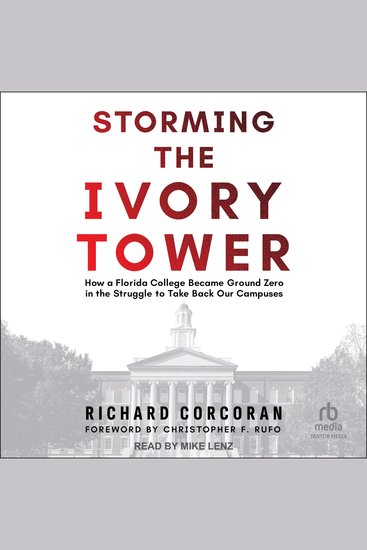
  • Storming the Ivory Tower - How a Florida College Became Ground Zero in the Struggle to Take Back Our Campuses - cover

    Storming the Ivory Tower - How a...

    Richard Corcoran, Christopher F....

    • 0
    • 0
    • 0
    Covid alerted the nation to the reality that K-12 schools were infested with ideologues bent on indoctrinating children. Then, three years after the beginning of the pandemic, the response to Hamas's genocidal assault on Israel made Americans aware that the same tumor had wholly sickened our country's colleges and universities. Now, conservatives—and increasingly, moderates and old-school liberals—want to know exactly how the radical left captured higher education. 


    Florida has been the vanguard in the war to restore sanity to higher education. And Richard Corcoran has been one of its commanding generals. When Corcoran was Florida's education commissioner, he was the point person for reopening schools and banning mask mandates. He triumphed. Then, he was given a herculean task: remaking a college overrun by radicalism and cancel culture. In 2023, he moved into the president's office in Sarasota, took on a campus mob, and challenged a media firestorm. 


    Just a year later, Corcoran achieved the seemingly impossible. He turned around New College of Florida. Now, free speech is protected. Violence and anti-Semitism are abolished. DEI bureaucracy is eliminated. And enrollment records are being broken. Storming the Ivory Tower is the story of how Corcoran is winning the fight for freedom in hostile territory and how others can join.
    Ver libro
  • What's Out of Order Here? - Illness and Familiy Constellations - cover

    What's Out of Order Here? -...

    Ilse Kutschera, Christine Brugger

    • 0
    • 0
    • 0
    "What makes this book special is the richness of the illustrations of how symptoms of illness embody concrete events in a family and how family constellations can bring this to light with a respect that allows symptoms to recede and disappear. As far as I am aware, this has never before been identified and illustrated so clearly. This book is a first class pioneering effort. Alongside new insights, it also details the concrete steps that have led to new and often surprising resolutions."
    
    Bert Hellinger
    
    When a machine is out of order, we look for the broken part and attempt repairs. When something goes awry with the human mind, body and spirit, we need to look with a more holistic view for solutions. This book presents the experiences of a physician and psychotherapist who has gone far beyond the 'parts repair' approach to medical treatment to look not only at the whole person, but also the entire family system using the method of family constellations.
    
    The book is comprised of two parts. The first is a basic explanation of the approach, which was first developed by Bert Hellinger. In the second part of the book, practical applications of the method are documented in a wide variety of case studies. Illness and symptoms are viewed in the context of larger systems, and constellations are used to identify disturbances and restore a more health-supporting order.
    
    This report on the method of family constellations is a fascinating trip through theory and practice that offers a new concept of healing for lay readers as well as professionals.
    The Authors:
    Ilse Kutschera, M. D., born in Vienna, Austria in 1936, studied medicine in Graz. She worked as a physician until 1998, when she retired from her position as head of a rehabilitation clinic to devote her time to her private psychotherapy practice. During her career, she had developed a keen interest in psychotherapy and trained in various approaches including primal therapy, transactional analysis, gestalt therapy, NLP and Bert Hellinger's constellation work. This book is an expression of her interest in integrating psychotherapy and classical medicine.
    Christine Brugger, born in Germany in 1962, is head of a radio station in the East Tyrol in Austria. Through her friendship with Dr Kutschera, she became interested in writing about constellation work in the medical field. The book is the result of many interviews, discussions and recorded case histories.
    Ver libro
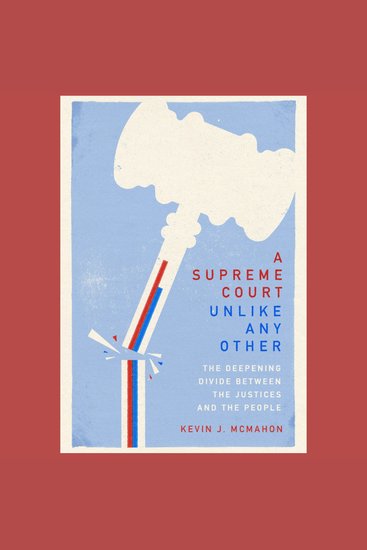
  • A Supreme Court Unlike Any Other - The Deepening Divide Between the Justices and the People - cover

    A Supreme Court Unlike Any Other...

    Kevin J. McMahon

    • 0
    • 0
    • 0
    A data-rich examination of the US Supreme Court’s unprecedented detachment from the democratic processes that buttress its legitimacy. 
    Today’s Supreme Court is unlike any other in American history. This is not just because of its jurisprudence but also because the current Court has a tenuous relationship with the democratic processes that help establish its authority. Historically, this “democracy gap” was not nearly as severe as it is today. Simply put, past Supreme Courts were constructed in a fashion far more in line with the promise of democracy—that the people decide and the majority rules. 
    Drawing on historical and contemporary data alongside a deep knowledge of court battles during presidencies ranging from FDR to Donald Trump, Kevin J. McMahon charts the developments that brought us here. McMahon offers insight into the altered politics of nominating and confirming justices, the shifting pool of Supreme Court hopefuls, and the increased salience of the Court in elections. A Supreme Court Unlike Any Other is an eye-opening account of today’s Court within the context of US history and the broader structure of contemporary politics.
    Ver libro
  • The Great Beyond - Unraveling the Mysteries of the Afterlife - cover

    The Great Beyond - Unraveling...

    John Harpoon

    • 0
    • 0
    • 0
    The concept of life after death is one of humanity’s most profound and enduring mysteries. Across cultures and time periods, people have sought to understand what happens after we take our last breath. Whether driven by religious beliefs, philosophical musings, or personal experiences, the question of the afterlife has shaped much of human thought and civilization. It has influenced not only religious teachings but also art, literature, and even scientific inquiries into consciousness and the nature of existence. 
    Throughout history, the afterlife has been envisioned in countless ways. Ancient Egyptians believed in a journey to the underworld where the soul would face judgment, while the Greeks and Romans saw it as a realm of shadows or a place of eternal bliss for the virtuous. In the East, Hinduism and Buddhism introduced the concept of reincarnation, where the soul is reborn into new lives, shaped by karma. Similarly, Christianity, Islam, and Judaism have their own distinct visions of heaven, hell, and the possibility of eternal life. 
    Despite the diversity of beliefs, there is a common thread that runs through all of them: the hope that death is not the end, but a transition to another realm or state of being. For many, the afterlife provides comfort, offering a sense of continuity after the end of physical existence. For others, it serves as a source of moral guidance, with promises of reward for virtue and punishment for wrongdoing.
    Ver libro