¡Acompáñanos a viajar por el mundo de los libros!
Añadir este libro a la estantería
Grey
Escribe un nuevo comentario Default profile 50px
Grey
Suscríbete para leer el libro completo o lee las primeras páginas gratis.
All characters reduced
Promoting good citizenship - Exploring the Essence of Civic Responsibilities and Rights - cover

Promoting good citizenship - Exploring the Essence of Civic Responsibilities and Rights

James Bryce Bryce

Editorial: Good Press

  • 0
  • 0
  • 0

Sinopsis

In "Promoting Good Citizenship," James Bryce, Viscount Bryce, delves into the essential ideals and responsibilities intrinsic to a functioning democracy. This work combines a rich historical narrative with a vigorous call to civic engagement, illustrating how good citizenship is vital not only to individual fulfillment but also to societal stability. Bryce employs a clear, impactful prose style, seamlessly weaving empirical evidence, philosophical reflection, and practical examples to advocate for active participation in public life and the significance of moral character within citizenship, particularly against the backdrop of early 20th-century societal changes. James Bryce, a prominent British statesman, historian, and diplomat, drew upon his extensive experiences in public service and his deep understanding of political philosophy to craft this resonant text. Having observed the challenges faced by democracies firsthand, especially in the post-Victorian era, Bryce was uniquely positioned to emphasize the pressing need for citizens to be informed and engaged. His belief in the power of education and moral development as cornerstones of civic duty is thoroughly reflected throughout the book. This seminal work is highly recommended for anyone interested in the dynamics of citizenship and democratic governance. Bryce'Äôs articulate arguments not only serve as a historical testimony of his time but also resonate profoundly with contemporary discussions surrounding civic responsibility, making it an indispensable read for scholars, students, and active citizens alike.
Disponible desde: 09/07/2023.
Longitud de impresión: 35 páginas.


Otros libros que te pueden interesar

  • Occult Diseases - A Review of Unbalance - cover

    Occult Diseases - A Review of...

    Manly P. Hall

    • 0
    • 0
    • 0
    In Occult Diseases: A Review of Unbalance, Manly P. Hall turns his penetrating insight toward the hidden roots of human suffering. More than a study of physical or mental illness, this rare essay—originally published in The All-Seeing Eye—investigates the spiritual and psychological disorders that arise when harmony is broken between the soul, mind, and body. Hall reveals how ignorance, selfishness, and emotional extremes generate destructive vibrations that can manifest as disease, imbalance, and inner decay. He outlines not only the causes of occult affliction but also the principles of restoration: discipline, clarity, virtue, and alignment with higher truth. 
    This is not a medical manual—it is a guide for the soul's hygiene.
    Ver libro
  • Voices of History Israel: A Country with Its Institutions - cover

    Voices of History Israel: A...

    Anónimo

    • 0
    • 0
    • 0
    See Israel like you never have before with this comprehensive and fascinating guide to modern history.Never before released audio programs!Throughout the 1970's Dr. Samuel J. Citron took it upon himself to interview leading authorities on special topics in contemporary Jewish history, mostly relating to the State of Israel.Over the course of ten years of painstaking work, he completed the immense task of pulling together personal accounts of many of the more significant events of the last hundred years.A modern 20th century state required an infrastructure and direction.This Collection from The Voices of History: Israel includes these recordings:Religion in Tzahal: Chief Rabbi Gen. Shlomo GorenIn The International Arena: Abba EbanThe Hebrew University: Pres. Avraham HarmanThe Legal & Judicial System: Justice Moshe LandauCitadels of Healing: Professor Kalman MannThe Shaare Zedek Hospital: Zvi Kaspi, Nahum Pessin, Sister SelmaThe Weizmann Institute: Meyer W. Weisgal
    Ver libro
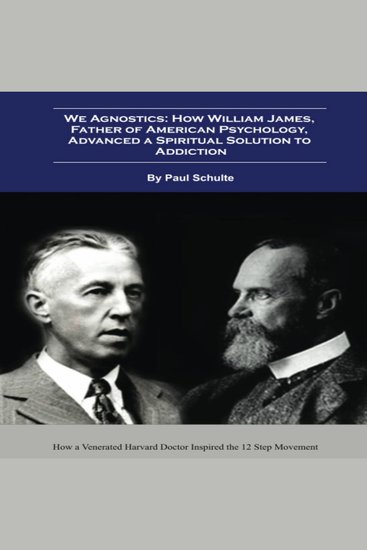
  • We Agnostics: How William James Father of American Psychology Advanced A Spiritual Solution to Addiction: How a Venerated Harvard Doctor Inspired the 12 Step Movement - cover

    We Agnostics: How William James...

    Paul Schulte

    • 0
    • 0
    • 0
    Bill Wilson was a washed up Wall Street analyst after the Great Crash of 1929 who was dying of alcoholism and decided to clean up. He read “Varieties off Religious Experience” by eminent Harvard Professor William James (whose own brother had died of alcoholism). The rest, as they say, is history and the result was what Aldous Huxley called the most Important social movement of the 20th century. This book weaves together brief excerpts from James’ book (which had radical ideas about spirituality being an end to itself and mostly separate from religion) with the writings of Bill Wilson to show how the two men’s thinking interacted to create the 12 Step movement. It sheds light on the profound influence James had on early 20th Century Agnosticism. It is solid analysis of James’ important contribution to American Spiritualism. Most of all, though, it is a reflection on the 12 Steps of AA & a meditation on what ‘Higher Power’ means. It is a soothing hot soak in the great writing of two men who developed a way out of the soul sickness that is addiction. They both saw spirituality as separate from religion which arises from the basic human need for some private higher power during moments of self-despair. The relief that comes makes life larger, allows us (finally) to belong and offers dignity — for alcoholics or those who live with alcoholics. It works. It really does. Read a sentence or a page per day. This book is a journey of reflection and meditation.
    Ver libro
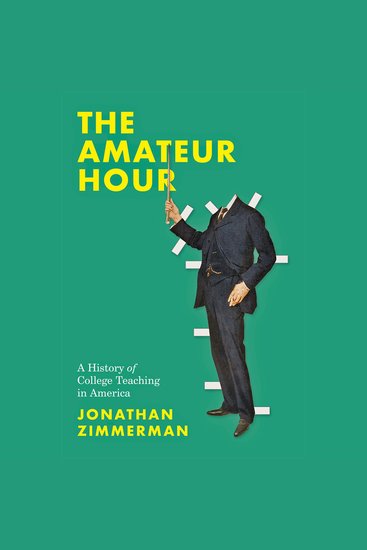
  • The Amateur Hour - A History of College Teaching in America - cover

    The Amateur Hour - A History of...

    Jonathan Zimmerman

    • 0
    • 0
    • 0
    American college teaching is in crisis, or so we are told. But we've heard that complaint for the past 150 years, as critics have denounced the poor quality of instruction in undergraduate classrooms. Students daydream in gigantic lecture halls while a professor drones on, or they meet with a teaching assistant for an hour of aimless discussion. The modern university does not reward teaching, so faculty members at every level neglect it in favor of research and publication. In the first book-length history of American college teaching, Jonathan Zimmerman confirms but also contradicts these perennial complaints. Drawing upon a wide range of previously unexamined sources, The Amateur Hour shows how generations of undergraduates indicted the weak instruction they received. But Zimmerman also chronicles institutional efforts to improve it, especially by making teaching more "personal." As higher education grew into a gigantic industry, he writes, American colleges and universities introduced small-group activities and other reforms designed to counter the anonymity of mass instruction. They also experimented with new technologies like television and computers, which promised to "personalize" teaching by tailoring it to the individual interests and abilities of each student.But, Zimmerman reveals, the emphasis on the personal inhibited the professionalization of college teaching, which remains, ultimately, an amateur enterprise. The more that Americans treated teaching as a highly personal endeavor, dependent on the idiosyncrasies of the instructor, the less they could develop shared standards for it. Nor have they rigorously documented college instruction, a highly public activity which has taken place mostly in private. Pushing open the classroom door, The Amateur Hour illuminates American college teaching and frames a fresh case for restoring intimate learning communities, especially for America's least privileged students. Anyone who wants to change college teaching will have to start here.
    Ver libro
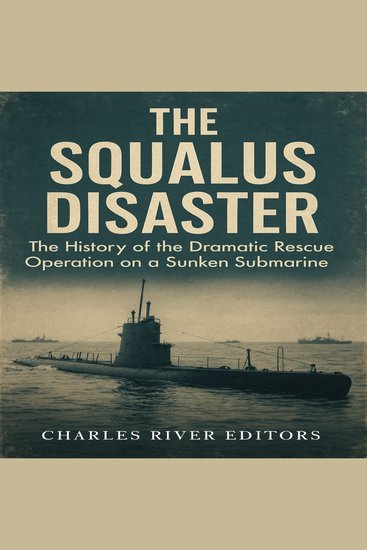
  • Squalus Disaster The: The History of the Dramatic Rescue Operation on a Sunken Submarine - cover

    Squalus Disaster The: The...

    Charles River Editors

    • 0
    • 0
    • 0
    Given that there’s such little margin for error in a submersible, many submarine losses remain sources of intrigue and mystery, but in American history, few rival the tragedy and drama aboard the Squalus in 1939. On May 23 of that year, the Squalus, one of the U.S. Navy’s newest submarines, was undertaking the latest in a series of test dives off the coast of New Hampshire. She had been commissioned less than three months before and represented the cutting-edge of new submarine technology. Provided with eight torpedo tubes and a three-inch deck gun, Squalus had a range of over 11,000 miles and was capable of running at over 20 knots on the surface. This was a formidable warship, and the test dives undertaken in May were a routine part of preparing the submarine for service. 
    After successfully completing a series of dives over the previous days, on the 23rd, the Squalus undertook practice for one of the most challenging maneuvers, a rapid dive performed while the sub was running at full speed on the surface. This was a vital procedure if the submarine was attacked unexpectedly by an aircraft or surface ship - it had to be able to dive quickly in any circumstances. This practice ensured that the crew, and the submarine, were fully prepared.  
    Tragically, during this test dive, the unthinkable happened: the rear section of Squalus flooded, and the submarine, without power, began to sink to the bottom of the Atlantic Ocean. 26 men in the rear compartments died in the flooding, but 33 men in the forward compartments were still alive as Squalus came to rest on the ocean floor almost 250 feet below the surface.  
    The situation seemed hopeless to everyone but one naval officer, Lieutenant Commander Charles B. "Swede" Momsen. 
    Ver libro
  • Enquiry Concerning Human Understanding An - cover

    Enquiry Concerning Human...

    David Hume

    • 0
    • 0
    • 0
    David Hume's 'An Enquiry Concerning Human Understanding' explores the foundations of human knowledge. Written with philosophical precision, it challenges conventional thinking on causation, scepticism, and the limits of human understanding. Hume delves into the nature of belief, empiricism, and the intricacies of human cognition. A seminal work in epistemology, this inquiry invites readers to critically examine the basis of their beliefs, making it a timeless exploration of the human mind and the nature of knowledge. Read in English, unabridged.
    Ver libro