¡Acompáñanos a viajar por el mundo de los libros!
Añadir este libro a la estantería
Grey
Escribe un nuevo comentario Default profile 50px
Grey
Suscríbete para leer el libro completo o lee las primeras páginas gratis.
All characters reduced
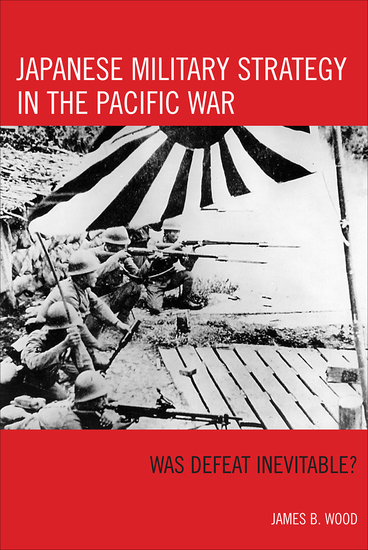
Japanese Military Strategy in the Pacific War - Was Defeat Inevitable? - cover

Japanese Military Strategy in the Pacific War - Was Defeat Inevitable?

James B Wood

Editorial: Stackpole Books

  • 0
  • 0
  • 0

Sinopsis

In this provocative history, James B. Wood challenges the received wisdom that Japan's defeat in the Pacific was historically inevitable. He argues instead that it was only when the Japanese military prematurely abandoned its original sound strategic plan—to secure the resources Japan needed and establish a viable defensible perimeter for the Empire—that the Allies were able to regain the initiative and lock Japanese forces into a war of attrition they were not prepared to fight. The book persuasively shows how the Japanese army and navy had both the opportunity and the capability to have fought a different and more successful war in the Pacific that could have influenced the course and outcome of World War II. It is therefore a study both of Japanese defeat and of what was needed to achieve a potential Japanese victory, or at the very least, to avoid total ruin.   Wood's argument does not depend on signal individual historical events or dramatic accidents. Instead it examines how familiar events could have b
Disponible desde: 14/06/2023.
Longitud de impresión: 152 páginas.


Otros libros que te pueden interesar

  • Literature and the New Culture Wars - Triggers Cancel Culture and the Teacher's Dilemma - cover

    Literature and the New Culture...

    Deborah Appleman

    • 0
    • 0
    • 0
    Can educators continue to teach troubling but worthwhile texts? 


    Our current "culture wars" have reshaped the politics of secondary literature instruction. Due to a variety of challenges from both the left and the right—to language or subject matter, to potentially triggering content, or to authors who have been canceled—school reading lists are rapidly shrinking. For many teachers, choosing which books to include in their curriculum has become an agonizing task with political, professional, and ethical dimensions. 


    In Literature and the New Culture Wars, Deborah Appleman calls for a reacknowledgment of the intellectual and affective work that literature can do, and offers ways to continue to teach troubling texts without doing harm. Rather than banishing challenged texts from our classrooms, she writes, we should be confronting and teaching the controversies they invoke. Her book is a timely and eloquent argument for a reasoned approach to determining what literature still deserves to be read and taught and discussed.
    Ver libro
  • Rare Recording of Ludwig von Mises A - Volume 1 - cover

    Rare Recording of Ludwig von...

    Ludwig Von Mises

    • 0
    • 0
    • 0
    Ludwig Heinrich Edler von Mises (September 29, 1881 - October 10, 1973) was an Austrian–American Austrian School economist, historian, logician, and sociologist. Mises wrote and lectured extensively on the societal contributions of classical liberalism and the power of consumers. He is best known for his work on human behavior studies comparing communism and capitalism.
    Ver libro
  • Embrace The Happiness Within : A Guide to Elevating Your Mental Well-being - Psychological Perspective on Happiness Wellbeing and Mental Health - cover

    Embrace The Happiness Within : A...

    GKS

    • 0
    • 0
    • 0
    Discover a journey to happiness and a fulfilled life with "Embrace The Happiness Within." Dive into a comprehensive guide that combines actionable steps and profound insights, designed to revolutionize your approach to life and mental wellbeing. This book breaks down complex psychological concepts into practical, easy-to-understand strategies, offering a roadmap to transform your daily habits and elevate your happiness quotient. Written by G.K. Shoo, this guidebook integrates various psychological perspectives, unveiling the core elements shaping happiness. From exploring the intricacies of psychological theories to dissecting the biological, behavioral, cognitive, and socio-cultural influences on happiness, this book is your compass to navigate through the intricacies of mental wellbeing. 
    With a blend of the most effective models like the "PERMA" Model of Wellbeing, Hedonic Model, Authentic Happiness Concept by Martin Seligman, and insights from Ed Diener's Subjective Wellbeing, this guide empowers readers with practical action points and checklists that transcend theoretical boundaries. Learn how environmental factors, such as positive influences and social connections, impact happiness and mental health. Engage with Bandura's Self-Efficacy Concept, Easterlin Paradox, Sonja Lyubomirsky's Notion, Carol Ryff's Model, and Kahneman's Model, unlocking powerful strategies and examples to enhance your overall happiness. Navigate cognitive patterns and cultural influences on happiness while embracing genetic and environmental roles in shaping your emotional wellbeing. Find a curated exploration of happiness facts, a reader-friendly guide, and an insightful end note that ties together the essence of this transformative journey. "Embrace The Happiness Within" isn't just a book; it's your partner in crafting a life brimming with joy, resilience, and fulfillment. Step into the realm of genuine happiness, uncovering the secrets to living a life of contentment.
    Ver libro
  • The Fall of Rome - The Birth of the Middle Ages - cover

    The Fall of Rome - The Birth of...

    Harris Ropes

    • 0
    • 0
    • 0
    At its height, the Roman Empire stood as one of the most powerful and influential civilizations in history. Spanning continents, from the windswept moors of Britain to the deserts of Egypt, Rome’s reach seemed boundless. The strength of the empire lay not only in its vast military conquests but in the complexity and efficiency of its administrative systems. Roman law, engineering, and political structure provided a level of organization that allowed a diverse collection of peoples and cultures to function under a single imperial banner. The Pax Romana, a period of relative peace lasting over two centuries, demonstrated Rome’s ability to maintain stability across its vast territories. 
    Roman culture was a dynamic blend of traditions inherited from earlier civilizations and innovations of its own. Latin served as the unifying language, enabling administration and communication across the empire. The arts flourished, with literature, sculpture, and architecture reaching impressive heights. From the poetry of Virgil and Ovid to the engineering marvels of aqueducts and roads, Roman achievements stood as symbols of sophistication. The grandeur of public spaces like the Colosseum and the Roman Forum reflected the empire’s emphasis on civic life and the power of the state. 
    Governance played a key role in the success of Rome. A highly structured bureaucracy allowed the empire to manage its provinces effectively, while a legal system based on Roman law continued to influence Western societies long after the empire’s decline. Though emperors held supreme power, the Senate, magistrates, and various local officials contributed to a layered political system that managed both urban centers and rural territories. Roman citizenship, which could be extended to people across the empire, fostered a sense of unity and shared identity among diverse populations.
    Ver libro
  • Operation Dragoon: The History of the Allied Invasion of Southern France after D-Day - cover

    Operation Dragoon: The History...

    Editors Charles River

    • 0
    • 0
    • 0
    While D-Day is one of the most famous events of the war, it is widely overlooked that about two months after the landings in Normandy, there was a second Allied landing in France. On August 15, 1944, a combined US-French force landed in southern France on the beaches of the Côte d'Azur as part of Operation Dragoon. In just over four weeks of fighting, the Allied landing led to the liberation of most of southern France and to one of the most audacious and successful Allied operations of World War II.  
    	However, the planning that led to Operation Dragoon (originally named Operation Anvil) was anything but settled. The idea for a landing in the south of France had been raised by senior commanders as early as 1942, and at one time it was intended to be a concurrent operation with the Overlord landings in Normandy. However, the spectacular failure of the American landing at Anzio in Italy earlier in the year and an increase in the size of forces for Overlord meant there simply weren’t resources to spare for a second simultaneous landing in France. Thus, Operation Anvil was canceled. 
    	With less a one month to complete the planning and preparation of a major amphibious operation, many on the Allied side were skeptical of the chances of success for this operation. However, the supply situation in northern France and growing political pressures within the Allies meant it simply had to go ahead. With that, on the morning of August 15, 1944, Allied troops began landing on the beaches of the Côte d'Azur. What followed remains a controversial part of the end of the war in Europe. 
    Ver libro
  • Change They Can't Believe In - The Tea Party and Reactionary Politics in America - cover

    Change They Can't Believe In -...

    Christopher S. Parker, Matt A....

    • 0
    • 0
    • 0
    “Offers valuable empirical data on the Tea Party, and its focus on supporters’ antagonism toward Obama is critical to understanding the movement.” —Michael O’Donnell, The New Republic 
     
    Winner of the Best Book Award, Race, Ethnicity, and Politics Section of the American Political Science Association 
     
    Are Tea Party supporters merely a group of conservative citizens concerned about government spending? Or are they racists who refuse to accept Barack Obama as their president because he’s not white? Change They Can’t Believe In offers an alternative argument—that the Tea Party is driven by the reemergence of a reactionary movement in American politics that is fueled by a fear that America has changed for the worse. Providing a range of original evidence and rich portraits of party sympathizers as well as activists, Christopher Parker and Matt Barreto show that the perception that America is in danger directly informs how Tea Party supporters think and act. 
     
    In a new afterword, Parker and Barreto reflect on the Tea Party’s recent initiatives, including the 2013 government shutdown, and evaluate their prospects for the 2016 election. 
     
    “A scathing analysis of the Tea Party movement, linking it in spirit to the Ku Klux Klan and the John Birch Society. . . . Based on research and interviews, they suggest racism, desire for social dominance . . . drives the Tea Party.” —Publishers Weekly
    Ver libro